
Vancouver officer walks back description of response to Myles Gray as ‘compassionate’
Advertisement
Read this article for free:
or
Already have an account? Log in here »
We need your support!
Local journalism needs your support!
As we navigate through unprecedented times, our journalists are working harder than ever to bring you the latest local updates to keep you safe and informed.
Now, more than ever, we need your support.
Starting at $15.99 plus taxes every four weeks you can access your Brandon Sun online and full access to all content as it appears on our website.
Subscribe Nowor call circulation directly at (204) 727-0527.
Your pledge helps to ensure we provide the news that matters most to your community!
To continue reading, please subscribe:
Add Brandon Sun access to your Free Press subscription for only an additional
$1 for the first 4 weeks*
- Enjoy unlimited reading on brandonsun.com
- Read the Brandon Sun E-Edition, our digital replica newspaper
*Your next Free Press subscription payment will increase by $1.00 and you will be charged $20.95 plus GST for four weeks. After four weeks, your payment will increase to $24.95 plus GST every four weeks.
Read unlimited articles for free today:
or
Already have an account? Log in here »
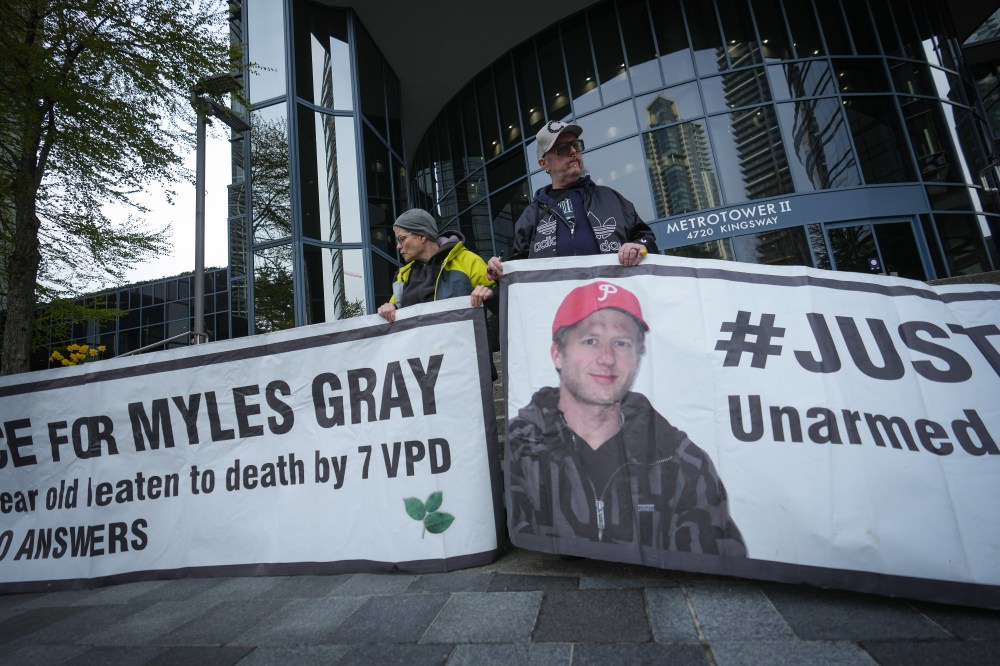
VANCOUVER – One of seven Vancouver police officers involved in the fatal beating of Myles Gray says he was wrong to describe police conduct during the call as “incredibly compassionate” in an interview with an RCMP investigator in 2017.
Nick Thompson, now a detective constable, continued testifying Wednesday at the public hearing called by the Office of the Police Complaint Commissioner over misconduct allegations against the officers involved in the fatal altercation on Aug. 13, 2015.
Thompson told the hearing he should not have used the word during an interview for a Police Act investigation into the altercation.
“Compassionate is the wrong word,” Thompson said, adding that he “would have loved to have had a thesaurus there” during the interview.
The officer apologized for his word choice, instead calling the use of force “measured” compared with the threat posed by Gray, whom he described as “assaultive” during the struggle.
Gray died after the altercation and had extensive injuries to his head, face, neck, torso, arms, legs and testicles.
Thompson testified that he’d kicked Gray and struck him with a baton multiple times during the struggle in a yard close to the boundary between Vancouver and Burnaby.
Police were called to the area after Gray had sprayed a woman with a hose and made inappropriate comments to her, acting erratically and appearing to be either intoxicated or having a mental health episode.
Thompson was under cross-examination by public hearing counsel Brock Martland, who questioned the officer about statements he had made in earlier probes, including the Police Act investigation and a 2023 coroner’s inquest into Gray’s death.
Thompson had been asked during the Police Act investigation whether he’d seen any conduct against Gray as “unnecessary, unjustified or inappropriate,” and he said he hadn’t, and stood by his answer at the hearing on Wednesday.
Thompson also said he hadn’t seen the other officers using force against Gray, and disagreed with Martland’s suggestion that he was trying to avoid the “awkward and unhappy position of giving evidence against a fellow member.”
Martland said “it cannot be the case that you didn’t see any other officer using force,” referring to Thompson’s claims that he did not witness other officers’ actions against Gray.
“I suggest that is untrue,” Martland said.
“I disagree,” Thompson replied.
Thompson told the hearing on Tuesday that he’d been told by the police union not to take notes or write anything down before speaking to a lawyer.
Both Thompson and another officer have testified that they don’t remember who it was from the union that gave the direction not to take notes.
He said on Wednesday that he began writing his statement a few days after the incident after visiting with the police department’s psychologist.
Thompson said he was told to write his statement on his home computer, and that it was uploaded to a police database eight months after Gray’s death.
“It was unusual, but all of the situation was unusual,” he said.
Thompson agreed that making accurate notes was part of his general duties as a police officer, and that their value lies in supporting memories when giving evidence in court, and if they’re made soon after an incident.
“Are there any other occasions where you have not made notes or a report soon after?” Martland asked.
“I don’t think so, no,” Thompson said.
Martland also asked Thompson if he was concerned at any point that not making notes within a day or two of the incident could be problematic, that it “might be obstructing justice or some other problem?”
Thompson said he didn’t think so, and that he recalls seeing the psychologist on the Sunday after the altercation, which occurred on a Thursday.
“I vividly remember this because I said he must be making a lot of money because it’s a Sunday,” Thompson said. “I didn’t think psychologists would have to work on a Sunday, and then I remember going home and then writing my notes at that point.”
The public hearing resumes in Vancouver on Thursday.
This report by The Canadian Press was first published Nov. 18, 2026.