
What we can take away from election statistics
Advertisement
Read this article for free:
or
Already have an account? Log in here »
We need your support!
Local journalism needs your support!
As we navigate through unprecedented times, our journalists are working harder than ever to bring you the latest local updates to keep you safe and informed.
Now, more than ever, we need your support.
Starting at $15.99 plus taxes every four weeks you can access your Brandon Sun online and full access to all content as it appears on our website.
Subscribe Nowor call circulation directly at (204) 727-0527.
Your pledge helps to ensure we provide the news that matters most to your community!
To continue reading, please subscribe:
Add Brandon Sun access to your Free Press subscription for only an additional
$1 for the first 4 weeks*
- Enjoy unlimited reading on brandonsun.com
- Read the Brandon Sun E-Edition, our digital replica newspaper
*Your next Free Press subscription payment will increase by $1.00 and you will be charged $20.95 plus GST for four weeks. After four weeks, your payment will increase to $24.95 plus GST every four weeks.
Read unlimited articles for free today:
or
Already have an account? Log in here »
In the wake of Brandon’s Oct. 28 municipal election, the dust has finally settled enough to look back for a moment at the story told by the numbers.
Much of the post-election commentary has focused on a single, sobering statistic: only 27.65 per cent of eligible voters cast a ballot. To critics and political observers alike, such as myself, seeing more than seven in 10 residents stay home feels like another chapter in Brandon’s long struggle with civic apathy.
A sub-30 per cent turnout certainly leaves room for improvement. Think of it another way — more than 70 per cent of eligible voters decided that local politics wasn’t important enough to mark an X and choose a new mayor, council and board of trustees.
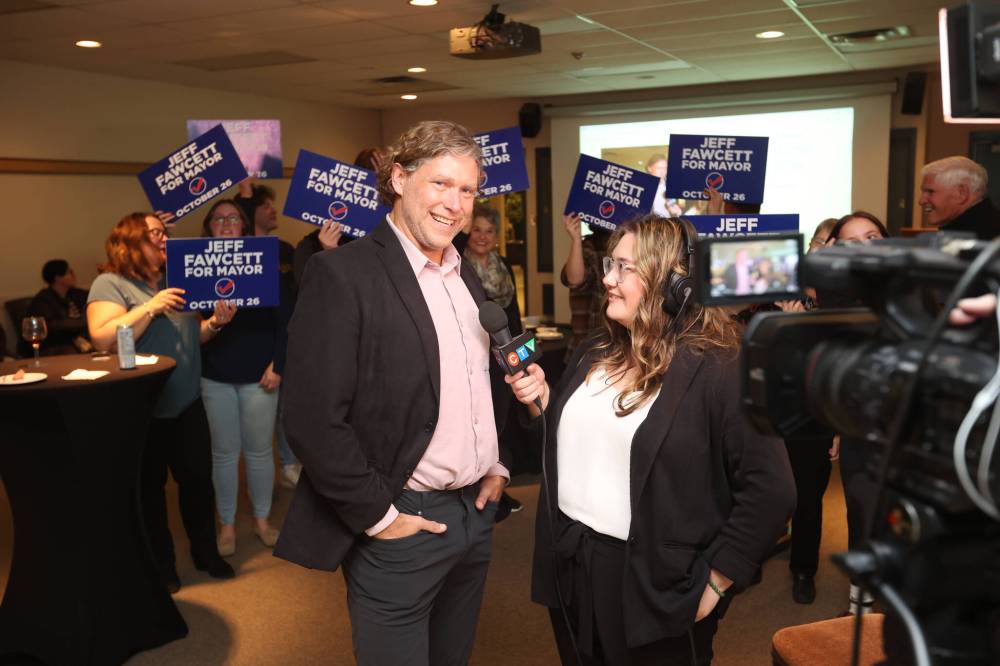
Jeff Fawcett speaks to CTV Winnipeg while awaiting official results of his mayoral win in Brandon's municipal election last month. (Tim Smith/The Brandon Sun files)
Ouch. That’s some harsh commentary.
But viewing the 2026 numbers in isolation would miss the bigger picture. When compared against the dismal participation rates of the past two election cycles, the 2026 municipal election represents a substantial improvement in local democratic engagement.
Consider the baseline.
In 2018, municipal voter turnout hit a historic low of 16.86 per cent, and 2022 was scarcely better at 17.9 per cent. All things considered, jumping to 27.65 per cent is not a minor uptick — it is nearly a 10-percentage-point surge.
While Brandon’s list of eligible voters grew by 1,800 people between 2022 and 2026 (from 36,528 to 38,328), the actual number of ballots cast in the mayoral race jumped by more than 4,060, climbing from 6,536 to 10,598. Advance voting alone shattered city records, with 2,386 residents casting early ballots — more than six times the 376 advance votes recorded four years prior.
More importantly, the 2026 election proved that when voters are given real choices on the ballot, at least some of them show up.
In 2022, voters in four of Brandon’s 10 wards — Wards 4, 6, 7, and 9 — had no council race to vote in at all because their representatives were acclaimed. There’s an argument to be made here that having a local council race for your ward is just as much a draw for voters as having solid candidate choices for the mayor’s chair.
In 2026, nine out of 10 wards were contested, leaving only Bruce Luebke in Ward 6 acclaimed. That single fact brought 3,391 council votes back into the democratic process across wards 4, 7 and 9. Overall, total ballots cast for city council candidates more than doubled, jumping from 4,135 in 2022 to 9,755 in 2026.
Even if we strip away the newly contested wards and look strictly at the six wards that held council races in both elections, the progress is obvious. Every single one of those six wards saw significant growth in 2026, collectively rising from 4,135 council votes to 6,365 — an increase of nearly 54 per cent.
In Ward 8, council ballot totals more than doubled from 430 to 914. Ward 2 saw a 76.8 per cent increase, and Ward 10 rose by 63.8 per cent.
And at the top of the ballot, a mayoral race that provided a clear choice between two well-known candidates — incumbent Jeff Fawcett (5,752 votes) and challenger Len Isleifson (4,845 votes) — gave residents across the entire city a clear reason to engage with municipal issues.
Nevertheless, Brandon still has a long way to go before returning to the 42 per cent turnout seen as recently as 2014. And that number was hardly a high-water mark for this city.
Municipal decisions affect everything from snow clearing and property taxes to downtown safety and that expensive water bill you got in the mail this fall. But those decisions must also include finding ways to get more than 70 per cent of the electorate off the sidelines and involved in those day-to-day issues.
And like it or not, getting the public to pay attention to the issues at hand takes more than friendly campaign banter between candidates.
Still, with more candidates stepping forward, nine contested wards, record advance poll numbers, and thousands more residents making their voices heard at the ballot box, the 2026 election shouldn’t be counted as a failure. It was a solid, measurable step in the right direction.
Reversing a decade-long slide in voter apathy rarely happens overnight, but we should take the wins where we find them.
» Matt Goerzen, editor