
LeBlanc gives update on U.S. trade talks to Canada-U.S. advisory committee
Advertisement
Read this article for free:
or
Already have an account? Log in here »
We need your support!
Local journalism needs your support!
As we navigate through unprecedented times, our journalists are working harder than ever to bring you the latest local updates to keep you safe and informed.
Now, more than ever, we need your support.
Starting at $15.99 plus taxes every four weeks you can access your Brandon Sun online and full access to all content as it appears on our website.
Subscribe Nowor call circulation directly at (204) 727-0527.
Your pledge helps to ensure we provide the news that matters most to your community!
To continue reading, please subscribe:
Add Brandon Sun access to your Free Press subscription for only an additional
$1 for the first 4 weeks*
- Enjoy unlimited reading on brandonsun.com
- Read the Brandon Sun E-Edition, our digital replica newspaper
*Your next Free Press subscription payment will increase by $1.00 and you will be charged $20.95 plus GST for four weeks. After four weeks, your payment will increase to $24.95 plus GST every four weeks.
Read unlimited articles for free today:
or
Already have an account? Log in here »
OTTAWA – Members of an advisory committee on economic relations with the U.S. heard Thursday that Ottawa is more optimistic now about the odds of an interim deal with the Trump administration — but challenging negotiations are expected to continue.
Canada-U.S. Trade Minister Dominic LeBlanc delivered the update on trade talks to a meeting of the Advisory Committee on Canada-U.S. Economic Relations in Ottawa. It was the first such meeting since midterm elections in the U.S. delivered a sharp rebuke of the Trump administration.
“It’s clear that the counterparty is still the administration and until the Congress takes hold, the political dynamic hasn’t changed,” Flavio Volpe, president of the Automotive Parts Manufacturers’ Association and a member of the advisory committee, said in a text message.
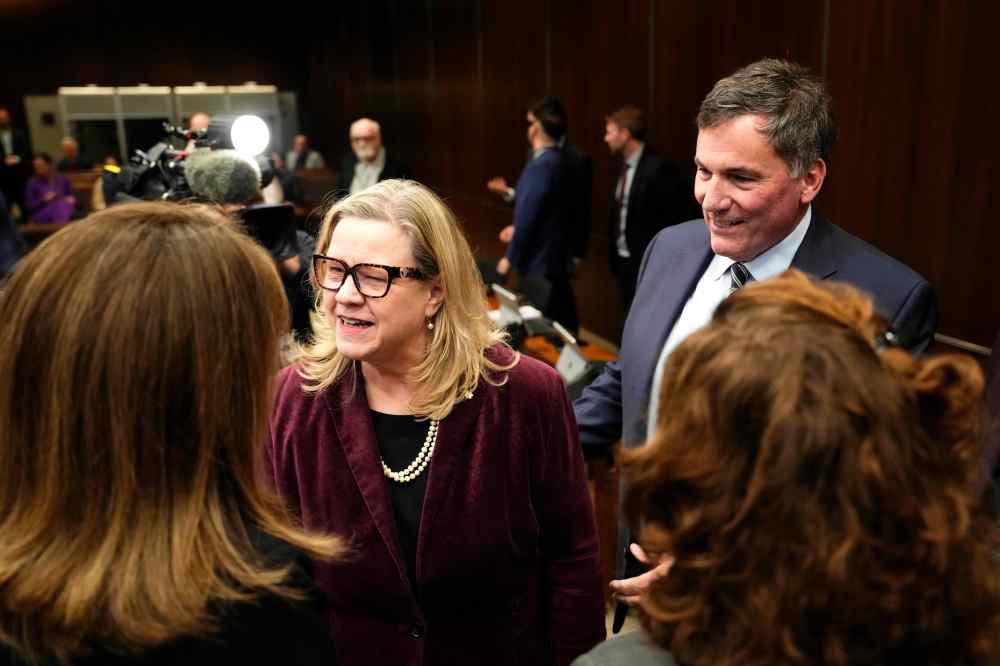
The virtual committee meeting also included Ambassador to the United States Mark Wiseman and chief trade negotiator Janice Charette.
The committee discussed “the evolving Canada-U.S. trade relationship and Canada’s approach to advancing its economic interests,” according to a readout from Global Affairs Canada.
U.S. President Donald Trump’s trade war with Canada rapidly escalated after negotiations broke down in August. Ottawa and Washington accused each other of putting eleventh-hour demands on the table.
Prime Minister Mark Carney said at the time that Trump’s team wanted to restrict Canada’s ability to make trade deals with other countries, endanger Canada’s protections for language and culture, and maintain hefty tariffs on some automobiles.
In response, Trump hit an array of Canadian goods with 50 per cent tariffs and banned imports of others. He threatened to further increase duties in January if no deal is made by then.
The president also signed an executive order to rename Lake Ontario as Lake America.
The Trump administration’s tone on Canada softened somewhat after midterm election exit polling indicated that the president’s trade war and his sweeping tariff agenda were unpopular with American voters.
“I remain optimistic that the conditions are present to do better than we did when we broke from the table in August,” Volpe said. “The negotiating team is making a fulsome effort to properly understand the implications otherwise.”
A source on the committee — who is not authorized to speak publicly — said that while there is a chance that an interim deal can be struck in the “lame duck” period between the midterms and the arrival of the new Democrat-controlled Congress in January, the midterm results won’t solve all of the problems in the bilateral relationship.
Democrats have indicated that ending the trade war with Canada will be among their top priorities in January — but they could struggle to achieve the supermajority they need to override the president’s veto.
Democrats likely will only tackle one of Trump’s tariff tools — Section 338 of the Tariff Act of 1930 — while leaving in place other duties still hammering parts of the Canadian economy.
Volpe said “there is some concern” that Canada’s moves to normalize trade with China — particularly in sectors that have been targeted by Trump’s national security tariffs — could undermine progress toward a deal.
White House trade adviser Peter Navarro has repeatedly criticized Carney’s trade strategy. In a video posted on social media Thursday, Navarro said Ottawa is misreading its position and compared it to “a high school team taking on the New York Knicks.”
“They are living in the past if they think Donald John Trump is going to let them continue to push us around,” Navarro said. “They can cry all they want about America being a bully and this and that … Those are arrogant people.”
Carney and Trump met on the sidelines of the Asia-Pacific economic summit in Shenzhen, China, on Wednesday. Both leaders also met separately with Chinese President Xi Jinping; on Thursday Trump held a rare three-way meeting with Xi and Russian President Vladimir Putin.
Following Carney’s meeting with Trump, the prime minister said a “very good trade arrangement” with the United States is possible but Canada won’t just sit around and wait.
During a meeting Tuesday of the House of Commons international trade committee in Ottawa, LeBlanc and Charette cautioned MPs that there is no guarantee Canada can restore the terms of the Canada-U.S.-Mexico Agreement on trade, better known as CUSMA.
Charette said Canada has to prepare for a world where a tariff-free arrangement may no longer be possible.
The objective is to “get to the lowest rate of tariff on the narrowest basket of goods with the most preferential access for Canadian businesses and Canadian workers,” Charette said.
The Trump administration chose not to renew CUSMA in July. The decision triggered a rolling annual review for up to a decade, at which point the agreement will expire if the three countries cannot agree on an extension.
Thursday’s readout said committee members “brought forward insights from their respective sectors and regions, highlighting the challenges businesses and workers continue to face because of U.S. trade measures.”
“The discussion also addressed the implementation of federal measures to support Canadian businesses and workers affected by U.S. tariffs, including the effectiveness of existing supports and opportunities to better respond to the needs of affected businesses,” it said.
This report by The Canadian Press was first published Nov. 19, 2026.
— By Kelly Geraldine Malone in Washington