
Pentagon criticizes Canada in ‘fact sheet’ after Hegseth memo
Advertisement
Read this article for free:
or
Already have an account? Log in here »
We need your support!
Local journalism needs your support!
As we navigate through unprecedented times, our journalists are working harder than ever to bring you the latest local updates to keep you safe and informed.
Now, more than ever, we need your support.
Starting at $15.99 plus taxes every four weeks you can access your Brandon Sun online and full access to all content as it appears on our website.
Subscribe Nowor call circulation directly at (204) 727-0527.
Your pledge helps to ensure we provide the news that matters most to your community!
To continue reading, please subscribe:
Add Brandon Sun access to your Free Press subscription for only an additional
$1 for the first 4 weeks*
- Enjoy unlimited reading on brandonsun.com
- Read the Brandon Sun E-Edition, our digital replica newspaper
*Your next Free Press subscription payment will increase by $1.00 and you will be charged $20.95 plus GST for four weeks. After four weeks, your payment will increase to $24.95 plus GST every four weeks.
Read unlimited articles for free today:
or
Already have an account? Log in here »
WASHINGTON – The Pentagon has released what it calls a “fact sheet” criticizing Canada’s defence spending in the latest symbolic push from the Trump administration to upend long-standing norms in North American continental security.
“Unfortunately, Canada has yet to make the hard decisions and tradeoffs needed to put it on track to fulfill its NATO Defense Investment Pledge and become a credible partner in the defense of our shared continent,” said the document released publicly on Monday and first reported by Axios the day prior.
“Canada’s defense shortfalls speak for themselves.”
The document points to operational readiness deficits in air, land and sea operations. It denounces Canadian political leadership for pursuing “parochial economic and commercial interests over military optimization.”
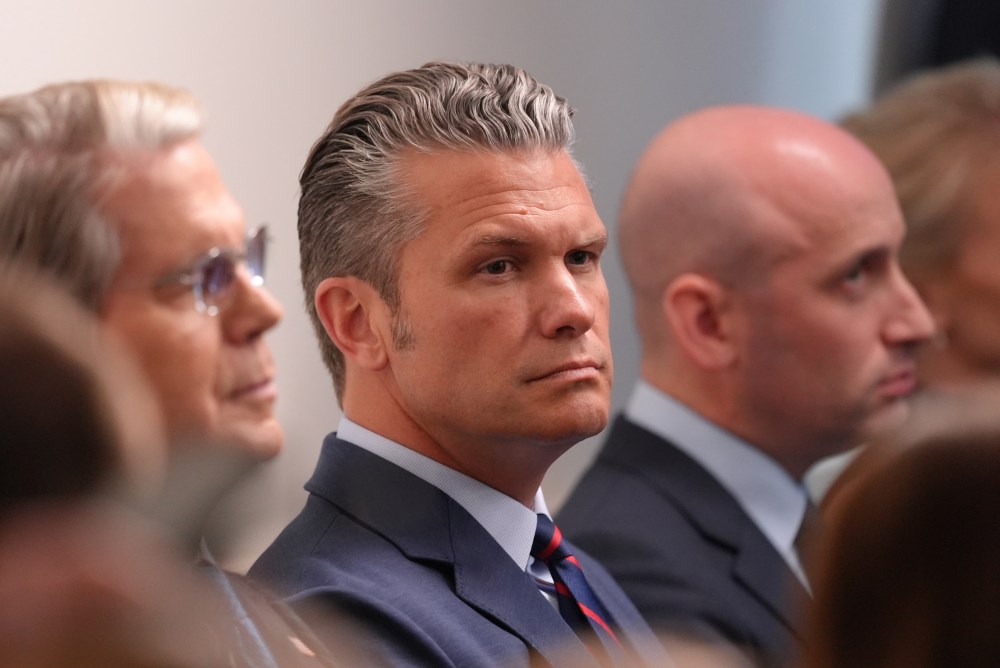
It was released after U.S. Defense Secretary Pete Hegseth last week issued a classified memo imposing restrictions on military co-operation with Canada on think tanks and socializing.
Sen. Mike Rounds, a Republican, told reporters at the Halifax International Security Forum on Saturday that the move would not affect military operations.
Defence Minister David McGuinty’s office has not yet responded to a request for comment about the fact sheet. On Saturday at the security conference, McGuinty said it was “business as usual” between the Canadian and U.S. militaries.
He assured Canadians that co-operation between the two countries on defence, security and intelligence was continuing.
In response to Hegseth’s memo, chief Pentagon spokesperson Sean Parnell said the defence department is “taking steps to ensure its engagements with Canada advance tangible U.S. defense objectives and ultimately support a reinvigorated defense relationship.”
The memo and Monday’s fact sheet are the latest moves the Pentagon has taken under the Trump administration to break norms with Canada.
In May, Elbridge Colby, U.S. undersecretary of defence for policy, said his department was pausing the Permanent Joint Board on Defense “to reassess how this forum benefits shared North American defence.”
The board was established in 1940 and is an advisory forum for U.S.-Canada bilateral defence co-operation.
At that time, a high-ranking U.S. defence official said the Pentagon gave Ottawa a classified paper laying out priorities for a collective North American defence pact with Canada, but that Ottawa did not deliver a “credible” response.
That same month, Canada announced it would purchase early warning planes from Sweden’s Saab rather than a competing option from Boeing.
This criticism of Canada’s defence readiness is not happening in a vacuum. Experts have said it’s likely connected to a planned purchase of F-35 fighter jets and ongoing tensions between the two countries.
The Liberal government has yet to reach a decision on its order of F-35 fighter jets from Lockheed Martin — which Pentagon officials have cited as a source of frustration. The fighter jet purchase has been the subject of a political review for more than a year.
“It is a major issue for them and a leverage point for us,” said former Conservative leader Erin O’Toole, who is also a distinguished fellow at the Washington-based Hudson Institute.
Canada has long faced criticism about its lagging defence spending, but with U.S. President Donald Trump’s return to the White House it was directly connected to larger trade issues, including the renewal of the Canada-U.S.-Mexico Agreement on trade, known as CUSMA.
O’Toole said he was not surprised by the content of the fact sheet but, in a text message, he added that it “ignores everything in the last year.”
“This is like someone was asked to prepare a one-sided, negative summary without acknowledging any of the changes made in the last 18 months,” O’Toole said.
Prime Minister Mark Carney has made historic defence investments as Trump rattled the bilateral relationship with tariffs and threats of annexation.
Canada spent $63.4 billion on national defence in 2025, meeting its NATO commitment to spend two per cent of gross domestic product on defence for the first time.
NATO members met last year in The Hague and agreed to up defence spending to the equivalent of five per cent of GDP by 2035.
Ottawa has said Canada continues to accelerate its path to NATO’s new target of 3.5 per cent on core defence and is optimizing an additional 1.5 per cent of GDP spending on defence and security-related investments.
November’s federal budget laid out a plan to spend around four per cent of Canada’s gross domestic product on defence per year by the end of the decade — which includes the purchase of submarines, early warning jets and other capabilities.
But Carney has also faced domestic pressure about the lack of transparency around defence spending moving forward.
This report by The Canadian Press was first published Nov. 23, 2026.