
Messy geopolitics scuttle climate talks
Advertisement
Read this article for free:
or
Already have an account? Log in here »
We need your support!
Local journalism needs your support!
As we navigate through unprecedented times, our journalists are working harder than ever to bring you the latest local updates to keep you safe and informed.
Now, more than ever, we need your support.
Starting at $15.99 plus taxes every four weeks you can access your Brandon Sun online and full access to all content as it appears on our website.
Subscribe Nowor call circulation directly at (204) 727-0527.
Your pledge helps to ensure we provide the news that matters most to your community!
To continue reading, please subscribe:
Add Brandon Sun access to your Free Press subscription for only an additional
$1 for the first 4 weeks*
- Enjoy unlimited reading on brandonsun.com
- Read the Brandon Sun E-Edition, our digital replica newspaper
*Your next Free Press subscription payment will increase by $1.00 and you will be charged $20.95 plus GST for four weeks. After four weeks, your payment will increase to $24.95 plus GST every four weeks.
Read unlimited articles for free today:
or
Already have an account? Log in here »
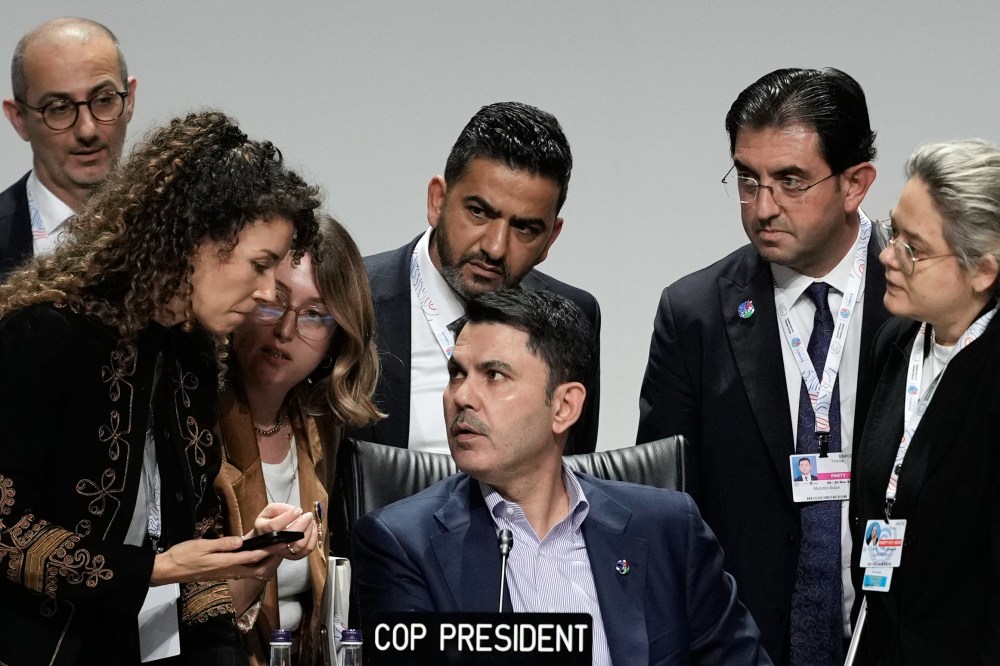
There are several things that are appalling about the outcome of the recently completed COP31 gathering in Antalya, Turkey, but among the most irksome is the fact the annual United Nations climate summit’s complete and utter failure was so darned predictable.
COP31 — so named because it was the 31st Conference of the Parties (COP) to the United Nations Framework Convention on Climate Change — brought together governments, scientists, business leaders and other stakeholders to advance climate action in the hope of limiting global warming and the threats it poses to the planet’s population.
These annual gatherings have always been ambitious in their intentions, and have produced legitimate action plans such as the 2015 Paris Agreement, a legally binding international climate treaty that set the goal of holding global temperatures to below 2 C — and hopefully below 1.5 C — above pre-industrial levels.
The concerns regarding climate change and the aspirations to address them have been genuine, and the commitments of time, energy and money have been substantial. Monitoring mechanisms have been put in place, and annual updates have offered a clear picture of how the planet’s climate is faring.
But the one immutable truth — perhaps an inconvenient truth, in keeping with the title of former U.S. vice-president and committed climate activist Al Gore’s landmark 2006 documentary — about the COP gatherings is that the global community has consistently failed to meet the benchmarks set at the annual summit.
And so it was at this year’s conference, co-chaired by host nation Turkey and Australia, as the gathering of 196 nations was once again forced to consider unmet targets while seeking a consensus commitment to redouble international efforts to address the ever-worsening climate crisis before it’s too late (assuming it isn’t already).
What made COP31 unique, however, was the colossal magnitude of its failure. Despite pushing its discussions and attempts at negotiation two days beyond its scheduled conclusion, the summit’s participants were unable to arrive at an agreement.
After two extra days of wrangling over wording, COP31’s leadership could not even come up with a statement that represented the consensus view of the gathering, in part because countries with deep petrochemical interests would not allow the words “fossil fuels” to appear in the agreement.
With oil-producing nations absurdly forbidding references to fossil fuels and many other countries rightly rejecting any deal that didn’t include their mention, there was no hope of an agreement.
Add to that the fact several poorer countries objected to the absence of specific financial commitments from richer nations to help them adapt to the impacts of climate change, and the fate of COP31 was sealed.
In describing the “unbridgeable red lines” that scuttled the discussions, Australian government minister and COP31 president of negotiations Chris Bowen said the global community is facing “the most complicated and fraught geopolitical environment in living memory.”
For proof of that, one need look no further than the fact that at the same time COP31 was failing to produce anything of substance, U.S. President Donald Trump, Chinese President Xi Jinping and Russian President Vladimir Putin — two dictators and a wannabe despot representing three of the world’s four biggest greenhouse-gas emitters — were having a private meeting during the APEC summit in China, during which they committed to increasing the production and supply of “refined petroleum products for the benefit of all nations.”
The major criticism of the COP summits used to be that they were all talk and too little action. It’s a very sad — and correspondingly dire — statement on the global commitment to fighting climate change that they now can’t even agree on the talk.
» Winnipeg Free Press