
Co-ordinated police effort seizes drugs, guns
Project Alliance targeted gangs and drug traffickers across 47 Manitoba communities
Advertisement
Read this article for free:
or
Already have an account? Log in here »
We need your support!
Local journalism needs your support!
As we navigate through unprecedented times, our journalists are working harder than ever to bring you the latest local updates to keep you safe and informed.
Now, more than ever, we need your support.
Starting at $15.99 plus taxes every four weeks you can access your Brandon Sun online and full access to all content as it appears on our website.
Subscribe Nowor call circulation directly at (204) 727-0527.
Your pledge helps to ensure we provide the news that matters most to your community!
To continue reading, please subscribe:
Add Brandon Sun access to your Free Press subscription for only an additional
$1 for the first 4 weeks*
- Enjoy unlimited reading on brandonsun.com
- Read the Brandon Sun E-Edition, our digital replica newspaper
*Your next Free Press subscription payment will increase by $1.00 and you will be charged $20.95 plus GST for four weeks. After four weeks, your payment will increase to $24.95 plus GST every four weeks.
Read unlimited articles for free today:
or
Already have an account? Log in here »
WINNIPEG — Manitoba police agencies seized almost 60 kilograms of illicit drugs and 191 guns in October in a joint campaign that targeted street-level dealers and gangs, including some who exploited kids as young as 12.
Officials said arrests happened in 47 communities, with 335 people charged — nearly half of them for alleged drug trafficking — in an operation dubbed Project Alliance.
“If you try to profit off of selling drugs to kids, or using kids to sell drugs for you, you are going to be held accountable,” Premier Wab Kinew said at a news conference at Manitoba RCMP headquarters.
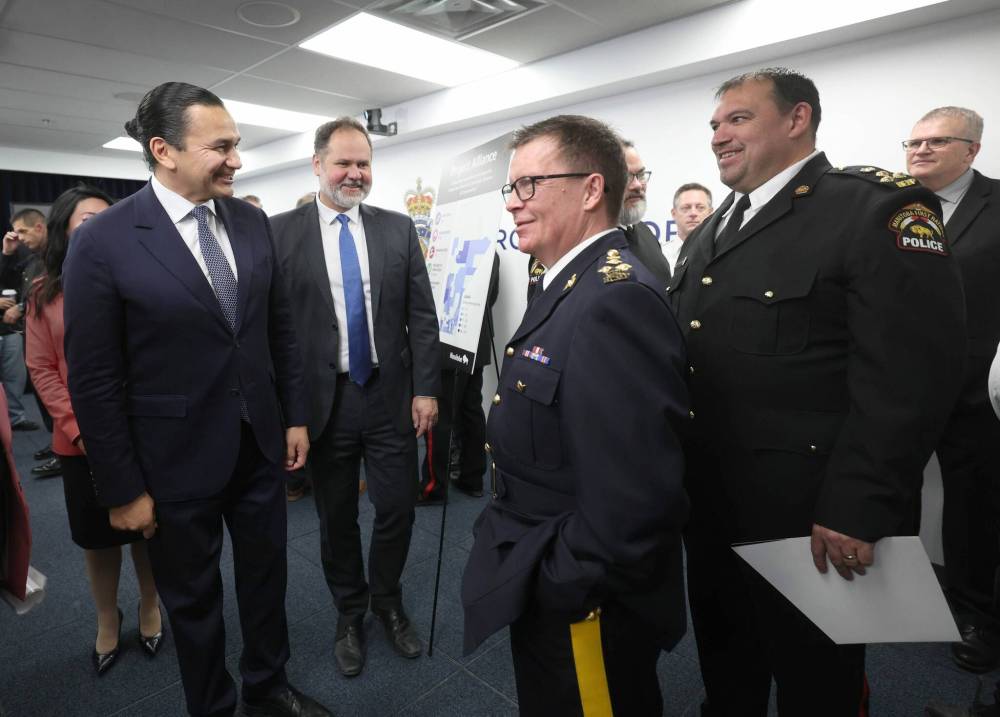
Premier Wab Kinew (left), Justice Minister Matt Wiebe and Manitoba RCMP Assistant Commissioner Scott McMurchy (second from right) are shown at a press conference at Manitoba RCMP headquarters on Friday. (Ruth Bonneville/Winnipeg Free Press)
He appealed to older gang members, including those operating from prison, to “let go of the kids.”
“Spare them of repeating the cycle that you have gone through,” Kinew said.
Staff Sgt. Wayne Davis of the Winnipeg Police Service’s organized crime unit said officers encountered children as young as 12 and 13 while working on the drug enforcement project.
“It’s hard for our officers to deal with children that young,” he said, noting children those ages are referred to a gang prevention program.
Older gang members wield significant influence when they recruit younger kids to traffic drugs, Davis said.
“They can try to tempt them with money, with items that they wouldn’t normally have access to,” he said.
At least a dozen municipal, provincial and federal law enforcement agencies were involved in Project Alliance. Justice Minister Matt Wiebe called the co-ordination “unprecedented.”
Officials said 57 kilograms of cocaine (worth more than $1 million on the street), two kilograms of meth, one kilogram of heroin and 194 grams of fentanyl were among the drugs seized, along with nearly $220,000 in cash.
Of the drugs and guns, a high proportion were seized in Winnipeg.
Assistant commissioner Scott McMurchy, the commanding officer of Manitoba RCMP, said organized crime groups based outside the province are moving into northern communities.
“They see vulnerable communities, and they try to come in and take advantage of those vulnerable communities,” he said.
McMurchy said RCMP are working with police across Canada to target those groups. He said intelligence gathered in Project Alliance will be used to build investigations into the “next level” of drug traffickers and organized crime.
McMurchy stressed the importance of providing “after care,” including health services for drug users, in communities that were included in the project.
“We have to reduce the demand in the community, and then the supply, hopefully, will go away,” McMurchy said.
Cocaine remains the drug of choice in communities policed by RCMP, McMurchy said, adding the purity of drugs continues to increase.
“Other drugs are mixed with other things, so you never really know what you’re getting,” he said.
Wiebe acknowledged Manitoba has a “huge” addictions crisis.
On the enforcement side, he pointed to a need for provincial funding for more police officers and Crown attorneys.
Manitoba First Nations Police Service Chief Jason Colon said officers arrested high-ranking members of a street gang when they seized cocaine and five guns in Sandy Bay Ojibway First Nation on Oct. 13.
He said his officers have seen a “slowdown” in drug activity in the communities they targeted.
Winnipeg police Chief Gene Bowers described trafficking networks as more organized and interconnected than ever before. He said work will continue to target them.
Davis said police face a struggle to keep up with the evolution of organized crime, including groups that are bringing drugs into Manitoba. Dealers, he noted, are using e-transfers for sales and encrypted methods to communicate.
Project Alliance stemmed from the NDP governments’ plan for a “meth sweep,” first announced in the November 2025 throne speech.
A task force, comprising police agencies and provincial and federal departments, was created to co-ordinate the project and other efforts to combat organized crime and drug trafficking.
The project was largely funded through the law enforcement agencies’ existing budgets. The province contributed an additional $500,000.
Tory addictions critic Jeff Bereza said organized crime groups see Manitoba as a place of opportunity.
“If (the government) would have been on this three years ago, instead of making this like a pre-election (initiative), we could have had a lot of this taken care of by now,” he said.
“We’re dealing with drugs that are highly addictive, and that’s why it’s so important that there is after-care service here, that there is service for people that want to get into treatment.”
» Winnipeg Free Press