
Premier Moe says new trade deal with India would benefit Saskatchewan despite tariffs
Advertisement
Read this article for free:
or
Already have an account? Log in here »
We need your support!
Local journalism needs your support!
As we navigate through unprecedented times, our journalists are working harder than ever to bring you the latest local updates to keep you safe and informed.
Now, more than ever, we need your support.
Starting at $15.99 plus taxes every four weeks you can access your Brandon Sun online and full access to all content as it appears on our website.
Subscribe Nowor call circulation directly at (204) 727-0527.
Your pledge helps to ensure we provide the news that matters most to your community!
To continue reading, please subscribe:
Add Brandon Sun access to your Free Press subscription for only an additional
$1 for the first 4 weeks*
- Enjoy unlimited reading on brandonsun.com
- Read the Brandon Sun E-Edition, our digital replica newspaper
*Your next Free Press subscription payment will increase by $1.00 and you will be charged $20.95 plus GST for four weeks. After four weeks, your payment will increase to $24.95 plus GST every four weeks.
Read unlimited articles for free today:
or
Already have an account? Log in here »
REGINA – As Ottawa appears to inch closer to a trade deal with India, Saskatchewan Premier Scott Moe says he hopes the agreement addresses punishing tariffs on pulse crops.
But Moe says if the deal doesn’t remove the duties, it’s something his province can work around.
“The need for pulses in India is not going to go away. (Saskatchewan’s) relationship with India is not going to go away,” he told reporters Friday.
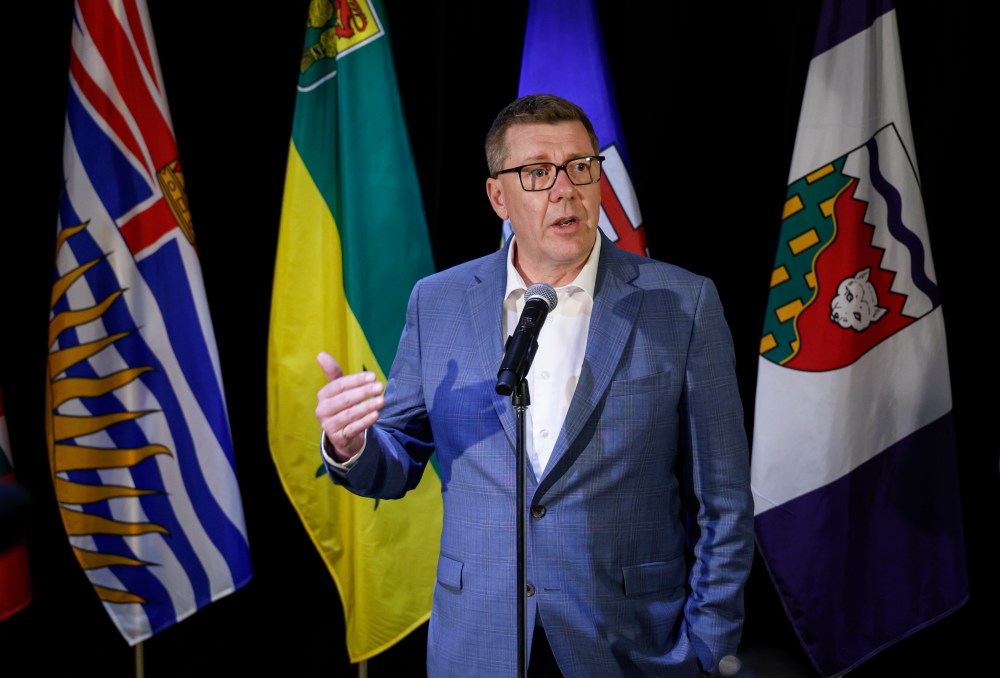
“We’ve had pulse tariffs come on and off over my time in this position … and each and every time, we’ve been able to rely on our relationship.”
Last year, India imposed a 30 per cent levy on all imported yellow peas and a 10 per cent duty on lentils, causing Canadian exports of the crops to dampen.
Over 80 per cent of all pulses exported from Canada to India are grown in Saskatchewan.
Moe spoke at the Western Canada-India Leaders Summit on Friday, where Canadian and Indian diplomats talked about improving the relationship between both countries.
Christopher Cooter, Canada’s high commissioner to India, told the conference he’s confident a trade deal will be signed later this year and that it will help Canada grow its economy.
“Doubling trade is actually a rather modest objective. We should be thinking about quintupling trade,” Cooter said. “There’s so much headroom to grow in so many different sectors.”
Moe said an agreement with India would be positive.
Along with agriculture products, he said there are opportunities to supply India with potash — a key ingredient for fertilizer — and uranium.
In March, Moe was with Prime Minister Mark Carney in India to watch Saskatoon-based Cameco sign a $2.6-billion deal to supply just under 9.9 million kilograms of uranium to the country over nine years.
“Saskatchewan and India are aligned when it comes to reliable, lower emissions energy,” Moe told the conference Friday. “Our uranium and our nuclear sector in this province are going to play an important role in helping both of our nations achieve that.”
Dinesh Patnaik, India’s high commissioner to Canada, said his country would also benefit from a deal. He told attendees there are opportunities in the agriculture and energy industries.
As for pulse tariffs, they’ve been part of the trade discussions, he said.
“What we’re trying to work out is how do we do a system in which there is a sustainable level Canada can export every year,” Patnaik said.
India normally applies the tariffs to protect its own farmers from lower crop prices, he added.
“These are marginal farms … and whatever they get out of farming sustains them,” he said.
Canada and India have been in trade talks since 2010, but they were shut down by Ottawa in 2023 after former prime minister Justin Trudeau accused New Delhi of playing a role in the assassination of Canadian Sikh activist Hardeep Singh Nijjar in Surrey, B.C.
Carney, after becoming prime minister in 2025, has prioritized resetting relations with the country.
Cooter told attendees Friday security issues remain “the grizzly bear in the room.”
“The reason we weren’t in a good position a year ago and beyond was because of security, but we made a lot of progress on that,” he said.
All of Canada’s and India’s heads of security have met, he added. “They began to build that trust that we now benefit from,” Cooter said.
Patnaik said when security issues arise, both countries should talk more.
“Because we’ve been talking more, look at the difference that’s made on the ground,” he said.
Further on trade, Saskatchewan has established an advisory council to hear from businesses ahead of the joint review of the Canada-United States-Mexico Agreement, which is set for July 1.
Moe said the council will help inform the province as it shares its priorities with Ottawa. Any new deal with the United States must ensure free and fair trade, he added.
This report by The Canadian Press was first published May 29, 2026.