
Who are you calling entitled? Today’s youth say they have it tougher — and the numbers back them up
Advertisement
Read this article for free:
or
Already have an account? Log in here »
We need your support!
Local journalism needs your support!
As we navigate through unprecedented times, our journalists are working harder than ever to bring you the latest local updates to keep you safe and informed.
Now, more than ever, we need your support.
Starting at $15.99 plus taxes every four weeks you can access your Brandon Sun online and full access to all content as it appears on our website.
Subscribe Nowor call circulation directly at (204) 727-0527.
Your pledge helps to ensure we provide the news that matters most to your community!
To continue reading, please subscribe:
Add Brandon Sun access to your Free Press subscription for only an additional
$1 for the first 4 weeks*
*Your next subscription payment will increase by $1.00 and you will be charged $20.00 plus GST for four weeks. After four weeks, your payment will increase to $24.00 plus GST every four weeks.
Read unlimited articles for free today:
or
Already have an account? Log in here »
Hey there, time traveller!
This article was published 31/08/2012 (4948 days ago), so information in it may no longer be current.
Dani Finch counts herself as one of the lucky ones.
The 22-year-old graduated from Creative Communications at Red River last spring and almost immediately landed a job in Swan River. Three months later she moved back to Winnipeg to start working for the Sou’Wester.

The job doesn’t pay much, but at least she can afford to start repaying her $10,000 in student loans, rent an apartment and operate a used car.
Her boyfriend, also a CreComm graduate, is still unemployed despite a constant job search. A third of the 70 students she graduated have yet to find work.
Many paid for their entire education with student loans and now they’re desperate to find their way into a job market that is becoming more and more elusive to the young.
That is today’s reality — young Canadians starting out now face far steeper challenges than previous generations. Soaring tuition has led to record levels of student debt. Home prices have skyrocketed, making ownership a dream they can’t even see if they stand on their tippy toes. Incomes aren’t rising as fast as they once did, and the income gap between the young and old is growing.
Brenda Lafleur, an economist at the Conference Board of Canada, crunched some numbers and found the income gap between young workers (age 25 to 34) and older workers (age 45 to 54) is about six times today what it was in the 1970s.
Jacques Marcil, a senior economist at TD Economics, said the economic downturn hit young Canadians the hardest. A TD Economics report earlier this year found workers between 15 and 24 were not only hurt the most by the recession, they have yet to see any recovery.
Since 2008, 250,000 jobs employing workers aged 15 to 19 have disappeared, including 70,000 since the economic recovery began.
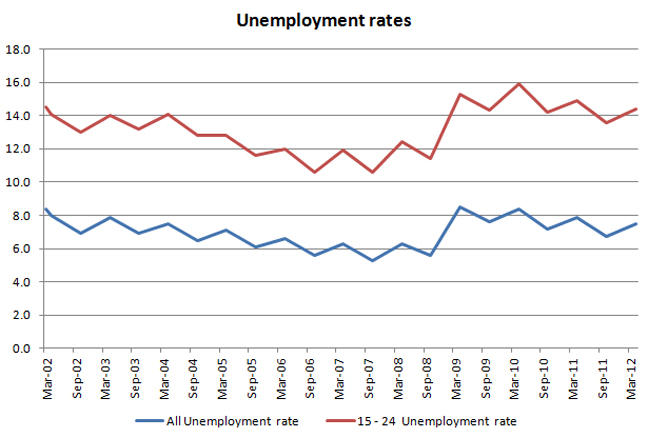
The unemployment rate for Canadians under 25 in May 2008, before the recession hit, was 13.5. A year later, during the height of the recession, it was 17.3. In May 2012 it was 16.3.
That is more than twice the overall unemployment rate of 7.4.
“For youth, it’s always harder on the job market,” said Marcil. “They are the last in and the first out.”
Marcil said one of the issues hurting young graduates is that older workers are staying in their jobs longer.
He said the need for older people to work longer is driven by the low interest rates affecting their investments. Not only are jobs more difficult to find for graduates with specific skills, they are also hard to find for students trying to put themselves through school in the first place.
“Just think about retailers. It’s not a kid welcoming you at the door, it’s a senior,” he said. “There’s a more limited choice of jobs for youth.”
The TD report said jobs for the under 20 set have continued to disappear. While the 20 to 24 group has seem some improvement, “it hasn’t been at a break-neck pace.”
What economists are also noticing is the number of Canadians in those age groups who simply stop looking for work has increased, Marcil said.
In the meantime, student debts are rising rapidly.
In the 1960s, tuition was a token amount, and students often could find non-repayable grants to pay for whatever tuition there was.
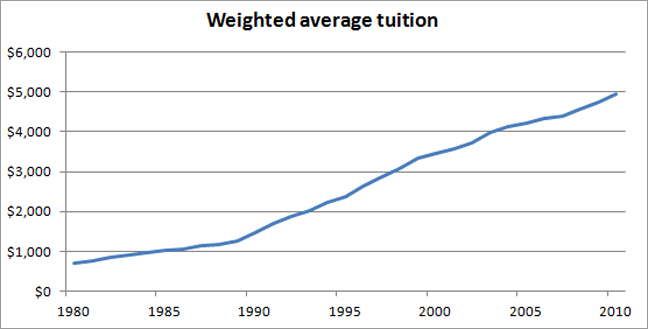
Now, nearly two-thirds of college and university graduates will be handed a debt repayment form along with their diploma. The average student debt upon graduation is $27,000. It’s $21,564 in Manitoba.
In 1989, governments funded nearly 85 per cent of the costs of universities and colleges. In 2009, that had fallen to 57 per cent.
In the same time frame, tuition went from 14 per cent of post-secondary budgets to 34 per cent.
Federal government statistics show a four-year university degree will cost about $60,000, including tuition (averaging $5,366 a year), living costs, books, and other expenses.
Bilan Arte, a fourth-year politics student at the University of Manitoba and president of the U of M Students Union, estimates she’ll owe more than $25,000 by the time her degree is completed — even though she moved to Manitoba with her family because university is cheaper here (the average tuition in Manitoba is $3,645).
Arte, 20, said students like herself know getting a degree is more likely to improve your job prospects and your lifetime earnings but there are still plenty of graduates with big loans and no paycheque.
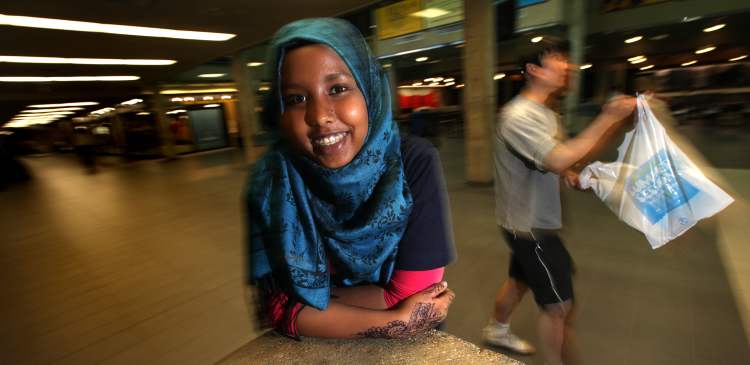
“With today’s job market, it’s not guaranteed you’ll get a job,” she said.
A silver lining to the current economic downturn is the ongoing existence of low interest rates. Last spring there was a “perfect storm” bearing down on the young as the threat of interest rate hikes loomed. Marcil said the fact that interest rates look like they aren’t going to jump much in the near future will help keep student loans a little more affordable for the time being.
Finch and Arte are both accustomed to hearing their generation referred to as “entitled” by older Canadians. When students in Quebec went on strike earlier this year in protest of planned tuition hikes, it was not uncommon to hear the young described as entitled, lazy and thinking everything should be handed to them on a silver platter.
But both Finch and Arte say while their parents weren’t handed a silver spoon, times were not as tough for young people then as they are now.
Finch worked multiple jobs to put herself through school at the University of Winnipeg, and borrowed more than $10,000 to complete her diploma at Red River College when the demands of school made part-time work impossible.
Despite this, when she wanted to buy a car — a used car with money she had saved — her own grandparents shook their heads and called her entitled.
She thinks they’re incredibly off base but she tries to shrug it off.
“I just smile and nod,” said Finch.
One under-40 worker said it is frustrating that, even though he and his girlfriend have degrees and professional employment, they are still drowning in student loans and have to move back in with one of their parents in order to save enough money to buy a house.
“How is it that, for example, my father, the sole breadwinner in a family of five, who had no high school diploma, was able by my age to work and pay for a house, two cars and family expenses by my age and afford luxuries like vacations with his sole income,” the man wondered. “I keep asking myself this and finding no real satisfactory answer.”
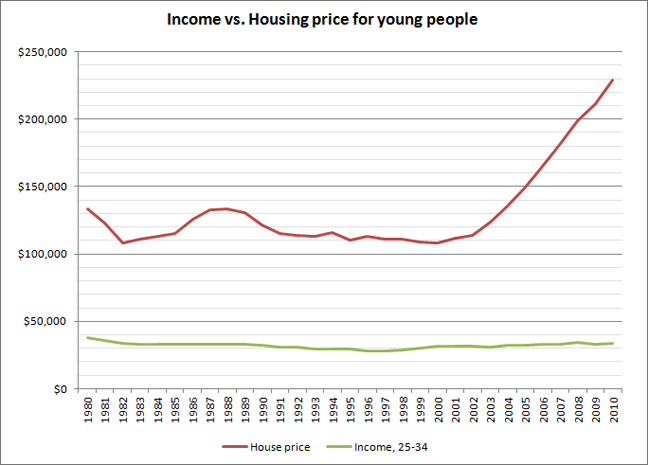
Part of the answer may be because income levels are stagnant while house prices are soaring.
In 1980, the average price of a home in Winnipeg was $50,491. In 2001 it was $94,214. In 2011 it was $241,409.
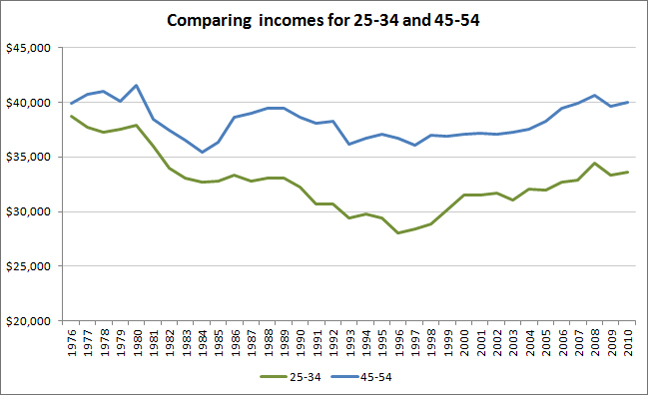
During the same time, median incomes, in constant dollars, fell for Canadians under 35. According to Statistics Canada, the median income for those aged 25 to 34 was $38,700 in 1976 (adjusted to 2010 dollars). In 2010, it was $33,600. For Canadians 45 to 54, it remained virtually the same, from $39,900 to $40,000.
Arte said it would be nice if governments paid attention to the issues facing youth, but she admits her age group is ignored in part because today’s youth aren’t as engaged in politics as previous generations were.
“It’s a self-fulfilling prophecy,” she said. “Young people aren’t participating because they aren’t being listened to.”
mia.rabson@freepress.mb.ca
History
Updated on Wednesday, September 5, 2012 6:56 AM CDT: Corrects number of graduates who have found work in their field