
Air Canada to lay off 20,000 workers amid travel industry collapse
Advertisement
Read this article for free:
or
Already have an account? Log in here »
We need your support!
Local journalism needs your support!
As we navigate through unprecedented times, our journalists are working harder than ever to bring you the latest local updates to keep you safe and informed.
Now, more than ever, we need your support.
Starting at $15.99 plus taxes every four weeks you can access your Brandon Sun online and full access to all content as it appears on our website.
Subscribe Nowor call circulation directly at (204) 727-0527.
Your pledge helps to ensure we provide the news that matters most to your community!
To continue reading, please subscribe:
Add Brandon Sun access to your Free Press subscription for only an additional
$1 for the first 4 weeks*
*Your next subscription payment will increase by $1.00 and you will be charged $20.00 plus GST for four weeks. After four weeks, your payment will increase to $24.00 plus GST every four weeks.
Read unlimited articles for free today:
or
Already have an account? Log in here »
Hey there, time traveller!
This article was published 15/05/2020 (2152 days ago), so information in it may no longer be current.
MONTREAL – Air Canada will lay off more than half of its 38,000 employees next month as it grapples with the fallout from the COVID-19 pandemic.
The layoffs, which will take place June 7, will affect a minimum of 19,000 staff and could go as high as 22,800.
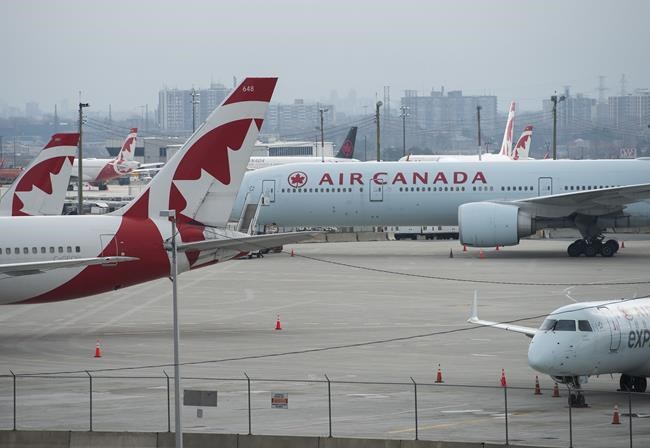
The country’s largest airline — along with its competitors — has seen demand for air travel evaporate amid ongoing border shutdowns and confinement measures, prompting Air Canada to ground some 225 airplanes and slash flight capacity by 95 per cent.
“We therefore took the extremely difficult decision today to significantly downsize our operation to align with forecasts, which regrettably means reducing our workforce by 50 to 60 per cent,” the airline said in an email Friday evening. “We estimate about 20,000 people will be affected.”
The airline made a similar decision in March to let go of nearly half of its workforce under a cost reduction scheme, only to rehire some 16,500 laid-off flight attendants, mechanics and customer service agents in April under the Canada Emergency Wage Subsidy — a program it has not committed to participate in past June 6.
To minimize the number of layoffs, Air Canada will ask flight attendants to slash their schedules, go on leave for up to two years or resign with travel privileges, according to an internal bulletin to members from the Canadian Union of Public Employees sent out Thursday night and obtained by The Canadian Press.
The memo states that CUPE is in discussions with Air Canada over continuing the federal wage subsidy.
“We know this news is not what any of us were expecting,” states the bulletin, signed by the president of CUPE’s Air Canada component and two other union officials.
“The reality is that COVID-19 has severely impacted the demand for air travel over the past few months and into the foreseeable future. As such, there is no denying that we are dealing with the largest surplus of cabin personnel in our history.”
Air Canada did not respond directly to questions about whether it would exit the wage subsidy program, which Ottawa recently extended through August.
The subsidy program that allowed employees — including 6,800 flight attendants — to be rehired last month covers 75 per cent of a worker’s normal hourly wages or up to $847 per week. The vast majority of those workers have stayed at home, however, as operations remain at a virtual standstill.
While Air Canada is not currently contributing to most worker wages, the airline has continued to pay into its pensions and benefits funds, a continuous cash drain at a company that lost more than $1 billion last quarter.
The Montreal-based company has been bleeding cash since mid-March and expects even fewer passengers between April and June.
Though traffic is expected to pick up somewhat before year’s end, Air Canada CEO Calin Rovinescu said last week the recovery will be slow, with at least three years of subpar earnings.
This report by The Canadian Press was first published May 15, 2020.
Companies in this story: (TSX:AC)
Related Articles
Air Canada revises refund policy as anger rises

Advertisement Advertise With Us
Advertisement Advertise With Us