
‘Dirty deal’: protesters disrupt Joe Manchin event over Mountain Valley pipeline
Advertisement
Read this article for free:
or
Already have an account? Log in here »
We need your support!
Local journalism needs your support!
As we navigate through unprecedented times, our journalists are working harder than ever to bring you the latest local updates to keep you safe and informed.
Now, more than ever, we need your support.
Starting at $15.99 plus taxes every four weeks you can access your Brandon Sun online and full access to all content as it appears on our website.
Subscribe Nowor call circulation directly at (204) 727-0527.
Your pledge helps to ensure we provide the news that matters most to your community!
To continue reading, please subscribe:
Add Brandon Sun access to your Free Press subscription for only an additional
$1 for the first 4 weeks*
- Enjoy unlimited reading on brandonsun.com
- Read the Brandon Sun E-Edition, our digital replica newspaper
*Your next Free Press subscription payment will increase by $1.00 and you will be charged $20.95 plus GST for four weeks. After four weeks, your payment will increase to $24.95 plus GST every four weeks.
Read unlimited articles for free today:
or
Already have an account? Log in here »
Hey there, time traveller!
This article was published 06/06/2023 (1198 days ago), so information in it may no longer be current.
WASHINGTON – Protesters chanted “dirty deal” and belted out a John Denver favourite Tuesday as they disrupted moderate Democrat Sen. Joe Manchin to let him know what they think of the newly fast-tracked Mountain Valley pipeline.
Manchin, long a key swing vote in a bitterly divided Congress, had just taken the stage to talk about his latest win: getting the controversial West Virginia project shoehorned into last week’s deal to raise the debt ceiling.
That’s when a group of about 20 audience members rose from their seats and suddenly climbed on stage, locking arms, shouting epithets and unfurling banners that denounced Manchin as a “climate criminal.”
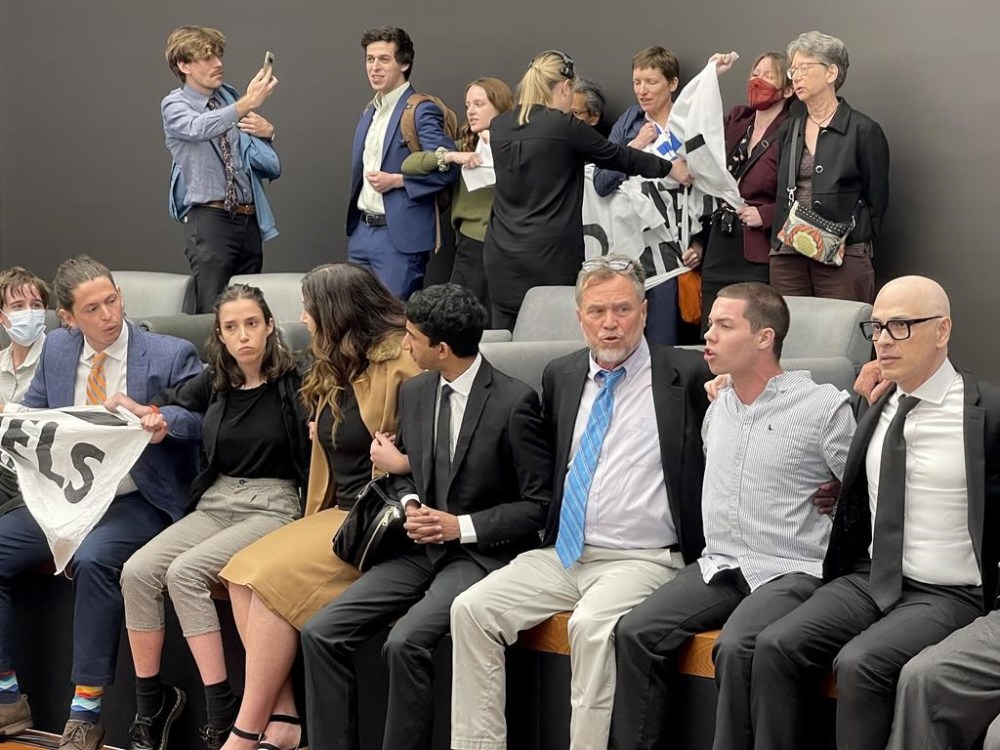
“Dirty deal, M.V.P.,” the protesters chanted, using the senator’s preferred shorthand for a project he’s been backing for years. “Manchin, you are killing me.”
The event, a panel discussion on permitting reform hosted by online news outlet Semafor, was paused for several minutes as security, staff and moderator tried in vain to dislodge the interlopers.
Mediator Steve Clemons, Semafor’s editor-at-large, eventually ushered Manchin and the remaining members of the audience into an adjacent boardroom, where he and the senator gamely resumed their interview.
But the day showcased an emerging tension in U.S. politics, one that’s likely not far off in Canada: fossil fuel and renewable energy interests trying to merge simultaneously into a single express lane toward a climate-friendly future.
That lane is permitting reform — a catch-all term for streamlining and modernizing the multiple environmental assessment and regulatory hurdles that can hold up energy projects, green and otherwise, for more than a decade.
It’s an overdue overhaul that’s also underway in Canada, where the federal government has promised to unveil a new, more efficient regulatory regime for energy infrastructure before the end of the year.
But business leaders there fear Canada is being leapfrogged by the U.S., where the regulatory reforms included in the Fiscal Responsibility Act, which codified the debt ceiling deal, are only the beginning.
As the protest continued beyond the boardroom, Manchin spelled out how his rationale for fast-tracking emerged from last year’s energy and inflation crisis, much of it fuelled by Russia’s war in Ukraine.
“Everything was going the wrong direction, the president’s poll numbers were extremely low, so people were saying, ‘Well, you got anything?'” Manchin recalled, the protesters’ rendition of “Take Me Home, Country Roads” audible through the wall.
“I said, ‘I got something, but I’m not sure you’re going to like it.'”
What resulted was the Inflation Reduction Act, the centrepiece climate spending and tax package President Joe Biden signed into law in August 2022 — and which, thanks to Manchin, ensured Canadian-made electric vehicles would be eligible for tax credits that had originally been earmarked as only for U.S.-built EVs.
Manchin’s second act was included in the bill Biden signed Saturday, language that establishes a central oversight agency for environmental reviews that would eliminate duplication and slash the decision timeline to no more than two years.
The idea, he said, is simply that the U.S. can have it both ways on energy security, relying more on North American fossil fuels in the short term while ramping up renewables at the same time.
“We can walk and chew gum, that was the premise,” Manchin said. And permitting reform needed to be part of the process “from Day 1,” he added.
“You can’t do what needs to be done to be energy secure unless you can get the electrons where they’re needed. And you can’t do that unless you have the pipelines, and then you have transmission.”
Not everyone during Tuesday’s panel was convinced fossil fuel projects like Mountain Valley will be able to co-exist with new green energy initiatives without dramatically escalating the worsening climate emergency.
“The Mountain Valley pipeline, in my mind, fails on climate, on economic and on community safeguards,” said Manish Bapna, president of the Natural Resources Defense Council.
Bapna cited the International Energy Agency — “not the most radical of global institutions,” he joked — in saying new fossil fuel projects would make it impossible to meet the goal of limiting global warming to 1.5 degrees Celsius.
“It is incompatible,” he said, making the same argument about other fossil endeavours as well, including the sprawling Willow drilling project in Alaska, which Biden approved in March.
“Willow will be another example of something that’s going to lock us in, and make it virtually impossible, if we continue to build out that type of infrastructure, to meet our obligations,” Bapna said.
“The future economic model we want to see in the United States, that we want to see in the world, is one that is going to be largely driven by the dynamism and innovation of a clean-energy economy.”
This report by The Canadian Press was first published June 6, 2023.