
Further negotiations won’t bring end to B.C. port workers strike, employers say
Advertisement
Read this article for free:
or
Already have an account? Log in here »
We need your support!
Local journalism needs your support!
As we navigate through unprecedented times, our journalists are working harder than ever to bring you the latest local updates to keep you safe and informed.
Now, more than ever, we need your support.
Starting at $15.99 plus taxes every four weeks you can access your Brandon Sun online and full access to all content as it appears on our website.
Subscribe Nowor call circulation directly at (204) 727-0527.
Your pledge helps to ensure we provide the news that matters most to your community!
To continue reading, please subscribe:
Add Brandon Sun access to your Free Press subscription for only an additional
$1 for the first 4 weeks*
- Enjoy unlimited reading on brandonsun.com
- Read the Brandon Sun E-Edition, our digital replica newspaper
*Your next Free Press subscription payment will increase by $1.00 and you will be charged $20.95 plus GST for four weeks. After four weeks, your payment will increase to $24.95 plus GST every four weeks.
Read unlimited articles for free today:
or
Already have an account? Log in here »
Hey there, time traveller!
This article was published 03/07/2023 (1171 days ago), so information in it may no longer be current.
VANCOUVER – Talks to end a strike at British Columbia’s ports have stalled with both sides accusing the other of being unreasonable.
The BC Maritime Employers Association released a statement Monday afternoon saying it had gone as far as possible on core issues and it doesn’t think more bargaining is going to produce a collective agreement.
The International Longshore and Warehouse Union Canada, representing thousands of workers who load and unload cargo at terminals at more than 30 B.C. ports, says it’s the association that “sabotaged the progress.”
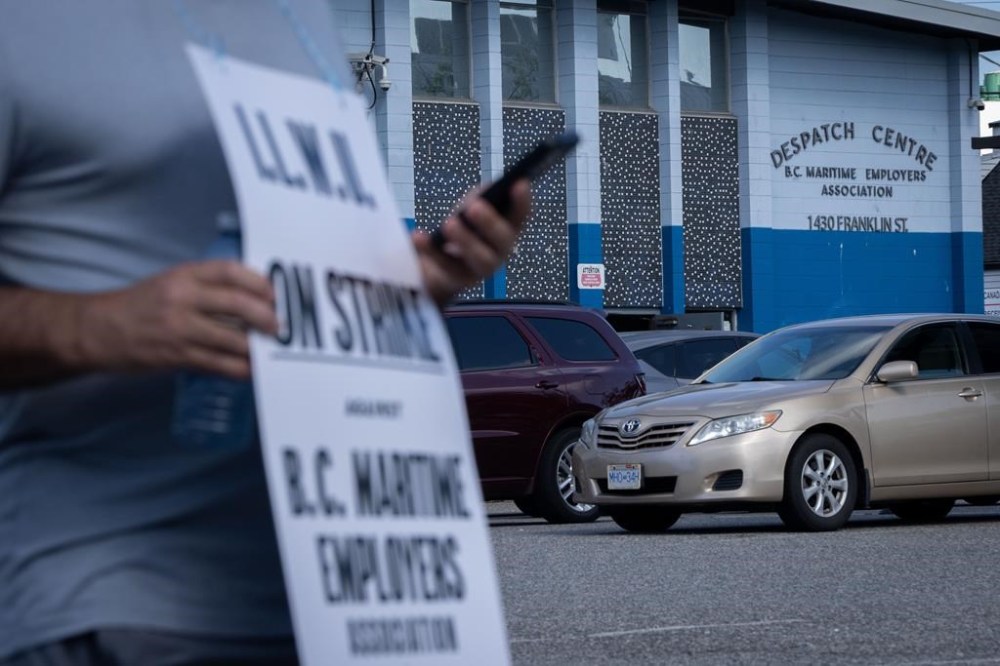
Thousands of union members walked off the job Saturday morning. Both sides negotiated over the weekend and were at the table earlier in the day on Monday.
The association said it has advanced “reasonable proposals and positions in good faith” but said the union refuses to budge.
“ILWU Canada went on strike over demands that were and continue to be outside any reasonable framework for settlement. Given the foregoing mentioned, the BCMEA is of the view that a continuation of bargaining at this time is not going to produce a collective agreement,” the statement read.
“ILWU Canada needs to decide if they are going to continue this strike with no hope of settlement, or significantly modify their position so a fair and balanced deal can be reached.”
A key stumbling block appears to be around maintenance work, with the association accusing the union of attempting to change definitions and “aggressively expand their scope.” Union president Rob Ashton said ILWU Canada is focused on stopping “the erosion of jurisdiction” and the extensive use of contractors.
“When we finally had a document that was largely agreed upon as the result of continuous movement by the union on this one position the association decided to change their position in an attempt to muddy the water and mischaracterize the work, we have spent months discussing,” Ashton said in a statement.
Ashton said it’s reasonable for workers, who he said helped achieve record profits during the pandemic, to have a fair and equitable share of them.
The strike led businesses organizations to issue warnings about wide-reaching implications across the country, with some pushing for the federal government to step in with back-to-work legislation.
The union, meanwhile, warned Ottawa not to interfere.
“We implore the BCMEA to get back to the table to achieve a fair and reasonable agreement that the parties negotiate together,” Ashton said in his statement.
“It is unrealistic to think that a collective agreement that is imposed will result in long term labour stability in the industry. The parties need to put their best effort forward for the entire country and not just their individual aims.”
Federal Labour Minister Seamus O’Regan has said the focus of negotiations “needs to be on the table.”
The association represents 49 private sector employers operating in B.C. ports, and its website says the industry contributes $2.7 billion to Canada’s GDP while handling roughly 16 per cent of the country’s total traded goods — amounting to $180 billion in 2020.
This report by The Canadian Press was first published July 3, 2023.