
Quebec eyes construction industry shakeup to boost housing, infrastructure projects
Advertisement
Read this article for free:
or
Already have an account? Log in here »
We need your support!
Local journalism needs your support!
As we navigate through unprecedented times, our journalists are working harder than ever to bring you the latest local updates to keep you safe and informed.
Now, more than ever, we need your support.
Starting at $15.99 plus taxes every four weeks you can access your Brandon Sun online and full access to all content as it appears on our website.
Subscribe Nowor call circulation directly at (204) 727-0527.
Your pledge helps to ensure we provide the news that matters most to your community!
To continue reading, please subscribe:
Add Brandon Sun access to your Free Press subscription for only an additional
$1 for the first 4 weeks*
- Enjoy unlimited reading on brandonsun.com
- Read the Brandon Sun E-Edition, our digital replica newspaper
*Your next Free Press subscription payment will increase by $1.00 and you will be charged $20.95 plus GST for four weeks. After four weeks, your payment will increase to $24.95 plus GST every four weeks.
Read unlimited articles for free today:
or
Already have an account? Log in here »
Hey there, time traveller!
This article was published 20/10/2023 (1073 days ago), so information in it may no longer be current.
MONTREAL – How many workers does it take to shift a wall in Quebec? Too many, says Isabelle Rinfret of construction and real estate management company Arvisais, based roughly 95 kilometres northeast of Montreal, in Louiseville, Que.
During a recent project, her company had to move a wall one metre. But to comply with the rules, she had to hire an interior systems installer to move the partition, a plasterer to smooth out the surface, and a third person to paint the wall.
All of the “minor” work, she said, “could have been done by a single experienced carpenter.”
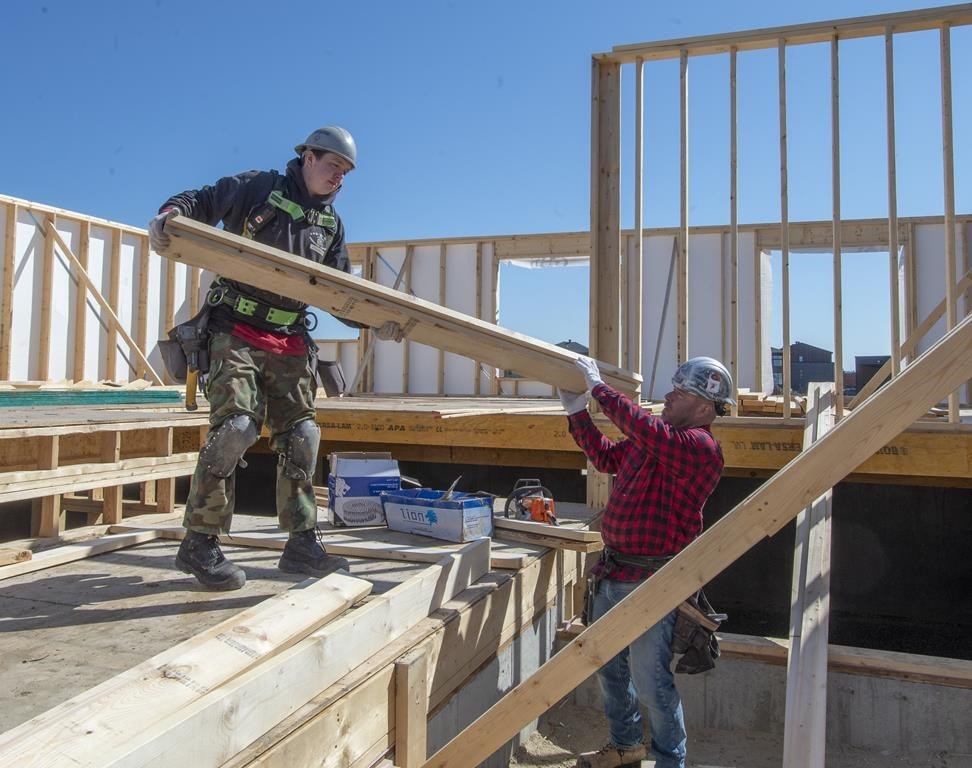
Provincial regulation certifies 25 construction trades in Quebec, and divisions between them are rigid — a tradesperson can’t do a stitch of work outside their distinct area of practice, leading to situations where several people may be required to complete seemingly simple work, like moving a wall, that involves multiple steps or skills.
But the province is toying with the idea of relaxing some of those barriers. Amid an affordable housing crunch and push to update public infrastructure, Quebec Labour Minister Jean Boulet says allowing workers to carry out select, related tasks across trades could help accelerate construction projects.
The proposal has set up a clash between economic development goals and labour interests in the province, where union influence runs deep and construction accounted for 6.6 per cent of economic output as of 2022, according to Statistics Canada.
“We have needs that are growing in Quebec: housing, hospitals, roads, infrastructure, industrial projects,” Boulet said in an interview. “We need to help our capacity to build to meet these needs, and that happens by meeting two challenges: first, a larger workforce and second, more productivity.”
Versatility between trades, the minister continued, “is one of the elements we’re working on to cut lead times, possibly reduce costs, and thus increase our capacity to build to meet the needs of Quebec society.”
Those needs are staggering. In March, Quebec earmarked $150 billion for public construction, renovation and maintenance projects through 2033, an increase of $7.5 billion from the 2022 10-year plan. The government intends to spend most of that money, $81 billion, to maintain existing infrastructure.
The Canadian Housing and Mortgage Corporation, meanwhile, estimates the province will need to build more than 1.1 million additional housing units by 2030 in order for housing to be as affordable to average income households as it was in 2004, the corporation said in a September report.
A persistent labour shortage is compounding construction challenges. Statistics Canada counted more than 12,200 vacant construction industry jobs in Quebec in the second quarter of 2023.
Rinfret agrees more versatility between trades for qualified workers would be a boon for the industry. “I totally agree that decompartmentalizing certain trades would enable us to gain in productivity,” she said in an email. “With additional training or experience, a single person who could, for example, do carpentry and plastering work could … be part of the solution to the labour shortage.”
Her stance echoes that of the Association provinciale des constructeurs d’habitations du Québec, a network of 20,000 residential construction industry employers. Association vice-president Isabelle Demers said more flexibility in the industry would not only simplify site management but also help with worker retention.
“This will enable us to mobilize workers,” Demers said in a phone interview. “You can imagine few workers want to do the same thing for 20, 30, 40 years. So if we want to … motivate people to stay in the industry, offering them greater versatility to develop is an advantage.”
However, Boulet’s proposal has drawn criticism from CSD Construction, a union that represents almost 25,000 Quebec construction workers. It argues greater versatility between trades would place an unfair burden on labourers while threatening work site safety and construction quality.
“Versatility should never be at the expense of expertise,” union president Carl Dufour said in a statement this month. “What the government wants to do by reforming (construction industry regulations) is to cut corners, because it can’t deliver the seniors’ homes, hospitals, schools and roads promised during the election.”
Pier-Luc Bilodeau, a Université Laval industrial relations professor who studies the construction industry, also questioned the government’s eagerness to streamline the trades, saying he has yet to see reliable studies that show the measure would increase productivity.
“I think that the government and a lot of people right now in this debate are acting on the basis of common sense: that if people can do more things, we would need to bring in fewer people,” Bilodeau said. But, he cautioned, “common sense doesn’t always do justice to the complexity of real-life situations.”
Flexibility between trades is one part of what Boulet called his push to modernize the construction industry, which he said also includes a focus on increasing access to the field for women, immigrants and Indigenous people. He said consultations with employers and unions are ongoing to identify opportunities to streamline construction projects without compromising safety or quality.
The minister plans to introduce his construction industry modernization bill by the end of November.
This report by The Canadian Press was first published Oct. 20, 2023.