
A vibrant art scene in Uganda mirrors African boom as more collectors show interest
Advertisement
Read this article for free:
or
Already have an account? Log in here »
We need your support!
Local journalism needs your support!
As we navigate through unprecedented times, our journalists are working harder than ever to bring you the latest local updates to keep you safe and informed.
Now, more than ever, we need your support.
Starting at $15.99 plus taxes every four weeks you can access your Brandon Sun online and full access to all content as it appears on our website.
Subscribe Nowor call circulation directly at (204) 727-0527.
Your pledge helps to ensure we provide the news that matters most to your community!
To continue reading, please subscribe:
Add Brandon Sun access to your Free Press subscription for only an additional
$1 for the first 4 weeks*
- Enjoy unlimited reading on brandonsun.com
- Read the Brandon Sun E-Edition, our digital replica newspaper
*Your next Free Press subscription payment will increase by $1.00 and you will be charged $20.95 plus GST for four weeks. After four weeks, your payment will increase to $24.95 plus GST every four weeks.
Read unlimited articles for free today:
or
Already have an account? Log in here »
Hey there, time traveller!
This article was published 16/12/2023 (1058 days ago), so information in it may no longer be current.
KAMPALA, Uganda (AP) — Lilian Nabulime hasn’t forgotten the time in the 1990s when the Ugandan capital had just one commercial art gallery, a small space that emerging artists struggled to get into.
Now, there are at least six in Kampala, including one whose curator recently exhibited the sculptor’s contrarian work.
Nabulime’s show, which has attracted audiences for its conspiratorial take on the peculiarities of urban “gossip,” might never have happened if she hadn’t approached Xenson Art Space and asked for the opportunity to exhibit her work. Her work includes terracotta works topped with the deformed facial features of gossip bearers.
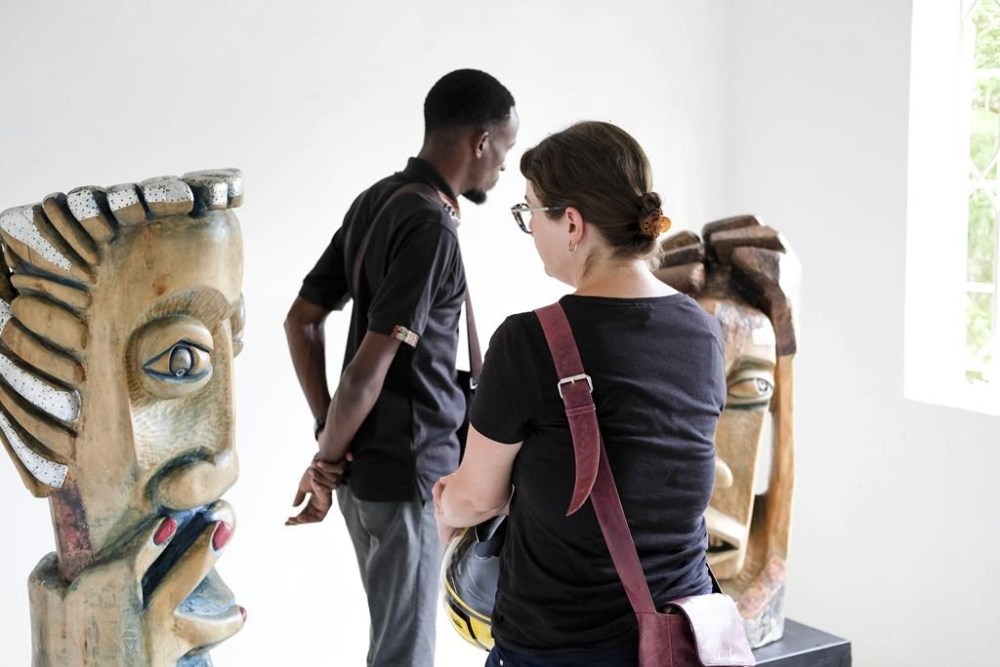
“Nobody ever comes to me and says, ’Oh, can we show your work?” she said, sitting amid her sculptures. “For me, I just decided and said, ‘Let me go and exhibit my work.’ I asked for the exhibition, and they gave me the space.”
Her solo show, which will last until Dec. 20, exemplifies an expanding artistic landscape that allows more room for local artists who once struggled for space. Nabulime, who teaches sculpture at a prestigious art school in Kampala, is among a growing list of artists whose body of work contributes to a feeling among curators of an exciting moment for Ugandan art.
Their sense of cheer mirrors a similar trend across Africa that’s fueled not just by an explosion of compelling new work but also by the growing ability of curators from the continent to reach new collectors at a time of rising global interest in modern African art.
There are fresh signs of this momentum. The Ivorian painter Aboudia was the world’s bestselling artist in 2022, selling two more artworks than the popular Damien Hirst, according to the Hiscox Artist Top 100 survey. And in November, an artwork by the Ethiopian-born artist Julie Mehretu fetched $10.7 million at auction, a new record for an African artist.
In addition to the annual Art Auction East Africa in Kenya — during which dead and living artists are valued if not rediscovered — the most ambitious curators from Africa are accredited to attend events such as the influential Art Basel.
“Let us have more curators so that they can show other people’s work,” Nabulime said, speaking of the growing number of gallerists in Kampala. “In Uganda, if we are to have more work on the international market, we have to have more curators who are well connected.”
Daudi Karungi, an artist and entrepreneur who founded Kampala’s Afriart Gallery in 2002, spoke to the AP of his struggle to nurture talented artists from hungry beginnings to a level of professionalism where their work is properly documented and accessible to global collectors.
One of Africa’s most prominent art spaces, Afriart Gallery runs a training program for artists, with the most successful among them now able to show their work abroad. Karungi usually invites some of his artists to join him at art fairs abroad, a key element in giving them international visibility, he said.
“We are now doing shows with artists in other places in the world,” he said. “We are publishing books about these artists because some of the things that we need to correct is that we need to write our own stories. We are doing that kind of work for now, and all so far is good.”
Those artists not represented by Afriart Gallery have choices, including an alternative space in a disused banking hall in the central district of Masaka, the scene now of a vibrant artistic community that was unimaginable five years ago. A painter born and raised there, Godwin Champs Namuyimba, has had some of his pieces sold for six figures at auction in Europe despite being largely unknown at home.
The regular art auction in Nairobi, the Kenyan capital, also has been critical in the reappraisal in recent years of Ugandan artists such as Geoffrey Mukasa, a painter who was underappreciated in his lifetime and died poor but now commands hefty prices.
Many of Mukasa’s works remained unsold by the time he died in 2009, but his work is now acknowledged as “timeless,” said Danda Jaroljmek, an influential curator whose Circle Art Gallery in Nairobi puts on the annual auction.
“We were able to source works and to be able to put them in the auction and introduce them to a new audience,” she said, adding that the auction creates a “secondary market” for collectors.
Jaroljmek described the Kampala art scene as more intellectually engaged in ways that the Nairobi scene isn’t. That’s partly because a prominent art school at Uganda’s Makerere University has proved a pivotal “central location” in educating artists, she said.
Yet Uganda’s collecting class remains minuscule, with new shows patronized by hip youngsters and expatriates. Gallerists still struggle to make sales, relying mostly on collectors outside Uganda who may spot desirable artworks through promotional materials before making offers.
These poor circumstances vex artists, despite optimism by curators and others who say more and more Ugandans are starting to appreciate art as an attractive investment option.
In 2022, a small group of Ugandans formed the Contemporary Art Society of Uganda, whose goal is to promote the emergence of private and corporate art collections in this East African country of 45 million people. Each of the group’s members is asked to collect at least one artwork by a Ugandan each year, creating opportunities for emerging artists.
Ugandan attorney Linda Mutesi, an art collector who helped launch the Contemporary Art Society of Uganda, said that collecting for her and others has become a principled effort aimed at retaining Africa’s most unique cultural resources.
“Over the years, the African middle class has been awakened to the things around them, the beauty around them and the issues that surround them and, as you can see, it’s always been the expatriates that sort of come to our countries and take all this art away,” she said.
“I feel that we are approaching collecting of art as an intervention. We are sort of safeguarding and saying, ‘Hey, let’s not have this continue. Let’s not have the bleeding of these works, all this intellectual property leaving the continent. Let’s keep it here.’”