
Alberta’s pledge to take over ownership of emissions data ‘irresponsible’: Guilbeault
Advertisement
Read this article for free:
or
Already have an account? Log in here »
We need your support!
Local journalism needs your support!
As we navigate through unprecedented times, our journalists are working harder than ever to bring you the latest local updates to keep you safe and informed.
Now, more than ever, we need your support.
Starting at $15.99 plus taxes every four weeks you can access your Brandon Sun online and full access to all content as it appears on our website.
Subscribe Nowor call circulation directly at (204) 727-0527.
Your pledge helps to ensure we provide the news that matters most to your community!
To continue reading, please subscribe:
Add Brandon Sun access to your Free Press subscription for only an additional
$1 for the first 4 weeks*
*Your next subscription payment will increase by $1.00 and you will be charged $20.00 plus GST for four weeks. After four weeks, your payment will increase to $24.00 plus GST every four weeks.
Read unlimited articles for free today:
or
Already have an account? Log in here »
Hey there, time traveller!
This article was published 27/11/2024 (520 days ago), so information in it may no longer be current.
EDMONTON – Federal Environment Minister Steven Guilbeault says Alberta’s plan to make greenhouse gas emissions data the property of the provincial government could lead to oil and gas companies breaking federal laws.
It’s one of many steps Alberta Premier Danielle Smith says her government would take to challenge the federal Liberal government’s proposed emissions cap if it comes into force.
Smith has said the cap is unconstitutional and harmful to Alberta, and on Tuesday she announced a series of steps her government would take under her untested Alberta Sovereignty within a United Canada Act to try and circumvent the cap, including a court challenge.
Smith said she’d also have the province take over the responsibility of emissions reporting to the federal government, something major emitters are now required to do. Emitters would be responsible for sharing that information with Ottawa under the proposed cap program as well.
A draft sovereignty act motion shared with media Tuesday said the province intends to declare “that all information or data related directly or indirectly to greenhouse gas emissions … are proprietary information and data that are owned exclusively by the government of Alberta.”
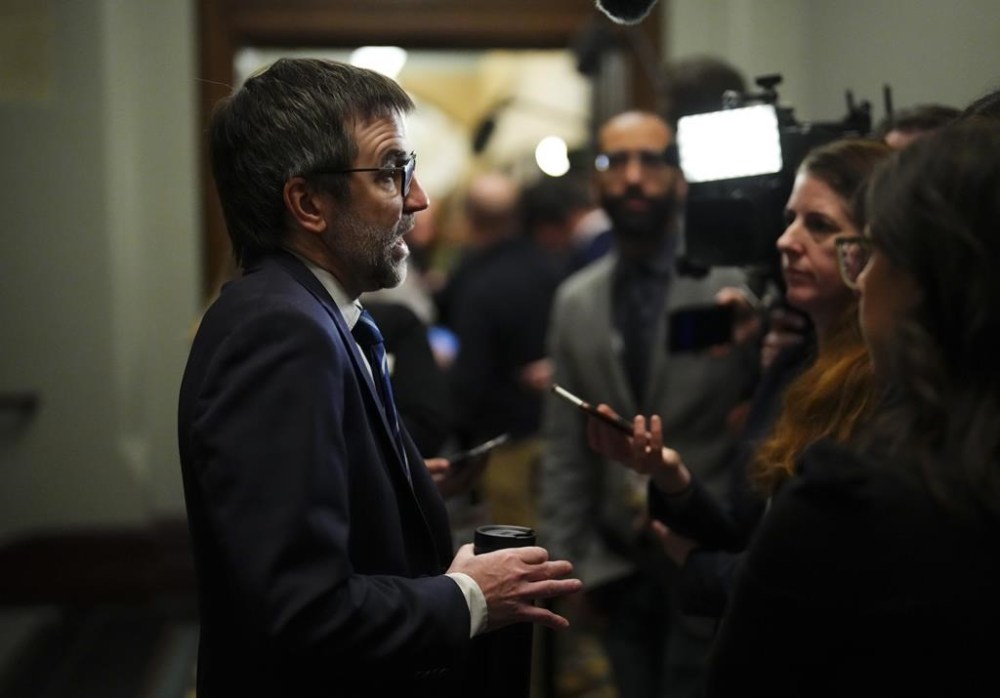
Guilbeault told reporters in Ottawa Wednesday that Smith is being “highly irresponsible.”
“It’s more irresponsible behaviour by the premier of Alberta,” he said.
“If companies stop reporting to the federal government, they would be in violation of federal laws — something I certainly wouldn’t advise to any large companies, especially oil and gas companies.”
The cap, which is still in draft form, would require individual oil and gas companies to cut emissions by 35 per cent from 2019 levels before 2030 to 2032.
A final version of the regulations is expected to be published next year.
Alberta Environment Minister Rebecca Schulz said Wednesday that her federal counterpart can’t be entrusted with emissions data, even though Smith said that data would still be shared with Ottawa.
“I think that they would use it to turn around and impose more punitive policies to shut down an industry that they are just absolutely fundamentally against,” said Schulz.
On Tuesday Smith said the data the government would disclose would represent the entire industry’s emissions and not those of individual companies.
She also mused about other ways emissions could be calculated, saying she’d like to see Alberta get credit for emissions reductions if energy produced in the province is used to reduce emissions in other parts of the world.
“If we are able to have a collective number for what our industry produces, and we have ways of offsetting that to get to neutrality, then we’re going to be able to meet the objective,” Smith said.
In a statement, a spokesperson for Guilbeault said emissions are calculated using an internationally agreed-upon framework, and Smith is politicizing the issue.
“Attempting to politicize this data is doing no favours for workers and communities reliant on the oil and gas sector,” the statement reads.
“Premier Smith is selling workers and communities short by taking such a short-sighted, politically motivated approach.”
University of Waterloo professor Emmett MacFarlane said in an interview that any attempt by Smith’s government to manipulate emissions data wouldn’t stand up in court if the cap becomes law.
“The more I think about it, the more it’s clear that this is just political theatrics and foot stomping,” said MacFarlane, whose research focus is constitutional law and the Supreme Court of Canada.
“If the federal law is valid, a valid exercise of federal authority, there’s nothing the province can actually do to negate or block a requirement of something like information disclosure that is part of an environmental regulation scheme.”
If the cap was deemed unconstitutional in the courts, then Alberta would have a legal leg to stand on, MacFarlane said, but it would also mean that any additional action taken by the Alberta government to circumvent the cap wouldn’t be necessary.
He said that if the cap was deemed constitutional and Alberta made legislative changes to the way this data is regulated within the province, the federal legislation would win out.
“I think the only way to figure this out is to actually have a legal determination in a court,” he said, adding that Smith’s pledge to challenge the cap in court is the only step he sees as a concrete attempt to push back against the federal legislation.
“(Other) aspects of this proposed motion under the sovereignty act I think really can only be described as nonsense.”
This report by The Canadian Press was first published Nov. 27, 2024.