
Saskatchewan to stop buying U.S. alcohol during trade war: Premier Moe
Advertisement
Read this article for free:
or
Already have an account? Log in here »
We need your support!
Local journalism needs your support!
As we navigate through unprecedented times, our journalists are working harder than ever to bring you the latest local updates to keep you safe and informed.
Now, more than ever, we need your support.
Starting at $15.99 plus taxes every four weeks you can access your Brandon Sun online and full access to all content as it appears on our website.
Subscribe Nowor call circulation directly at (204) 727-0527.
Your pledge helps to ensure we provide the news that matters most to your community!
To continue reading, please subscribe:
Add Brandon Sun access to your Free Press subscription for only an additional
$1 for the first 4 weeks*
*Your next subscription payment will increase by $1.00 and you will be charged $20.00 plus GST for four weeks. After four weeks, your payment will increase to $24.00 plus GST every four weeks.
Read unlimited articles for free today:
or
Already have an account? Log in here »
Hey there, time traveller!
This article was published 05/03/2025 (386 days ago), so information in it may no longer be current.
REGINA – Saskatchewan Premier Scott Moe said Wednesday the province will stop purchasing American booze and work to stop buying other U.S. goods.
His comments come one day after U.S. President Donald Trump imposed 25 per cent tariffs on Canadian goods, along with a 10 per cent levy on Canadian energy.
Speaking to reporters in Regina, Moe said liquor retailers won’t be able to buy U.S. alcohol but can sell their remaining inventory.
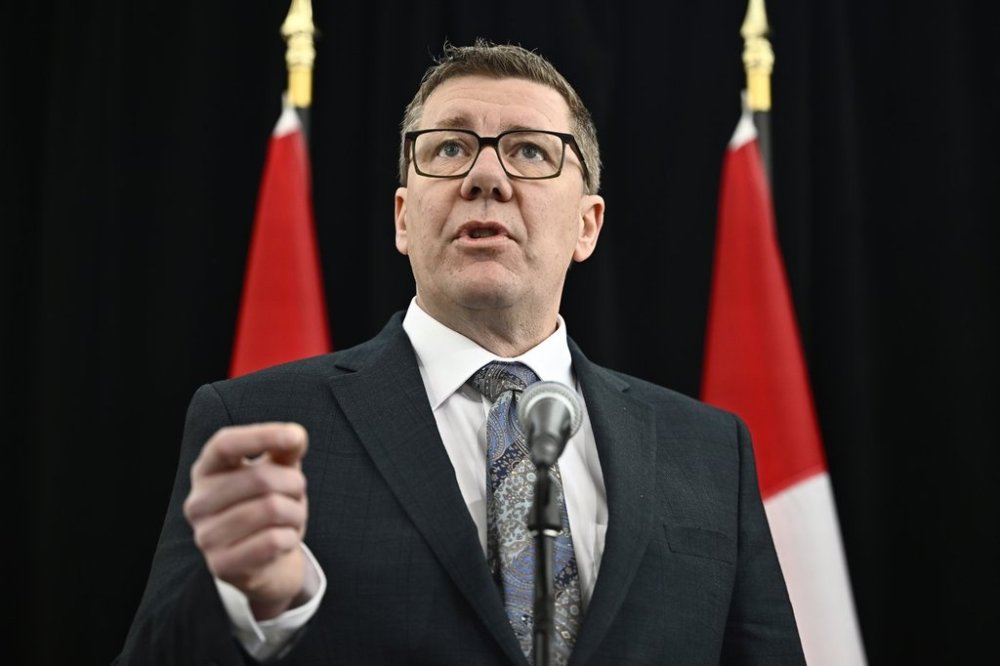
Saskatchewan Premier Scott Moe speaks as he arrives for a first ministers meeting in Ottawa on Wednesday, Jan. 15, 2025. THE CANADIAN PRESS/Justin Tang
Government procurement will also focus on prioritizing Canadian suppliers, he said. Some $43 million in video lottery terminals and slot machines that were to be upgraded are now to be sourced from other suppliers.
“The goal here is for us to greatly lower, or even get to zero, with respect to the U.S. procurement in the publicly funded capital projects that we have,” he said.
Moe said the U.S. is Saskatchewan’s biggest trading partner and would hopefully continue to be once the dust of the trade war settles.
But the relationship is changing quickly, he said.
“What’s happening today is just simply not right,” Moe said. “Decisions are being based on incorrect or flawed information that simply is bringing our North American economy to a place where nobody wants it to go.”
Moe has said Trump’s tariffs are unnecessary and would lead to steep “self-inflicted” price increases for goods and job losses on both sides of the border.
“The measures are going to be painful for a number of American families,” he said.
Earlier Wednesday, the Opposition NDP demanded to know why Moe’s Saskatchewan Party government didn’t have a response earlier, as it knew for weeks that tariffs were coming down the pipe.
Asked why it took a day to respond, Moe said the province was dealing with lots of moving pieces.
“This is the conversation that we’re going to be having for the next number of months, and I think it’s important to recognize that,” he said.
“This is going to be the new normal for the foreseeable future.”
NDP Leader Carla Beck has called for Saskatchewan to follow the lead of other provinces by pulling American liquor from store shelves and to support workers and businesses in sectors likely to feel the brunt of the tariffs fight.
She told reporters she doesn’t understand why it took Moe so long to respond.
“Scott Moe is a day late and a dollar short,” she said.
“The fact that he is the very last premier in this country to have come out and spoken to the people of his province has not gone unnoticed.
“This is weak leadership.”
On Tuesday, Ontario Premier Doug Ford called on Moe to stop selling potash, uranium and oil to the U.S. and find different markets.
Moe said American farmers rely on Saskatchewan potash and the tariffs would only make it more expensive, which in turn would drive up the cost of groceries.
Stopping the sale of potash would also kill jobs in Saskatchewan, he added.
“I’m not going to put Saskatchewan people out of work at potash mines,” he said.
Moe said the province will work to expand trade opportunities with other countries and within Canada.
This report by The Canadian Press was first published March 5, 2025.