
‘Still fresh in minds’: Vietnamese community marks 50 years since fall of Saigon
Advertisement
Read this article for free:
or
Already have an account? Log in here »
We need your support!
Local journalism needs your support!
As we navigate through unprecedented times, our journalists are working harder than ever to bring you the latest local updates to keep you safe and informed.
Now, more than ever, we need your support.
Starting at $15.99 plus taxes every four weeks you can access your Brandon Sun online and full access to all content as it appears on our website.
Subscribe Nowor call circulation directly at (204) 727-0527.
Your pledge helps to ensure we provide the news that matters most to your community!
To continue reading, please subscribe:
Add Brandon Sun access to your Free Press subscription for only an additional
$1 for the first 4 weeks*
*Your next subscription payment will increase by $1.00 and you will be charged $20.00 plus GST for four weeks. After four weeks, your payment will increase to $24.00 plus GST every four weeks.
Read unlimited articles for free today:
or
Already have an account? Log in here »
Hey there, time traveller!
This article was published 30/04/2025 (330 days ago), so information in it may no longer be current.
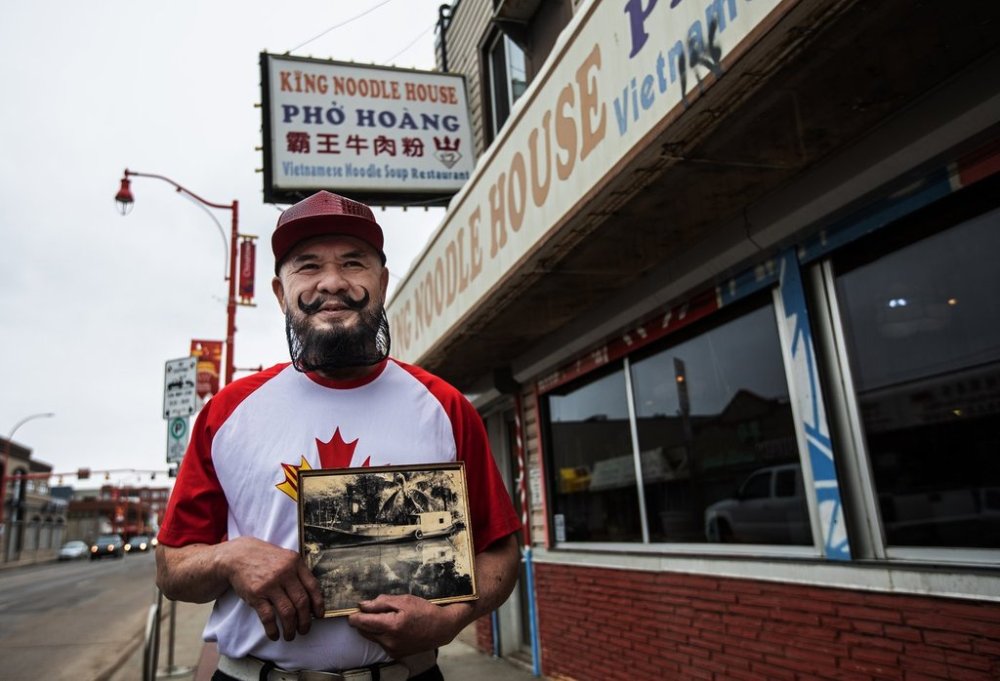
EDMONTON – Seventy-year-old Tan Hoang vowed he would never return to Vietnam after fleeing the country with his family on a makeshift wooden boat.
Officers in Vietnam remind him of the communist soldiers who once stormed and captured Saigon, the former South Vietnam capital now called Ho Chi Minh City.
The fall of Saigon 50 years ago — on April 30, 1975 — marked the end of the two-decade-long Vietnam War.
North Vietnamese and Viet Cong guerrilla troops captured the city to unify the country under a single communist regime, modelled after those of the Soviet Union and China. The Communist Party of Vietnam still rules the country.
“I miss my country too much, (but) I’m scared,” Hoang said at his pho restaurant in Edmonton’s Chinatown.
“I don’t want to see something like that.”
Hoang’s family is part of the large exodus of people from Vietnam after the fall of Saigon, referred to as the “boat people.”
Canada welcomed about 200,000 refugees fleeing Vietnam, as well as Cambodia and Laos, between 1975 and the 1990s.
Hoang said he plans to gather Wednesday with Vietnamese Canadians at a community centre for a sombre event marking the anniversary.
Hoang, who some affectionately call “Mustache Man” because of the curled hair above his lips, says they will be sharing their stories from 50 years ago.
He was 20 when the chaos erupted.
“I was scared, of course,” recalled Hoang.
But he couldn’t hold back his curiosity. He rode around Saigon on his Honda motorcycle from the morning until the afternoon.
He saw soldiers shooting at people, arresting others, he said.
At Saigon’s harbour, he saw hundreds fleeing on a large ship. Many fell to their deaths in the sea as they tried to climb on the moving vessel.
He saw a group blow themselves up with a grenade.
Looters were everywhere.
In the days that followed, he said life under the communist regime became more difficult. The government rationed food and extreme starvation was common.
Hoang fled Saigon a decade later with his wife and newborn son. He secretly built a boat on a river with his brother and other relatives. They bribed communist soldiers to look the other way.
The family’s four-night journey on the water was rough. They crossed paths with a tornado but eventually made it to Indonesia.
They lived in a refugee camp there for a year before immigrating to Edmonton.
In 1995, Hoang opened his restaurant, King Noodle House, where a photo of that handmade boat hangs on the wall.
Nhung Tran-Davies, a doctor in Calmar, Alta., fled Vietnam to Malaysia in 1978 with her mother and five older siblings on a boat. She thinks her father died in the war.
Eight months later, an Edmonton church sponsored the family.
After the fall of Saigon, she said starvation in Vietnam became unbearable.
“My mother was dragged by soldiers,” she said.
“People (were) being robbed and killed for a bag of rice. My older brothers and sisters often had to forgo eating so that the little ones could eat.”
Her mother found others who were planning to escape on a boat and took the family with them.
Tran-Davies was four and said she doesn’t remember much about the journey, other than feeling nauseous and smelling vomit everywhere on the boat.
“For some people, it’s still fresh in their minds,” said Linh Vu, also a “boat person,” who runs a Vietnamese street food restaurant in Edmonton with her mother.
“It changed a lot of lives.”
Vu was a toddler when her mother carried her on her shoulders to Saigon from a northern town a few days before the city was captured. Vu’s mother wanted to be closer to her parents in Saigon, as communist soldiers had warned they were coming.
The 300-kilometre hike, she said, would be the same as walking from Edmonton to Calgary.
When they arrived at her grandparents’ house, they were so dirty her grandfather didn’t recognize them, Vu said.
It took four years, but her grandfather built a wooden boat for the family to flee.
While at sea, a British cargo ship found them and took them to a refugee camp in Singapore.
They arrived in Edmonton about three months later and, years after that, opened Mai Mai Viet Street Kitchen.
Vu said her grandfather died in 2019, having never returned to Vietnam because he, too, believed he had lost his homeland to communists.
Vu and Nhung Tran-Davies said they will be marking the anniversary by talking to their relatives about the day.
“I’d like to remind my kids where they come from, and what grandma had gone through to bring her children to find freedom,” said Nhung Tran-Davies.
This report by The Canadian Press was first published April 30, 2025.
Note to readers:This is a corrected story. A previous version misquoted Nhung Tran-Davies as saying her mother was sexually assaulted.