
Rising seas could put Easter Island’s moai at risk by 2080, study warns
Advertisement
Read this article for free:
or
Already have an account? Log in here »
We need your support!
Local journalism needs your support!
As we navigate through unprecedented times, our journalists are working harder than ever to bring you the latest local updates to keep you safe and informed.
Now, more than ever, we need your support.
Starting at $15.99 plus taxes every four weeks you can access your Brandon Sun online and full access to all content as it appears on our website.
Subscribe Nowor call circulation directly at (204) 727-0527.
Your pledge helps to ensure we provide the news that matters most to your community!
To continue reading, please subscribe:
Add Brandon Sun access to your Free Press subscription for only an additional
$1 for the first 4 weeks*
*Your next subscription payment will increase by $1.00 and you will be charged $20.00 plus GST for four weeks. After four weeks, your payment will increase to $24.00 plus GST every four weeks.
Read unlimited articles for free today:
or
Already have an account? Log in here »
Hey there, time traveller!
This article was published 13/08/2025 (226 days ago), so information in it may no longer be current.
By the end of the century, rising sea levels could push powerful seasonal waves into Easter Island’s 15 iconic moai statues, according to a new study published in the Journal of Cultural Heritage. About 50 other cultural sites in the area are also at risk from flooding.
“Sea level rise is real,” said Noah Paoa, lead author of the study and a doctoral student at the University of Hawaii at Manoa’s School of Ocean and Earth Science and Technology. “It’s not a distant threat.”
Paoa, who is from Easter Island — known to its Indigenous people as Rapa Nui — and his colleagues built a high-resolution “digital twin” of the island’s eastern coastline and ran computer models to simulate future wave impacts under various sea level rise scenarios. They then overlaid the results with maps of cultural sites to pinpoint which places could be inundated in the coming decades.
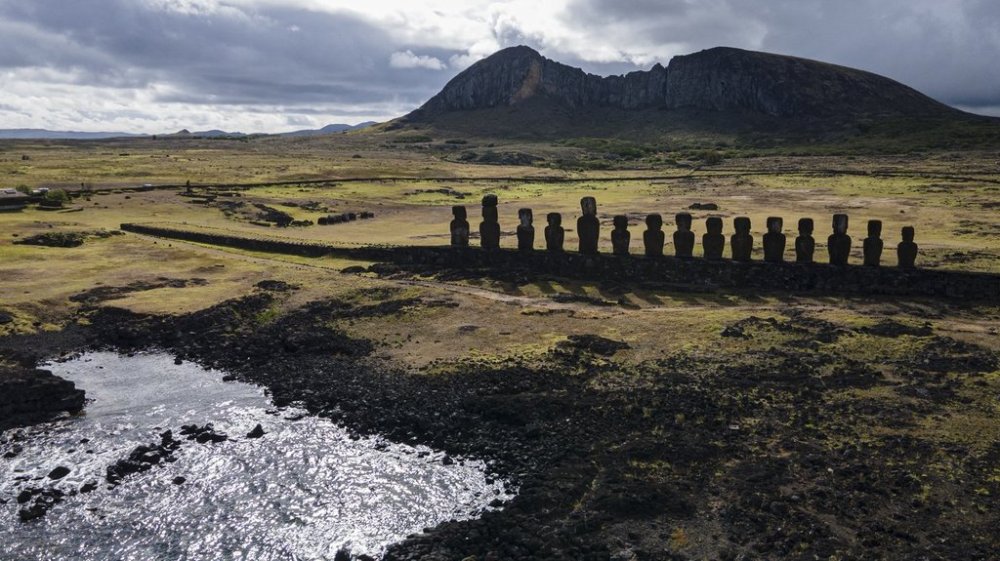
The findings show waves could reach Ahu Tongariki, the largest ceremonial platform on the island, as early as 2080. The site, home to the 15 towering moai, draws tens of thousands of visitors each year and is a cornerstone of the island’s tourism economy.
Beyond its economic value, the ahu is deeply woven into Rapa Nui’s cultural identity. It lies within Rapa Nui National Park, which encompasses much of the island and is recognized as a UNESCO World Heritage site.
The roughly 900 moai statues across the island were built by the Rapa Nui people between the 10th and 16th centuries to honor important ancestors and chiefs.
The threat isn’t unprecedented. In 1960, the largest earthquake ever recorded — a magnitude 9.5 off the coast of Chile — sent a tsunami surging across the Pacific. It struck Rapa Nui and swept the already-toppled moai further inland, which damaged some of their features. The monument was restored in the 1990s.
While the study focuses on Rapa Nui, its conclusions echo a wider reality: cultural heritage sites worldwide are increasingly endangered by rising seas. A UNESCO report published last month found that about 50 World Heritage sites are highly exposed to coastal flooding.
In an email to The Associated Press, a UNESCO spokesperson said climate change is the biggest threat to UNESCO’s World Heritage marine sites. “In the Mediterranean and Africa, nearly three-quarters of coastal low-lying sites are now exposed to erosion and flooding due to accelerated sea level rise.”
Possible defenses for Ahu Tongariki range from armoring the coastline and building breakwaters to relocating the monuments.
Paoa hopes that the findings will bring these conversations about now, rather than after irreversible damage.
“It’s best to look ahead and be proactive instead of reactive to the potential threats,” he said.
___
Follow Annika Hammerschlag on Instagram: @ahammergram
___
The Associated Press receives support from the Walton Family Foundation for coverage of water and environmental policy. The AP is solely responsible for all content. For all of AP’s environmental coverage, visit https://apnews.com/hub/climate-and-environment