
National Bank CEO, chief economist urge Ottawa to go further to attract investment
Advertisement
Read this article for free:
or
Already have an account? Log in here »
We need your support!
Local journalism needs your support!
As we navigate through unprecedented times, our journalists are working harder than ever to bring you the latest local updates to keep you safe and informed.
Now, more than ever, we need your support.
Starting at $15.99 plus taxes every four weeks you can access your Brandon Sun online and full access to all content as it appears on our website.
Subscribe Nowor call circulation directly at (204) 727-0527.
Your pledge helps to ensure we provide the news that matters most to your community!
To continue reading, please subscribe:
Add Brandon Sun access to your Free Press subscription for only an additional
$1 for the first 4 weeks*
*Your next subscription payment will increase by $1.00 and you will be charged $20.00 plus GST for four weeks. After four weeks, your payment will increase to $24.00 plus GST every four weeks.
Read unlimited articles for free today:
or
Already have an account? Log in here »
CALGARY – The federal government has struck the right tone on navigating recent trade and geopolitical upheaval, but Ottawa must go further and move faster if it is to meet the moment, said the chief executive of National Bank of Canada.
Laurent Ferreira told a Calgary business audience Wednesday that “complacency and delays caused by bureaucratic uncertainty” put Canada at risk. The remark was met with applause.
“The economic and geopolitical threats our country is facing are very serious and blind opposition to nation-building, reindustrialization and defence spending will put our country in a precarious state.”
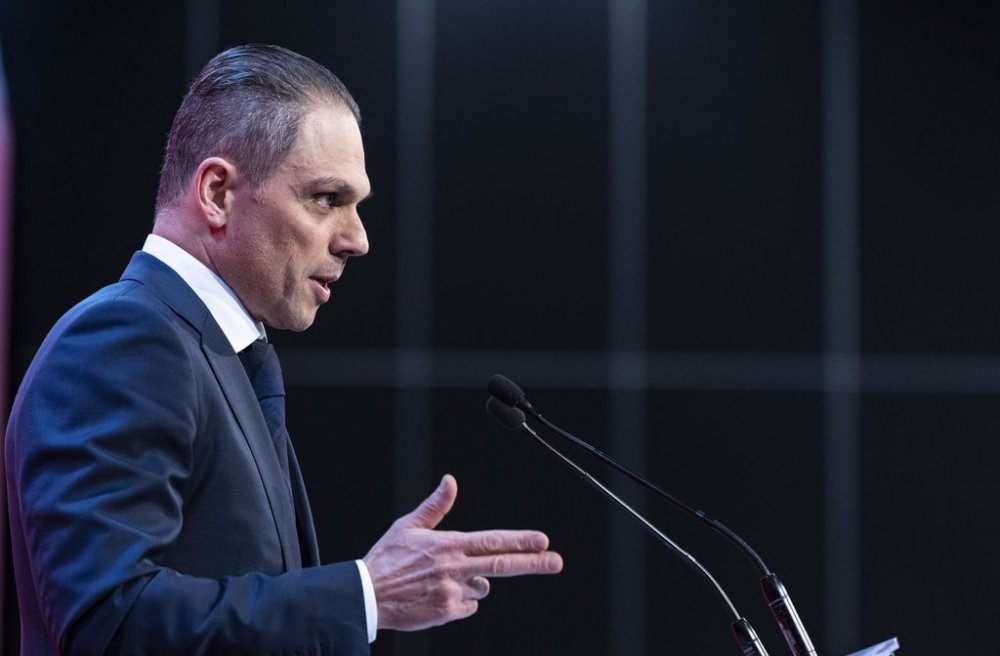
Ferreira added that “becoming an energy superpower is a necessary condition to protect our economic sovereignty.”
Following the CEO’s remarks, National Bank chief economist Stefane Marion delivered a presentation entitled “Why Alberta is Key to Making Canada Investible Again.”
He said despite being subject to the lowest effective tariff rates from the U.S. globally, Canada’s economy is “barely growing,” with lacklustre productivity and foreign direct investment.
Marion said federal legislation aimed at speeding along infrastructure projects in the national interest is not enough, and that Ottawa must do more to shed other regulations that are scaring away investment. He said Alberta should serve as an example of how to reduce the regulatory burden.
Marion, who is based in Calgary, is also advocating for Ontario and Quebec commit to using Alberta natural gas to fuel their manufacturing sectors, and that doing so could help foster national unity around a shared goal.
He told reporters that a potential new bitumen pipeline to the West Coast — the centrepiece of a sweeping energy accord Alberta and Ottawa signed late last year — would take some time to build.
“In the meantime, the best way to follow through on the (memorandum of understanding), in my opinion, is to deploy Alberta energy elsewhere in the country, particularly to Quebec and Ontario, to help them rebuild their manufacturing sector, which, at the end of the day, in my view, is critical for trade diversification.”
Canadian energy could also play a role in helping the U.S. revamp its own industrial sector. He said that country simply does not have enough of its own energy to achieve its ambitions of bringing manufacturing back onshore and building out massive artificial intelligence data centres.
“We’re part of the solution,” Marion said.
It’s become a harsh reality that it’s becoming tougher to trust trading partners in a world increasingly competing for resources and chasing economic independence, he said.
“I do believe that it is in the U.S. interest to have some agreement with Canada with respect to the integration of the supply chain.”
This report by The Canadian Press was first published Jan. 28, 2026.
Companies in this story: (TSX: NA)