
Dairy group to seek designated status for ‘Quebec poutine cheese’
Advertisement
Read this article for free:
or
Already have an account? Log in here »
We need your support!
Local journalism needs your support!
As we navigate through unprecedented times, our journalists are working harder than ever to bring you the latest local updates to keep you safe and informed.
Now, more than ever, we need your support.
Starting at $15.99 plus taxes every four weeks you can access your Brandon Sun online and full access to all content as it appears on our website.
Subscribe Nowor call circulation directly at (204) 727-0527.
Your pledge helps to ensure we provide the news that matters most to your community!
To continue reading, please subscribe:
Add Brandon Sun access to your Free Press subscription for only an additional
$1 for the first 4 weeks*
*Your next subscription payment will increase by $1.00 and you will be charged $20.00 plus GST for four weeks. After four weeks, your payment will increase to $24.00 plus GST every four weeks.
Read unlimited articles for free today:
or
Already have an account? Log in here »
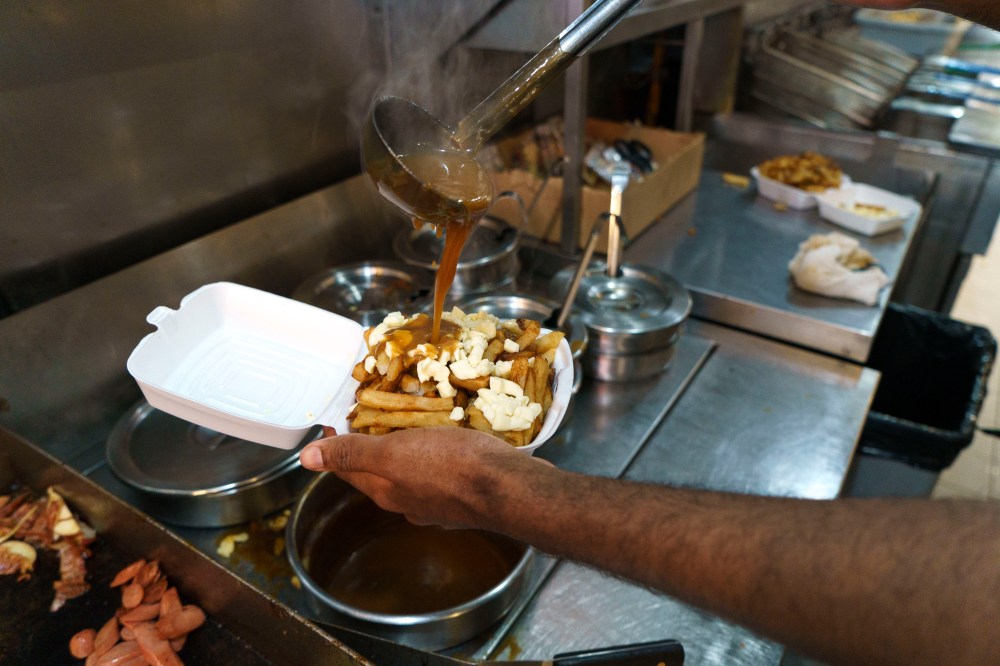
MONTREAL – A group representing Quebec’s dairy industry says it’s eyeing a special designation — similar to the one applied to Bordeaux wine or champagne — for the squeaky cheese curds best known as a key ingredient in poutine.
The Conseil des Industriels laitiers du Québec is seeking a protected geographical indication — a status similar to a trademark that links products to a specific region — for “Quebec poutine cheese.”
A protected indication “is a public intellectual property right that is defended by the state,” explains Marjolaine Mondon, a project coordinator at the Conseil des appellations réservées et des termes valorisants — CARTV — a group that oversees product designations in the province.
Currently, products that have the designation include Quebec icewine, Neuville sweet corn and Charlevoix lamb.
In order to get the protected status, a product has to be linked to the territory where it’s produced and “possess a particular quality, a reputation or another characteristic that is attributable to its geographical origin,” Mondon said.
For Charles Langlois, the head of the Conseil des Industriels laitiers du Québec, the goal is to protect Quebec’s food heritage and see how many producers are interested in having their curds certified.
“It’s also our … ‘national’ dish, which is part of our heritage, and we want to be able to tell outside consumers that if you want the original, you need Quebec cheese curds with the reserved designation seal,” he said.
Other products around the world have similar designations, famously France’s sparkling wine known as champagne, which obtained the status in 1936. According to the French government, products labelled “champagne” must come from a specific geographic area in northeast France extending over five departments from “vineyards planted at elevations between 90 and 300 metres and composed mainly of chalky soils.”
Langlois said the designation will also help promote Quebec cheese curds internationally, at a time when poutine is becoming increasingly popular outside the province’s borders.
“There’s an interest in the American market in certain high-value restaurants for more niche products, specialty products,” he said. “And also in Europe, especially in France and Germany.”
There are still several steps to go before a protected geographical indication can be granted. The dairy group has to formally present their request to the CARTV. Quebec law, which governs the certification process, stipulates that the CARTV must hold public consultations on the request for designation.
After the status is obtained, the CARTV has “powers of inspection and monitoring once the products are on the market. There are monitoring plans for public markets, websites, online marketplaces, businesses, kiosks, and of course all retail outlets, to ensure that the designation is being used correctly.”
Langlois, meanwhile, said the initiative is well underway, and both he and Mondon believe they could have a decision by 2027.
Mondon notes that the designation isn’t easy to get, and the process will have to determine the precise qualities the product will need to meet to be certified, including how it melts, its heat resistance, and maybe even how squeaky it is.
An independent body will also have to review each producer’s certification on an annual basis to ensure they meet the standard.
This report by The Canadian Press was first published March 5, 2026.