
Undoing renewables obstacles should be part of energy MOU talks: Pembina
Advertisement
Read this article for free:
or
Already have an account? Log in here »
We need your support!
Local journalism needs your support!
As we navigate through unprecedented times, our journalists are working harder than ever to bring you the latest local updates to keep you safe and informed.
Now, more than ever, we need your support.
Starting at $15.99 plus taxes every four weeks you can access your Brandon Sun online and full access to all content as it appears on our website.
Subscribe Nowor call circulation directly at (204) 727-0527.
Your pledge helps to ensure we provide the news that matters most to your community!
To continue reading, please subscribe:
Add Brandon Sun access to your Free Press subscription for only an additional
$1 for the first 4 weeks*
*Your next subscription payment will increase by $1.00 and you will be charged $20.00 plus GST for four weeks. After four weeks, your payment will increase to $24.00 plus GST every four weeks.
Read unlimited articles for free today:
or
Already have an account? Log in here »
CALGARY – Removing obstacles to renewable energy development must factor into talks the Alberta and federal governments are having around electricity emissions policy, clean energy think tank Pembina Institute said in a new report.
The two governments signed a sweeping energy accord late last year that includes the suspension of federal clean electricity regulations, pending an agreement on equivalent provincial rules by April 1.
Alberta’s plan to have a net-zero grid by 2050 seems to rely too heavily on technologies that take a lot of money, time and risk tolerance to build, such as carbon capture and storage and small modular nuclear reactors, said senior analyst Will Noel.
“I think there’s a real large risk that we’re going to get to mid-2030s and be in the same place we are now or potentially even worse off,” he said.
Focusing on 2050 as the end-goal and not on the emissions reductions that can be achieved in the interim would be a mistake, he added. He likened it to a boat taking on water and, instead of trying to bail it out now, hoping that a light on the horizon might be a rescue vessel.
“Focusing on these quick wins, these no-regret solutions … that’s really what we need to do to have this all be successful.”
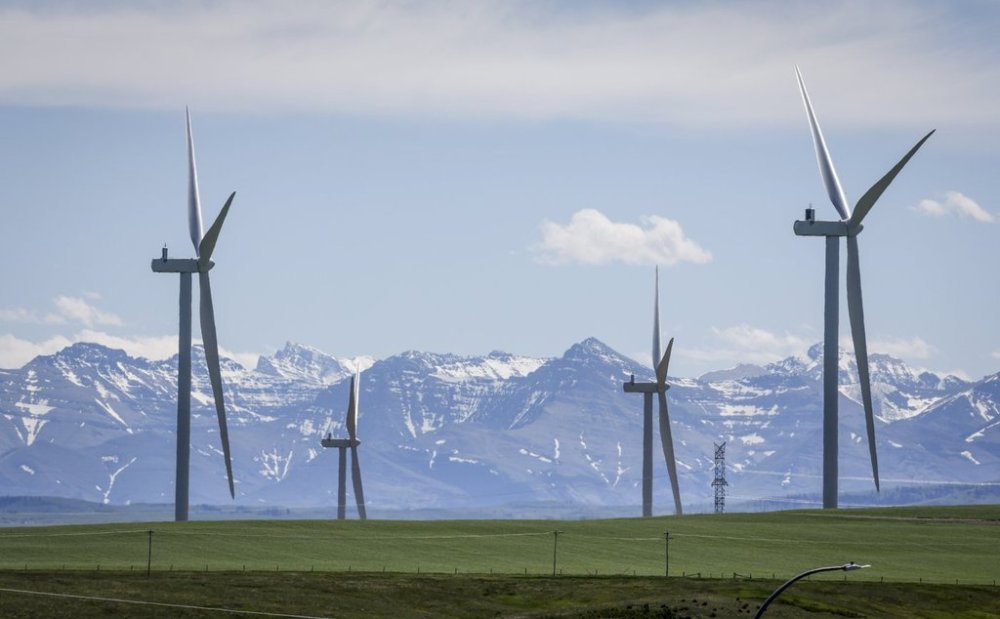
Noel argues that solar and wind power would deliver quicker, cheaper and more certain results, but Alberta has been spooking away investment in those technologies with an “onslaught” of policy changes targeting the renewables sector.
A seven-month moratorium on new renewable project approvals ended in early 2024, after which the province introduced a bevy of rules affecting the sector. Those include an “agriculture first” approach to land use, upfront payments for reclamation costs and a 35-kilometre buffer zone around wind projects so as not to impede “pristine viewscapes.”
At the time, Premier Danielle Smith said Alberta would continue to lead the country in renewable energy investment, but that the goal was to grow it in “well-defined and responsible ways” that guarantee grid reliability and affordability.
There was a 93 per cent drop in new installed wind, solar and storage capacity in 2025 compared to 2022, the peak year for such developments in Alberta, said the Pembina report, citing data from the Alberta Electric System Operator and Alberta Utilities Commission.
In 2025, less than one-fifth of new wind, solar and battery capacity installed in Canada was in Alberta. In the early 2020s, the trend was the exact reverse — four-fifths of Canadian renewables capacity was installed in Alberta, the report said.
“It seems like developers are getting fed up with the state of the renewables market in Alberta and they’re looking to move elsewhere,” Noel said.
“I’m hoping that they’re staying in Canada.”
A report last month from investor group SHARE and Dunsky Energy & Climate Advisors argued the federal and provincial governments must act urgently to build out the country’s green power infrastructure, or risk losing Canada’s global competitive edge.
“Power at Risk: The Investment Case for a Clean, Competitive Canada” says electricity constraints, slow infrastructure buildout and policy uncertainty are jeopardizing up to $220 billion in potential investment across the country.
Three-quarters of that figure relate to industrial projects that depend on green power.
“The window of opportunity to capitalize on the clean electricity advantage is closing. Other jurisdictions in North America, Europe and Asia are moving quickly to decarbonize electricity grids and attract fast-growing sectors reliant on clean power,” the groups said in the report.
“While Canada has successfully attracted the initial wave of investment, the physical and regulatory infrastructure to realize this growth is proving inadequate. Without an aggressive, co-ordinated national effort to rapidly scale and future-proof the grid, the capital that Canada has won risks being stalled, delayed or ultimately relocated, transforming a competitive advantage into a missed economic opportunity.”
The federal government is expected to soon release a new electricity and nuclear strategy.
Last week, 10 provinces and territories announced an agreement to expand electricity transmission between jurisdictions, and called for federal support to make it happen.
“A better-connected national grid will allow for a greater share of low-cost renewables by enabling the flow of electricity across regions to balance supply and demand, while long-distance transmission of clean power can help to minimize the need for provinces to rely on more expensive fossil generation, creating savings for ratepayers,” Ollie Sheldrick-Moyle, program manager at Clean Energy Canada, said in a news release.
This report by The Canadian Press was first published March 10, 2026.