
Trump administration expands trade probes to more countries, including Canada
Advertisement
Read this article for free:
or
Already have an account? Log in here »
We need your support!
Local journalism needs your support!
As we navigate through unprecedented times, our journalists are working harder than ever to bring you the latest local updates to keep you safe and informed.
Now, more than ever, we need your support.
Starting at $15.99 plus taxes every four weeks you can access your Brandon Sun online and full access to all content as it appears on our website.
Subscribe Nowor call circulation directly at (204) 727-0527.
Your pledge helps to ensure we provide the news that matters most to your community!
To continue reading, please subscribe:
Add Brandon Sun access to your Free Press subscription for only an additional
$1 for the first 4 weeks*
*Your next subscription payment will increase by $1.00 and you will be charged $20.00 plus GST for four weeks. After four weeks, your payment will increase to $24.00 plus GST every four weeks.
Read unlimited articles for free today:
or
Already have an account? Log in here »
WASHINGTON – The Trump administration has expanded its trade investigations to 60 countries, including Canada, in an effort to shore up the U.S. president’s tariff policies.
“We are trying to move very quickly,” United States Trade Representative Jamieson Greer told CNBC Friday. “We are trying to move in a matter of months.”
Greer’s office announced Wednesday that it was launching investigations of excess industrial capacity in the European Union and a handful of other countries under Section 301 of the Trade Act of 1974.
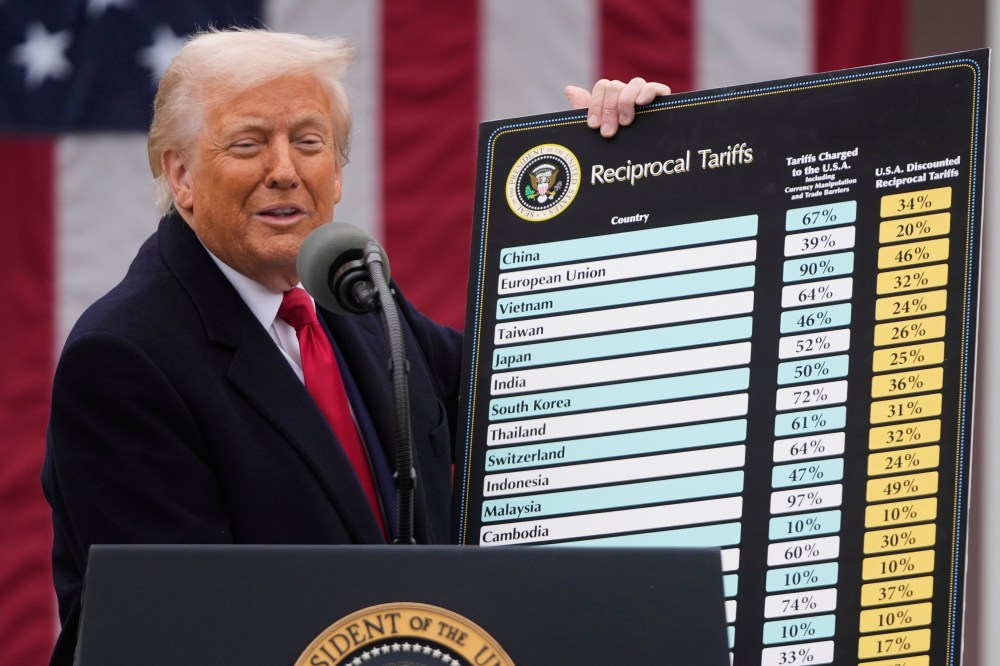
A Thursday evening news release from the office expanded the list of countries targeted by the investigations, citing forced labour.
“Despite the international consensus against forced labor, governments have failed to impose and effectively enforce measures banning goods produced with forced labor from entering their markets,” Greer said in the news release.
Canada is aware of the latest trade investigation, said Canada-U.S. Trade Minister Dominic LeBlanc’s spokesperson.
“We are committed to working with our (Canada-U.S.-Mexico Agreement) partners to further a North American approach to tackling forced labour in international supply chains, as we have done over the last number of years,” Gabriel Brunet said in an email.
The new investigations are meant to give President Donald Trump a legal basis to continue his worldwide tariff agenda.
Last month, the U.S. Supreme Court struck down Trump’s favourite tariff tool, which he used for his “Liberation Day” tariffs and fentanyl-related duties on Canada, Mexico and China.
In response to the top court’s ruling, Trump implemented a 10 per cent worldwide tariff using Section 122 of the 1974 Trade Act. Those tariffs do not apply to goods compliant with the Canada-U.S.-Mexico Agreement on trade.
Section 122 tariffs can only increase to 15 per cent and expire after 150 days unless Congress votes to extend them. An extension would be unlikely to get the approval of Congress.
Canada is also being hammered by Trump’s separate Section 232 tariffs on specific industries, including steel, aluminum, automobiles and cabinetry.
Trump is hoping to implement longer-term tariffs through Section 301 investigations but the process does require public consultations and reports.
Greer told CNBC that “if we find that countries have been involved in unfair trading practices” — such as subsidies, excess capacity or forced labour — “we can quantify that harm to U.S. commerce and then try to resolve that issue with that country.”
If the country doesn’t resolve the issue, Greer said, the Trump administration will impose tariffs.
It’s not immediately clear what the 301 investigation of Canada could cover, or if it will look beyond the justification of “forced labour.”
Ryan Majerus, a Washington-based partner in the international trade team at the law firm King & Spalding, said he expects “the investigation will focus on whether the targeted countries have implemented forced labor laws, similar to the U.S., that adequately address what is a clear and significant problem in the global supply chain.”
“And for countries that do have such measures and were named in this Section 301 investigation, the focus will undoubtedly be on the effectiveness of their enforcement efforts,” said Majerus, a former assistant general counsel at the Office of the U.S. Trade Representative during the first Trump administration.
The Federal Register notice published by the trade representative’s office about the investigation says that “Canada, Mexico, and the European Union have adopted measures intended to stop the importation or sale of products produced using forced labor.”
Canada already has legislation intended to curb forced labour in supply chains, which requires annual reports to the federal government. Canada has rules forbidding forced labour in supply chains and free trade agreements.
There are other long-standing irritants in the Canada-United States trading relationship and Trump has complained repeatedly about Canada’s dairy supply management system.
The 301 investigations are launching as Canada, Mexico and the U.S. prepare for a mandatory review of the Canada-U.S.-Mexico Agreement on trade, better known as CUSMA.
Trump has cast doubt on his commitment to the trade pact, which was negotiated during his first term. He has called it “irrelevant” and has said it may have served its purpose.
The U.S. has officially launched negotiations on the CUSMA review with Mexico, which is also subject to a 301 investigation. Ottawa and Washington have not announced a similar move.
While Greer has claimed often that Canada has barriers that make it difficult to negotiate — he has cited provincial bans on sales of U.S. alcohol — he met with Canada’s new trade team in Washington last week.
Canada’s chief trade negotiator Janice Charette and newly appointed Ambassador to the United States Mark Wiseman were joined by Canada-U.S. Trade Minister Dominic LeBlanc in that meeting.
This report by The Canadian Press was first published March 13, 2026.