
Canadian ships stuck in Persian Gulf as blockade of Strait of Hormuz continues
Advertisement
Read this article for free:
or
Already have an account? Log in here »
We need your support!
Local journalism needs your support!
As we navigate through unprecedented times, our journalists are working harder than ever to bring you the latest local updates to keep you safe and informed.
Now, more than ever, we need your support.
Starting at $15.99 plus taxes every four weeks you can access your Brandon Sun online and full access to all content as it appears on our website.
Subscribe Nowor call circulation directly at (204) 727-0527.
Your pledge helps to ensure we provide the news that matters most to your community!
To continue reading, please subscribe:
Add Brandon Sun access to your Free Press subscription for only an additional
$1 for the first 4 weeks*
*Your next subscription payment will increase by $1.00 and you will be charged $20.00 plus GST for four weeks. After four weeks, your payment will increase to $24.00 plus GST every four weeks.
Read unlimited articles for free today:
or
Already have an account? Log in here »
OTTAWA – Two Canadian cargo ships are stuck in the Persian Gulf and are unable to pass through the blocked Strait of Hormuz as the war in Iran continues.
The Miena Desgagnés and the Rosaire A. Desgagnés — owned by Quebec-based Desgagnés — were hauling general cargo to ports in Iraq, Saudi Arabia and the United Arab Emirates.
The company told The Canadian Press the ships have been there since before the start of the conflict. The ships typically service Arctic communities during shipping season in summer months, but are dispatched to other parts of the world in the winter.
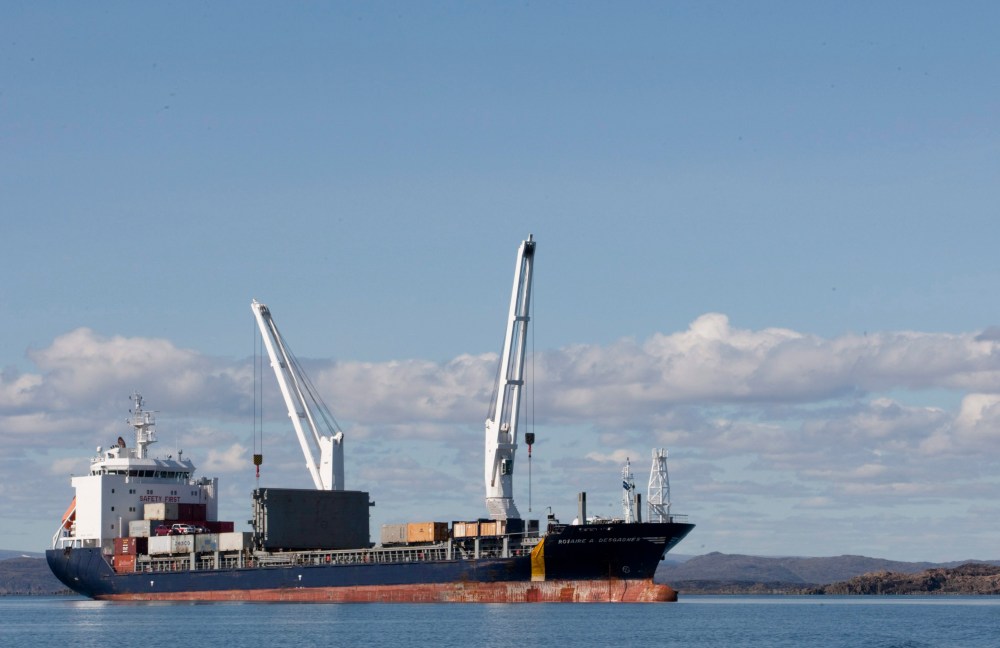
Serge Le Guellec, senior adviser to the chairman of the board and CEO of the Desgagnés group, said there are no Canadians among the 30 crew members on the ships, which are flying the flag of Barbados because its crewmen are all foreign nationals.
“You’re dealing with mariners that are used to trade worldwide, and so you’ve seen all manners of situations and of course this one is a bit different,” Le Guellec told The Canadian Press, adding all crew members are safe.
“Nobody really gets themselves into a war zone where there’s only one place to go to to get out of it, and it’s kind of locked right now.”
The Strait of Hormuz is a crucial shipping lane connecting the Persian Gulf to the Gulf of Oman and the Arabian Sea. Following the U.S. and Israel’s attacks on Iran, which began on Feb. 28, Iran’s retaliation has included missile strikes and reports of mines targeting the strait.
The war has brought most traffic in the strait to a stop and has had a particularly severe effect on oil supplies.
Le Guellec said his company has been in contact with Global Affairs Canada and Transport Canada. Like the rest of the world, the company is waiting for the Strait of Hormuz to reopen before it tries to pass through.
“It is absolutely not our intention at all to risk the lives of our mariners going to the Strait of Hormuz under the current situation,” Le Guellec said.
“It’s out of the question.”
According to online maritime traffic data, both ships appear to be near Al Jubayl in Saudi Arabia.
The Canadian Press has reached out to Global Affairs Canada and Transport Canada to ask how many other Canadian-based vessels are stuck in the region. Neither department has responded to the request so far.
While nearly 20 ships have been attacked in the area, The Associated Press reports Iran has let nearly 90 ships pass through, most of them Iranian.
This report from The Canadian Press was first published March 18, 2026.