
Calgary lifts water restrictions after 3 weeks as work continues to replace pipe
Advertisement
Read this article for free:
or
Already have an account? Log in here »
We need your support!
Local journalism needs your support!
As we navigate through unprecedented times, our journalists are working harder than ever to bring you the latest local updates to keep you safe and informed.
Now, more than ever, we need your support.
Starting at $15.99 plus taxes every four weeks you can access your Brandon Sun online and full access to all content as it appears on our website.
Subscribe Nowor call circulation directly at (204) 727-0527.
Your pledge helps to ensure we provide the news that matters most to your community!
To continue reading, please subscribe:
Add Brandon Sun access to your Free Press subscription for only an additional
$1 for the first 4 weeks*
- Enjoy unlimited reading on brandonsun.com
- Read the Brandon Sun E-Edition, our digital replica newspaper
*Your next Free Press subscription payment will increase by $1.00 and you will be charged $20.95 plus GST for four weeks. After four weeks, your payment will increase to $24.95 plus GST every four weeks.
Read unlimited articles for free today:
or
Already have an account? Log in here »
CALGARY – Residents in Calgary and surrounding communities are once again free to shower and flush at will as the latest fixes have been completed on a fragile – and mortally wounded – water main.
“As of today, you can resume normal water use,” Michael Thompson, Calgary’s general manager for infrastructure services announced Thursday, less than four weeks after the voluntary restrictions began on March 9.
“Recreation facilities are returning to normal operations. Hot tubs and kiddie pools are being refilled and will reopen as soon as they are ready.”
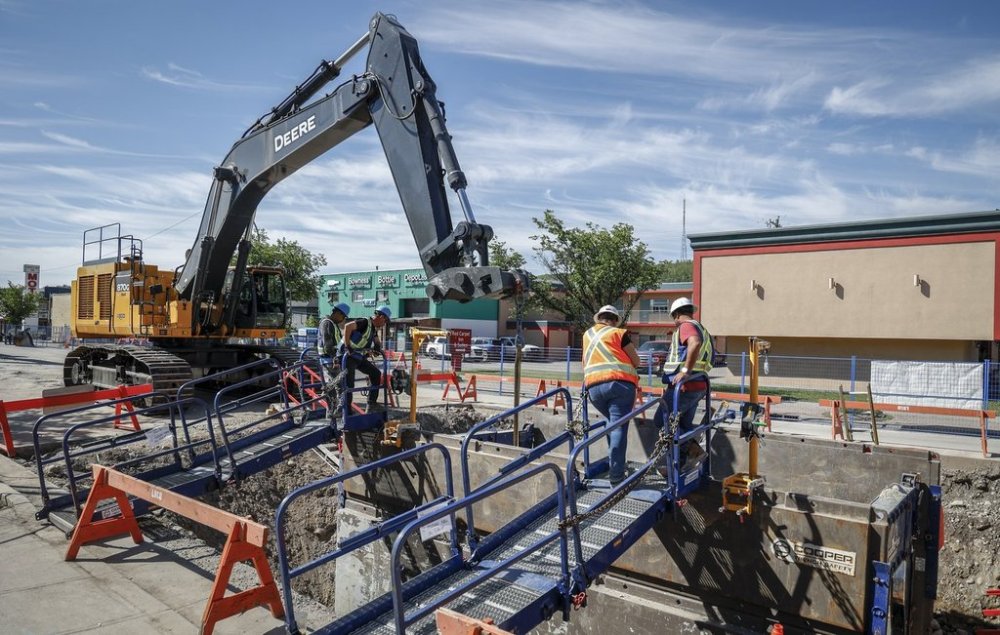
Residents had been urged to take shorter showers and reduce toilet flushes, laundry and dishwasher loads. The city also banned outdoor water use.
The restrictions were due to the shutdown of the Bearspaw South Feeder Main, which provides 60 per cent of treated water for the 1.6 million residents of Calgary along with municipalities on its boundaries and the Tsuut’ina Nation.
Residents were asked to voluntarily cut water use to keep enough in reserve for emergencies such as fighting fires.
Thompson said there were emergencies but, because people cut back on water, crews were able to handle them.
“I know it wasn’t easy, but let me assure you, those actions mattered,” Thompson said.
In the latest round of fixes to the pipe, Thompson said crews mended nine high-risk segments using steel and concrete while replacing subpar valves.
The main has a troubled recent history.
It ruptured in December for the second time in less than two years, spilling a torrent of frigid water onto a commuter road and leaving some drivers stranded. The line also failed in June 2024.
This was the third time the city imposed water use limits. It says the pipe is in poor condition and at risk of breaking again until a new one – now being constructed parallel to the current one — is operational in December.
“We are not planning to reintroduce water restrictions until fall, when we’ll shut this pipe down again to connect the new pipe,” the city said in a news release. “But if another issue happens before then, we may need to bring back water restrictions sooner.”
The water problem has grabbed the attention of Premier Danielle Smith’s government. Last month, the province ordered a sweeping third-party investigation into Calgary’s ongoing water main problems.
Municipal Affairs Minister Dan Williams has said the investigation is not political, even though it is expected to examine the actions and decisions of former Calgary mayor Naheed Nenshi.
Nenshi is now leader of the Opposition NDP and the main opponent of Smith’s United Conservatives, with an election slated for next year. Smith has placed some of the blame for the water crisis on city council action when Nenshi was mayor.
The investigation will be headed by David Goldie, a former chair of Alberta’s energy regulator. Total cost is estimated at $1.2 million.
Goldie will have the power to compel documents and witnesses, similar to a public judicial inquiry, and is expected to report back on his findings by the fall.
Calgary Mayor Jeromy Farkas, who has promised the replacement line will be ready by the end of the year, said he supports the province’s inspection and will co-operate fully with the investigation.
This report by The Canadian Press was first published April 2, 2026.