
Advocates urge Ottawa to crack down on slave labour, end yearlong watchdog vacancy
Advertisement
Read this article for free:
or
Already have an account? Log in here »
We need your support!
Local journalism needs your support!
As we navigate through unprecedented times, our journalists are working harder than ever to bring you the latest local updates to keep you safe and informed.
Now, more than ever, we need your support.
Starting at $15.99 plus taxes every four weeks you can access your Brandon Sun online and full access to all content as it appears on our website.
Subscribe Nowor call circulation directly at (204) 727-0527.
Your pledge helps to ensure we provide the news that matters most to your community!
To continue reading, please subscribe:
Add Brandon Sun access to your Free Press subscription for only an additional
$1 for the first 4 weeks*
- Enjoy unlimited reading on brandonsun.com
- Read the Brandon Sun E-Edition, our digital replica newspaper
*Your next Free Press subscription payment will increase by $1.00 and you will be charged $20.95 plus GST for four weeks. After four weeks, your payment will increase to $24.95 plus GST every four weeks.
Read unlimited articles for free today:
or
Already have an account? Log in here »
OTTAWA – A multi-party group of parliamentarians is urging Ottawa to step up its efforts to stop Canadian companies from profiting from slavery in their operations abroad and through imports.
Parliament passed the Supply Chains Act in 2023, which requires Canadian companies and government institutions to report annually on what they did to prevent or mitigate against the use of child labour or forced labour. Advocates argue the bill is not being adequately enforced.
The International Justice and Human Rights Clinic at the University of British Columbia analyzed filings of 119 companies over the past two years and found them to be extremely vague on their efforts to weed out forced labour.
There is no requirement for reporting on forced labour from companies involved in services, mining and real estate. The researchers say this is due in part to Public Safety Canada’s guidance for companies, which they say is much less comprehensive than what the law requires.
McMaster University researcher Sima Fallah-Tafti said an artificial intelligence analysis of more than a thousand filings under the law found an average 36 per cent score on specificity.
“Most reports we analyzed were boilerplate — generic language, no specific suppliers named, no meaningful risk identification,” she said.
“Firms are filing paperwork. They are not doing due diligence.”
The researchers spoke at a news conference Tuesday on Parliament Hill. They were joined by members of the All-Party Parliamentary Group to End Modern Slavery and Human Trafficking, which includes MPs from four federal parties and senators from various representative groups.
“It’s really, in my opinion, a problem of implementation,” Sen. Julie Miville-Dechêne, who helped shepherd the legislation through Parliament, told the news conference in French.
“There must be clear guidelines so that we can have something other than generic reports that say very little about the activities of a company.”
Former Liberal MP John McKay said Ottawa’s efforts need to be “far more robust” to screen out products linked to forced labour in areas like China’s Xinjiang region.
‘We could be actually doing something about impediments in our supply chains. It is concerning to us that we go to places like the UN and various other places and we talk a good game. But our good game is not backed up by robust analysis,” he said.
McKay and Miville-Dechêne pointed out that Ottawa hasn’t used the bill to access private companies’ records or issued any penalties for non-compliance.
Public Safety Canada, which enforces the forced labour law, did not immediately respond to a request for comment.
The parliamentarians and the UBC researchers are also urging the government to set a timeline for appointing a new federal corporate watchdog, a position that has been vacant for nearly a year.
The UN Human Rights Committee has urged Ottawa to name a new ombudsperson for responsible enterprise. The UBC group said the ombudsperson office’s investigations have stalled over the past year.
“There are complainants who are just left not knowing what to do next or if Canada is going to respond,” said UBC professor Nicole Barrett, who researches international human rights and criminal law.
Foreign Affairs Minister Anita Anand said last month the government intends to appoint a new ombudsman but did not offer a timeline. Her office referred questions to Trade Minister Maninder Sidhu’s office.
McKay said Canada needs to do a better job of policing forced labour because U.S. President Donald Trump has urged dozens of countries, including Canada, to do so under threat of tariffs.
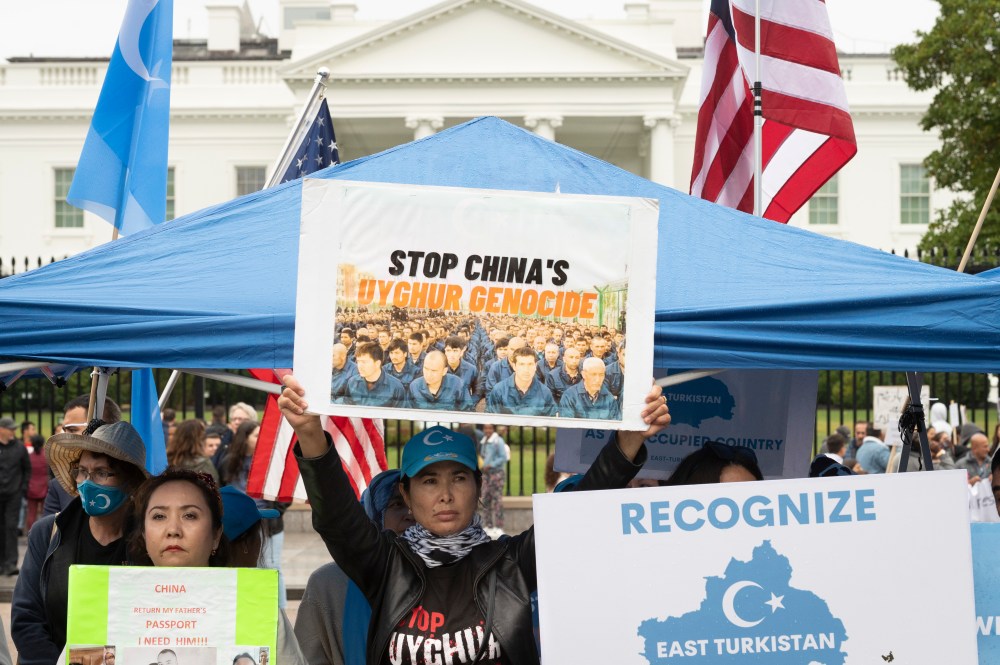
Parliament passed the Supply Chains Act after the United Nations reported in 2022 that China had committed serious human rights violations in Xinjiang against Uyghurs that “may constitute international crimes, in particular crimes against humanity.”
Global Affairs Canada reported that same year that China “is using otherwise legitimate programs for retraining and relocation of unemployed workers as instruments of a broader campaign of oppression, exploitation and indoctrination of the Uyghur Muslim population.”
Beijing vehemently disputes those claims, arguing it has addressed terrorism threats while offering economic opportunities to minority populations.
The issue of Xinjiang forced labour was at the centre of a heated exchange at a House committee last month, after Liberal MP Michael Ma asked a witness whether her evidence on forced labour in Chinese aluminum supply chains could be “hearsay.”
The committee had been discussing the remote Xinjiang region and Ma said hours later he was referring to the industrial hub of Shenzhen.
Energy Minister Tim Hodgson later said the Liberals are opposed to forced labour but are “focused on where we do agree” with China, adding Ottawa can discuss human rights behind closed doors with Beijing.
“We don’t need to have public discussions about where we disagree. We make that clear, to our friends in China,” he said on March 27.
McKay said the incident with Ma illustrates the conundrum facing Canada.
“The depth of the problem is such that Canada has a choice here. If we go along to get along, then we will compromise our own values,” McKay said.
Conservative MP Arnold Viersen told Tuesday’s news conference that the Tories remain concerned about Canada’s posture toward China.
“The ground is moving under our feet a little bit, because it also took … three days of zigging and zagging before the government really clarified where they’re at,” he said.
This report by The Canadian Press was first published April 14, 2026.
Note to readers:This is a corrected story. A previous version misspelled the first name of John McKay.