
Minister won’t commit to national flood insurance program in near future
Advertisement
Read this article for free:
or
Already have an account? Log in here »
We need your support!
Local journalism needs your support!
As we navigate through unprecedented times, our journalists are working harder than ever to bring you the latest local updates to keep you safe and informed.
Now, more than ever, we need your support.
Starting at $15.99 plus taxes every four weeks you can access your Brandon Sun online and full access to all content as it appears on our website.
Subscribe Nowor call circulation directly at (204) 727-0527.
Your pledge helps to ensure we provide the news that matters most to your community!
To continue reading, please subscribe:
Add Brandon Sun access to your Free Press subscription for only an additional
$1 for the first 4 weeks*
- Enjoy unlimited reading on brandonsun.com
- Read the Brandon Sun E-Edition, our digital replica newspaper
*Your next Free Press subscription payment will increase by $1.00 and you will be charged $20.95 plus GST for four weeks. After four weeks, your payment will increase to $24.95 plus GST every four weeks.
Read unlimited articles for free today:
or
Already have an account? Log in here »
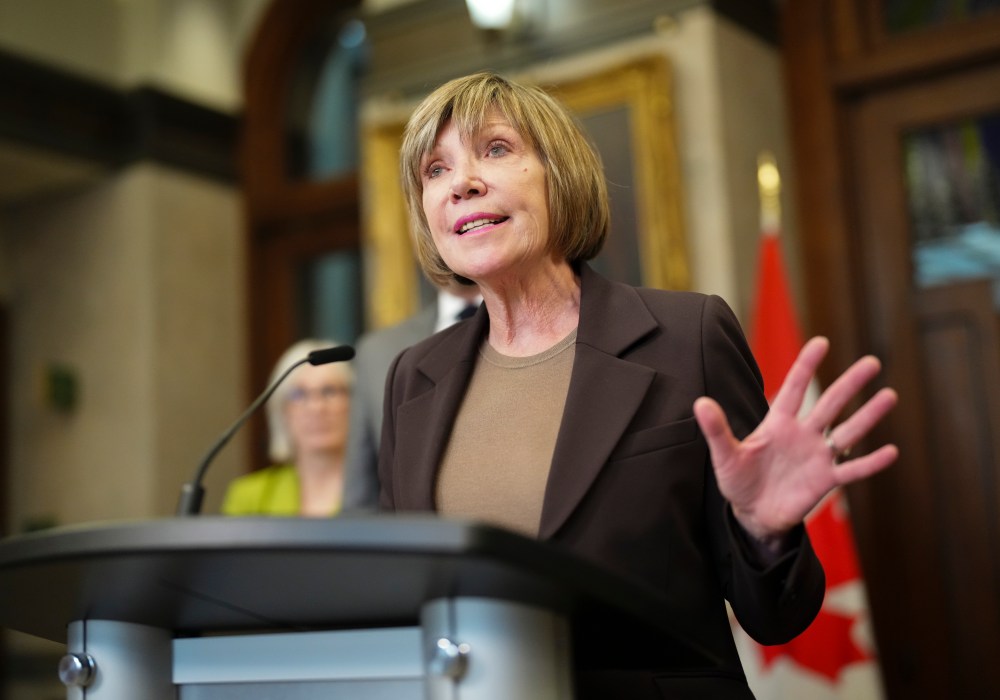
OTTAWA – Federal Emergency Management Minister Eleanor Olszewski said Tuesday she couldn’t promise the government will deliver a National Flood Insurance Program “in the near future.”
Speaking to reporters on Parliament Hill as several parts of the country were under flood warnings, Olszewski said the government is still looking into a flood insurance program.
“It’s an incredibly complicated discussion and a complicated thing to put in place for Canadians. Especially to determine the most viable structure for such an insurance program,” she said.
“But absolutely, it’s top of mind for us.”
The program was first promised by former prime minister Justin Trudeau during the 2019 federal election campaign as an affordability measure to help households in flood-prone areas.
The government didn’t start working on the program until 2023 and a year later committed to implementing it by the end of 2025.
A 2022 report by Canada’s Task Force on Flood Insurance and Relocation estimated the average annual losses from residential flooding — both insured and uninsured losses — at $2.97 billion.
The report said almost 90 per cent of all flooding losses came from the top 10 per cent highest-risk homes, while the top one per cent represented more than a third of all losses.
While Olszewski didn’t identify the complications involved in launching a flood insurance program Tuesday, she said the government is engaged in discussions with the Insurance Bureau of Canada.
Liam McGuinty, vice president of federal affairs at the Insurance Bureau of Canada, said the government is best suited to explain the challenges. He said the coverage gap has narrowed in the years since the government promised the program.
“When the notion of a program was first discussed, overland flood insurance barely existed in Canada. Today, the coverage gap is far narrower and concentrated in a relatively small number of extreme‑risk properties, often homes built (in) known flood-prone areas,” McGuinty, the nephew of Liberal cabinet minister David McGuinty, wrote in an email to The Canadian Press.
“Insurers have significantly expanded coverage, meaning any federal program would need to be carefully designed to fill a very specific gap rather than crowd out or disrupt a functioning (and continuously evolving) private market.”
Ryan Ness, research director on adaptation at the Climate Institute of Canada, said any federal subsidy program would need an off-ramp built into it.
“This kind of strategy, it’s not intended to simply subsidize homes built in risky places forever,” Ness told The Canadian Press.
“It’s intended to help people that are at risk right now that can’t get insurance because private insurance just can’t be affordable for them.”
Ness said he was surprised to hear Olszewski offer no timeline for an insurance program.
“A national flood insurance program can be a good thing, but it could be for a limited period of time, and there could be a longer-term, bigger picture plan to deal with flood risk,” Ness said.
“It’s a stopgap while we do something more permanent and more aspirational around reducing flood risk, which means sort of protecting people where they live, helping people move out of the most dangerous places and ensuring that we don’t build new houses in flood risk zones.
“That’s going to have to be addressed.”
— This report from The Canadian Press was first published April 22, 2026.