
Watchdog report confirms truck involved in Air Canada plane crash had no transponder
Advertisement
Read this article for free:
or
Already have an account? Log in here »
We need your support!
Local journalism needs your support!
As we navigate through unprecedented times, our journalists are working harder than ever to bring you the latest local updates to keep you safe and informed.
Now, more than ever, we need your support.
Starting at $15.99 plus taxes every four weeks you can access your Brandon Sun online and full access to all content as it appears on our website.
Subscribe Nowor call circulation directly at (204) 727-0527.
Your pledge helps to ensure we provide the news that matters most to your community!
To continue reading, please subscribe:
Add Brandon Sun access to your Free Press subscription for only an additional
$1 for the first 4 weeks*
- Enjoy unlimited reading on brandonsun.com
- Read the Brandon Sun E-Edition, our digital replica newspaper
*Your next Free Press subscription payment will increase by $1.00 and you will be charged $20.95 plus GST for four weeks. After four weeks, your payment will increase to $24.95 plus GST every four weeks.
Read unlimited articles for free today:
or
Already have an account? Log in here »
A preliminary report into the LaGuardia Airport crash that killed two Canadian pilots last month says system failures and communication issues played a part in the accident.
The report, released Thursday by the U.S National Transportation Safety Board, said a surveillance system did not generate an alert for air traffic controllers because ground vehicles were not equipped with transponders, including the fire truck that struck the Air Canada Jazz Aviation plane.
Because there were no transponders, surveillance systems could not identify them or determine their positions and did not predict the collision.
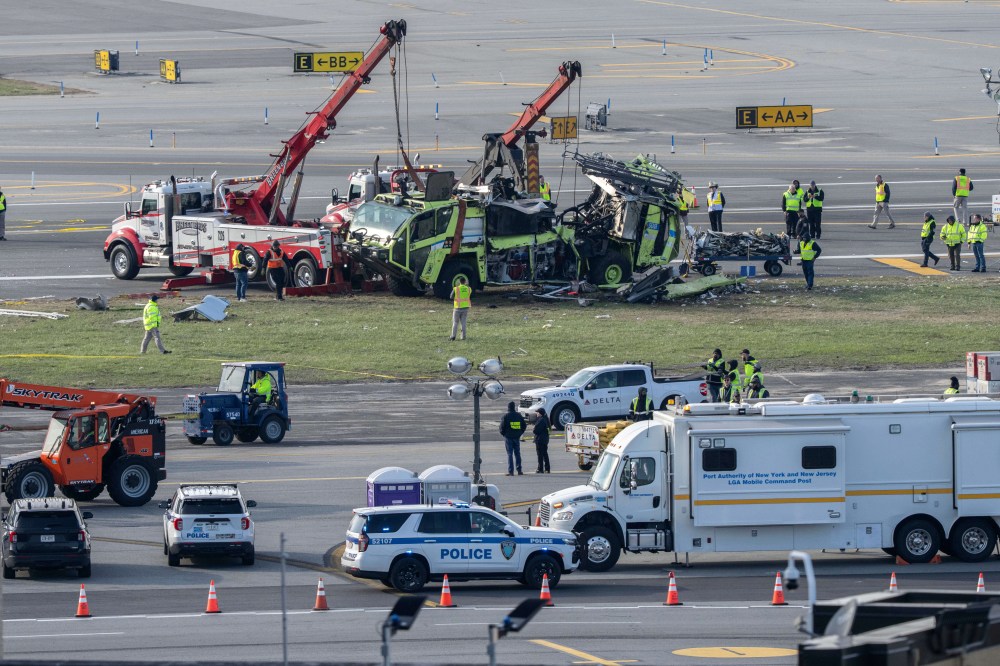
“At the time of the accident, (the surveillance system) displayed only two radar targets,” the report said, “rather than all seven of the response vehicles as distinct targets.”
The report also said radio transmissions were obscured about two minutes before the collision.
Though the turret operator in the truck reported hearing “stop, stop, stop” on the radio, he did not know who the transmission was intended for, said the report.
When the command was repeated, he realized the truck was already entering the plane’s runway and the vehicle’s speed continued to increase leading up to the collision.
“He further recalled that as they turned left, he saw the airplane’s lights on the runway,” the report said.
According to the report, the local controller cleared the emergency vehicle to cross the runway even though the plane was only about 400 metres from the intersection and less than 40 metres off the ground.
The red runway entrance lights, which serve as a warning to potential traffic, turned off about three seconds before the collision. The report noted the lights system is designed to turn them off sequentially as a plane lands, “about two to three seconds before the airplane reaches each intersection.”
The front of the Air Canada plane sustained severe damage. It was crushed from the nose to the front lavatory near the coat closet used by pilots and flight attendants.
“The two pilot seats, an unoccupied flight deck observer seat, and the forward flight attendant seat were separated from the airplane and found in the debris,” the report noted. All passenger seats remained intact.
Captain Antoine Forest, 30, and first officer Mackenzie Gunther, 24, were killed in the crash. About 40 passengers and crew members were taken to hospital, along with two emergency responders travelling in the fire truck.
The report does not mention how one of the flight attendants was strapped into a forward seat and ejected from the plane. She suffered fractures to her leg but survived, her daughter had previously told The Canadian Press.
However, the report mentions another flight attendant, who reported getting in the aft jump seat for landing, and “described the flight as normal until he felt an impact and jar.”
“He did not know what had happened and attempted to call the pilots and received no response. He reported the conditions were dark, but passengers deplaned orderly through all exits,” the report said.
Jazz said it has acknowledged the report and will “continue to fully co-operate with the investigation.”
The Canadian Press reached out to the Air Line Pilots Association Canada and the Jazz flight attendants union for comment but did not immediately hear back.
The collision happened on the first of a four-day trip for the flight crew, the report says. The plane first travelled from Montreal to Quebec City. It then flew back to Montreal before heading to LaGuardia. The flight was scheduled to return to Montreal from New York when the crash occurred.
This report by The Canadian Press was first published April 23, 2026.