
Quebec premier feels bound by Labrador energy deal despite expiration date
Advertisement
Read this article for free:
or
Already have an account? Log in here »
We need your support!
Local journalism needs your support!
As we navigate through unprecedented times, our journalists are working harder than ever to bring you the latest local updates to keep you safe and informed.
Now, more than ever, we need your support.
Starting at $15.99 plus taxes every four weeks you can access your Brandon Sun online and full access to all content as it appears on our website.
Subscribe Nowor call circulation directly at (204) 727-0527.
Your pledge helps to ensure we provide the news that matters most to your community!
To continue reading, please subscribe:
Add Brandon Sun access to your Free Press subscription for only an additional
$1 for the first 4 weeks*
- Enjoy unlimited reading on brandonsun.com
- Read the Brandon Sun E-Edition, our digital replica newspaper
*Your next Free Press subscription payment will increase by $1.00 and you will be charged $20.95 plus GST for four weeks. After four weeks, your payment will increase to $24.95 plus GST every four weeks.
Read unlimited articles for free today:
or
Already have an account? Log in here »
RIVIÈRE-DU-LOUP – The premier of Quebec says she feels her province is still bound by a framework energy agreement signed with Newfoundland and Labrador.
The tentative agreement for sharing energy from Labrador was set to expire on Thursday. Christine Fréchette said Friday she was waiting for Newfoundland and Labrador Premier Tony Wakeham to make the next move, after he digests a report from a panel he tasked with reviewing the draft deal.
“I am very confident about what lies ahead, in the sense that this is an agreement that is beneficial both for Newfoundland and Labrador and for Quebec,” Fréchette told reporters in Rivière-du-Loup, Que. “(It) places us in a position of energy security for decades to come. Financially as well, it is very advantageous for Newfoundland.”
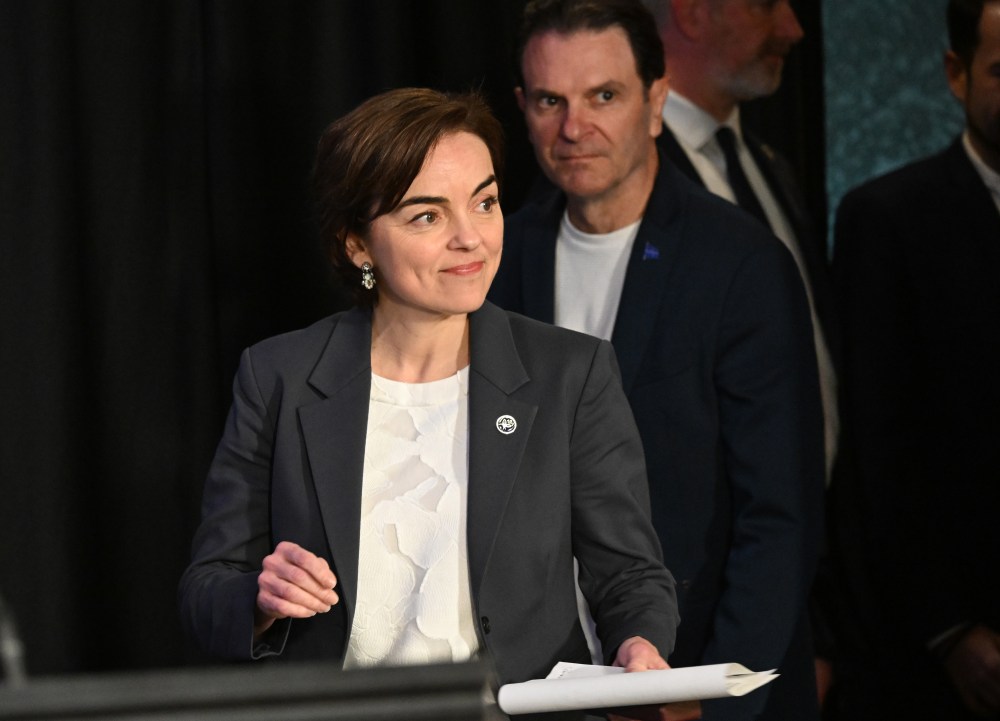
Fréchette was not the only one waiting for word from Wakeham on Friday. A spokesperson for the Newfoundland and Labrador government said the premier expected to make a statement about the report some time that day. As of 3:45 p.m. local time, he had said nothing.
Charles Milliard, leader of Quebec’s Liberals, was also keen to hear what the panel had concluded. “I’ve been very clear … that the (memorandum of understanding) is a good deal that is mutually beneficial,” Milliard told reporters Friday.
“Hopefully both (Premier) Fréchette and (Premier) Wakeham will be very adamant about signing this, but we have to wait for the report and see what the experts have to say.”
Wakeham had demanded a review of the deal since it was unveiled in St. John’s in 2024 by Newfoundland and Labrador’s former Liberal government. He ordered a three-person panel to carry out the review shortly after his Progressive Conservatives formed government last fall.
The premier told reporters on Thursday that he did not know when the panel’s report might be made public, explaining it had to be reviewed by lawyers and other officials before he could table it in the legislature.
The text of the memorandum of understanding said it would “terminate” Thursday if the signatories had not agreed to extend it or signed final agreements.
John Hogan, leader of Newfoundland and Labrador’s Liberals, said he was “extremely disappointed” the expiration date passed with no binding deal in place.
“We’re stuck with the 1969 contract, which is literally what every premier of this province has been trying to get rid of since 1969,” Hogan said in an interview.
The non-binding agreement laid out proposals for Hydro-Québec to manage new hydroelectric developments on the Churchill River in Labrador, alongside Newfoundland and Labrador Hydro. Quebec’s provincially owned utility would assume much of the cost and financial risk and get most of the power.
Its terms would also end a contract signed in 1969 that allows Hydro-Québec to buy power from the Churchill Falls plant for 0.2 cents per kilowatt hour. Under the new proposal, the utility would pay increasing rates reaching 7.84 cents per kilowatt hour by 2041 — the year the 1969 contract is supposed to expire.
This report by The Canadian Press was first published May 1, 2026.
— With files from Patrice Bergeron in Rivière-du-Loup, Que. and Erika Morris in Montreal