
Trans Mountain and its federal parent see case for Ottawa owning pipeline for good
Advertisement
Read this article for free:
or
Already have an account? Log in here »
We need your support!
Local journalism needs your support!
As we navigate through unprecedented times, our journalists are working harder than ever to bring you the latest local updates to keep you safe and informed.
Now, more than ever, we need your support.
Starting at $15.99 plus taxes every four weeks you can access your Brandon Sun online and full access to all content as it appears on our website.
Subscribe Nowor call circulation directly at (204) 727-0527.
Your pledge helps to ensure we provide the news that matters most to your community!
To continue reading, please subscribe:
Add Brandon Sun access to your Free Press subscription for only an additional
$1 for the first 4 weeks*
- Enjoy unlimited reading on brandonsun.com
- Read the Brandon Sun E-Edition, our digital replica newspaper
*Your next Free Press subscription payment will increase by $1.00 and you will be charged $20.95 plus GST for four weeks. After four weeks, your payment will increase to $24.95 plus GST every four weeks.
Read unlimited articles for free today:
or
Already have an account? Log in here »
There’s a case to indefinitely keep the Trans Mountain pipeline in government hands, possibly alongside Indigenous partners, say the leaders of its operator and financial overseer.
“It is a sovereign pipeline. It starts in Canada. It really ends in Canada. This is an incredibly strategic asset,” Trans Mountain Corp. president and CEO Mark Maki told a Canadian Club Toronto luncheon on Monday.
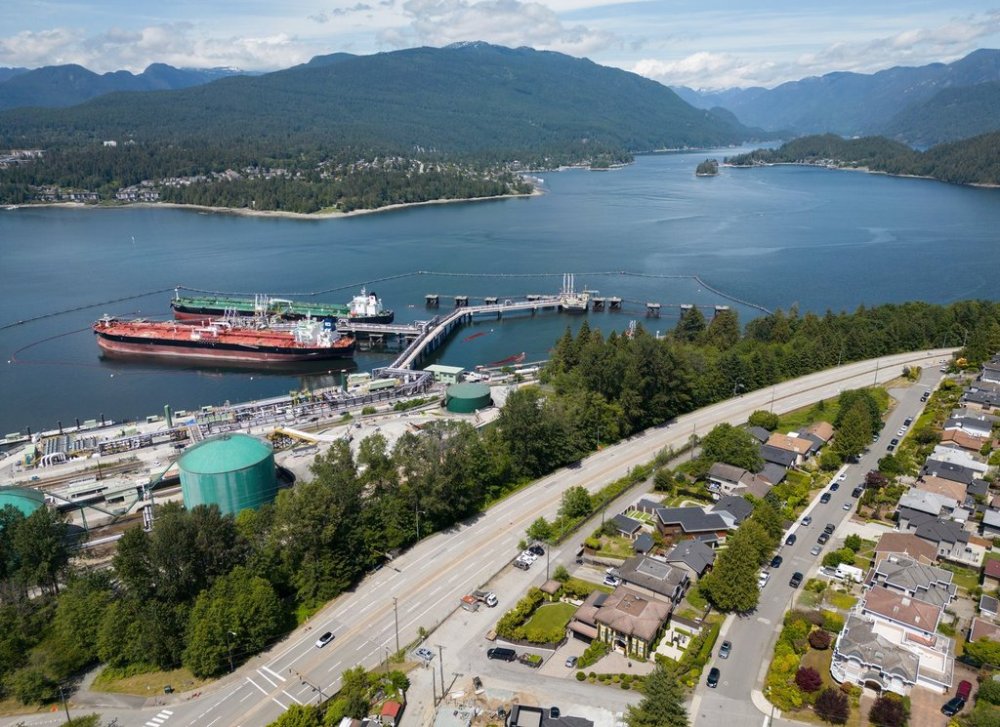
Maki was joined on stage by Elizabeth Wademan, who leads the Canada Development Investment Corp., or CDEV. She said recent geopolitical turmoil has underscored the importance of the pipeline, which delivers oilsands crude from Edmonton to a marine terminal in the Vancouver area, from which cargoes can be sent to Asia.
“It has incredible value,” said Wademan. “There’s absolutely a case to be a long term holder … I personally would love to see it owned by Canadians.”
However, she said CDEV must keep all options on the table and “keep its finger on the pulse” for opportunities in the market.
Trans Mountain Corp., which owns and operates the pipeline itself, is a subsidiary of CDEV, which manages investments on behalf of the federal government and answers to the minister of finance. Wademan said CDEV is essentially a “friendly yet challenging shareholder” in the pipeline firm.
The original Trans Mountain pipeline has been serving the B.C. Lower Mainland since the 1950s. Six decades later, the Canadian arm of U.S. energy shipper Kinder Morgan pitched a plan to expand the line through a project called TMX, enabling exports to Asia.
TMX ran into fierce opposition and court challenges, and Kinder Morgan ultimately walked away. Ottawa bought the pipeline for $4.5 billion in 2018 to ensure the expansion would be built. The projected cost of construction ballooned to more than $34 billion by the time it started up in May of 2024, up from the estimate of $7.4 billion seven years earlier.
Maki said the focus on the cost escalation misses a lot of context.
“It’s like comparing a PC cost 20 years ago to today and what the capabilities are,” he said, pointing to an onerous regulatory environment that now appears to be improving, as well as events beyond anyone’s control around the time of construction, such as natural disasters and the COVID-19 pandemic.
The federal government has said it did not intend to be the long-term owner and would eventually sell the pipeline to the private sector, Indigenous groups or a combination of the two. Indigenous participation is “absolutely still on the table,” Wademan said, but negotiations are complex and take time.
Maki said the system has been carrying 850,000 barrels of crude per day from the Edmonton area to its docks in Burnaby, B.C., getting close to its capacity of 890,000 barrels per day.
He said that’s not necessarily a good spot for Canada to be in, as it means there’s little flexibility for producers to get their oil to eager buyers across the Pacific. He said Canada needs a second West Coast pipeline — like the one Alberta is spearheading — but that it’s too early to determine whether a northern or southern route to the B.C. coast would be best.
Trans Mountain is among the firms providing technical expertise to the Alberta plan.
His advice: “Take your time. Don’t be in a rush to declare a north or south route.”
This report by The Canadian Press was first published May 11, 2026.