
Carney unveils new electricity strategy, noncommittal on 2030 climate targets
Advertisement
Read this article for free:
or
Already have an account? Log in here »
We need your support!
Local journalism needs your support!
As we navigate through unprecedented times, our journalists are working harder than ever to bring you the latest local updates to keep you safe and informed.
Now, more than ever, we need your support.
Starting at $15.99 plus taxes every four weeks you can access your Brandon Sun online and full access to all content as it appears on our website.
Subscribe Nowor call circulation directly at (204) 727-0527.
Your pledge helps to ensure we provide the news that matters most to your community!
To continue reading, please subscribe:
Add Brandon Sun access to your Free Press subscription for only an additional
$1 for the first 4 weeks*
- Enjoy unlimited reading on brandonsun.com
- Read the Brandon Sun E-Edition, our digital replica newspaper
*Your next Free Press subscription payment will increase by $1.00 and you will be charged $20.95 plus GST for four weeks. After four weeks, your payment will increase to $24.95 plus GST every four weeks.
Read unlimited articles for free today:
or
Already have an account? Log in here »
OTTAWA –
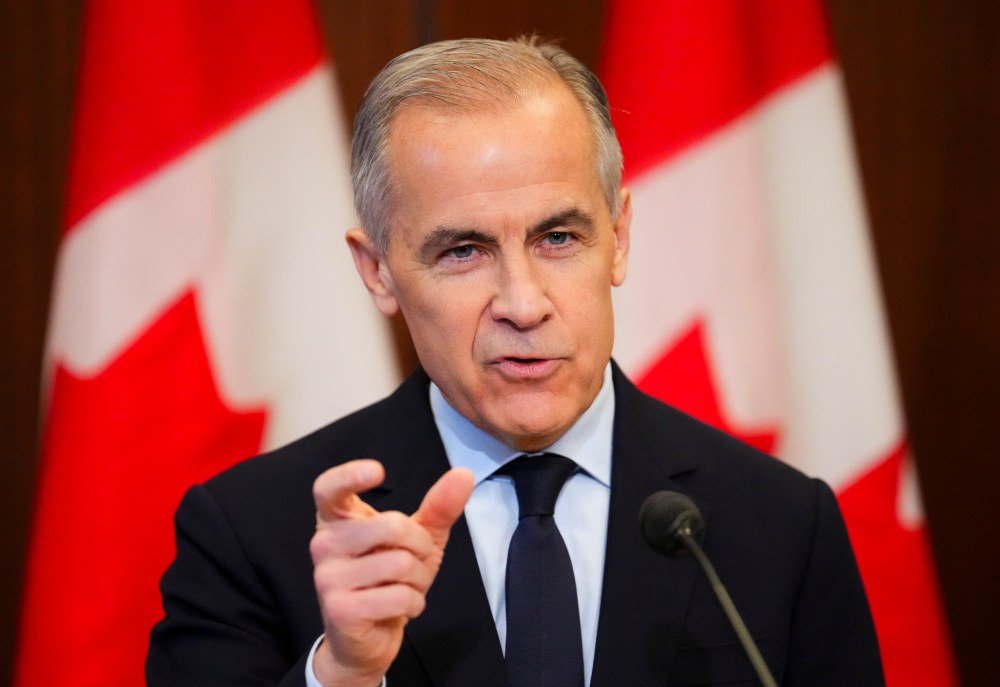
Prime Minister Mark Carney unveiled Canada’s long-awaited new electricity strategy Thursday, placing a heavy emphasis on expanding the role of natural gas in powering the grid as he seemed to distance the government from its 2030 Paris climate commitments.
The new strategy looks to double Canada’s electricity grid by 2050 and would adjust the clean electricity regulations to provide more flexibility to allow natural gas to play a larger role in building the grid.

At a news conference on Parliament Hill, Carney said there is a role for gas in helping some provinces meet an anticipated increase in demand for electricity.
“Under some interpretations of the current electricity regulations, it would be difficult to build some additional natural gas that would complement much bigger builds,” Carney said.
He called the measure a “very practical approach” that recognizes not all provinces are starting at the same place, adding gas will help deliver affordability.
“We have some of the cheapest gas in the world in Canada,” he said.
Affordability is a key consideration in the plan and the goal is to lower energy costs for 70 per cent of Canadian households, Carney said.
“If we get it wrong, Canadians will pay higher utility bills,” he said. “If we’re too timid, Canadians would end up short of power. We can’t pursue business as usual. We can’t simply rely on restrictions and prohibitions.”
The strategy document says natural gas plants are flexible and can complement renewables, such as wind and solar, ramping up or down quickly as needed.
The electricity strategy is the latest move by Carney to loosen climate policies put in place by the previous Liberal government under Justin Trudeau. Carney previously eliminated the consumer carbon price, scaled back emissions caps on oil and gas production and on Friday, is expected to formally announce changes to industrial carbon pricing in an announcement in Alberta.
Trudeau’s electricity plan was billed as “clean” while Carney’s is described as “national” instead. Trudeau’s plan promised to eliminate emissions from Canada’s grid by 2050 and set limits on carbon dioxide pollution from almost all electricity generation units that use fossil fuels.
In a post on X, Conservative Leader Pierre Poilievre said Thursday’s news was a re-announcement of old Liberal policies “that hiked electricity prices by a third and cut production over the last decade.”
The new strategy says construction will cost more than $1 trillion and public dollars will be used to cover some of the cost. The strategy doesn’t say how much money the government is willing to spend to achieve the goal, although it mentions offering tax credits and bringing back energy-saving retrofits for up to a million households.
Carney said the government will pay for those retrofits through loans, grants and “complementary measures.”
“It requires permitting reform, new partnerships with Indigenous Peoples and a willingness to use a wide range of energy, including hydro, nuclear, wind, solar, some gas, carbon capture and geothermal,” he said.
Rachel Doran, executive director of Clean Energy Canada, said while the intent of growing the grid was something to look forward to, the strategy missed the mark on how to get there.
“What was really absent from the strategy was this idea of jurisdictions around the world are moving to maximize their reliance on clean energy, and particularly renewables and batteries. Not because of environmental beliefs, but because they’re the cheapest available source of new electricity generation in almost every market globally,” Doran told The Canadian Press.
She said the emphasis on natural gas is “a bit of a flip.”
“Yes, natural gas will have a limited short-term role. But we should be starting from the position of ‘What can we do with the cheapest available resources that also happen to be the cleanest?’ So we’re going to be watching kind of cautiously.”
Vittoria Bellissimo, the CEO of the Canadian Renewable Energy Association, said the strategy signals that all sources are on the table.
“But the heavy preference is for clean electricity, and the Prime Minister in his remarks referred to how much clean there will be compared to thermal-based generation. I think it’s a really good news story for clean energy.”
The new plan, which will be finalized over the next four months in consultations with provinces and stakeholders, also appears to push back the timeline for lowering emissions.
Carney said the new strategy would result in the removal of 250 to 300 million tonnes of emissions by 2050 annually, through electrification with clean power sources.
To hit the current emissions target, Canada must reduce emissions by at least 227 million tonnes by 2030.
“We are putting in place a series of initiatives that will make material emission reductions. We will update our climate plans and emission reduction targets in due course,” Carney said when asked whether Canada is still committed to reaching its 2030 emissions reduction target.
When asked later to clarify his remarks on the government’s targets, Carney pushed back on the notion that Canada is “changing” its climate targets.
“That’s not what I said. What we are doing is we’re focused on investing to get results,” Carney said.
In November, Carney said on the floor of the House of Commons his government would “respect our Paris commitments for climate change, and we’re determined to achieve them.”
Electricity accounts for about seven per cent of Canada’s total greenhouse emissions, an amount that has fallen substantially over the last 15 years as most provinces reduced or phased out the use of coal power.
The government forecasts 130,000 new workers will be needed to double the size of grid. Carney said in his remarks 30,000 jobs will be created by the end of 2028, and 100,000 more by 2050.
This report by The Canadian Press was first published May 14, 2026.