
Frequent visits to Persian Gulf show Carney’s ambition goes beyond seeking investment
Advertisement
Read this article for free:
or
Already have an account? Log in here »
We need your support!
Local journalism needs your support!
As we navigate through unprecedented times, our journalists are working harder than ever to bring you the latest local updates to keep you safe and informed.
Now, more than ever, we need your support.
Starting at $15.99 plus taxes every four weeks you can access your Brandon Sun online and full access to all content as it appears on our website.
Subscribe Nowor call circulation directly at (204) 727-0527.
Your pledge helps to ensure we provide the news that matters most to your community!
To continue reading, please subscribe:
Add Brandon Sun access to your Free Press subscription for only an additional
$1 for the first 4 weeks*
- Enjoy unlimited reading on brandonsun.com
- Read the Brandon Sun E-Edition, our digital replica newspaper
*Your next Free Press subscription payment will increase by $1.00 and you will be charged $20.95 plus GST for four weeks. After four weeks, your payment will increase to $24.95 plus GST every four weeks.
Read unlimited articles for free today:
or
Already have an account? Log in here »
OTTAWA – The Carney government is putting a new emphasis on diplomacy with Persian Gulf countries — one that goes beyond seeking investments in Canada to arrangements touching on defence and artificial intelligence.
Foreign Affairs Minister Anita Anand made trips to both Oman and Qatar this week, while Defence Minister David McGuinty was in Qatar and the United Arab Emirates.
Prime Minister Mark Carney’s ministers and officials have made at least nine separate visits to Persian Gulf nations since October. Carney himself has travelled to the region twice — to the United Arab Emirates in November and to Qatar in January.
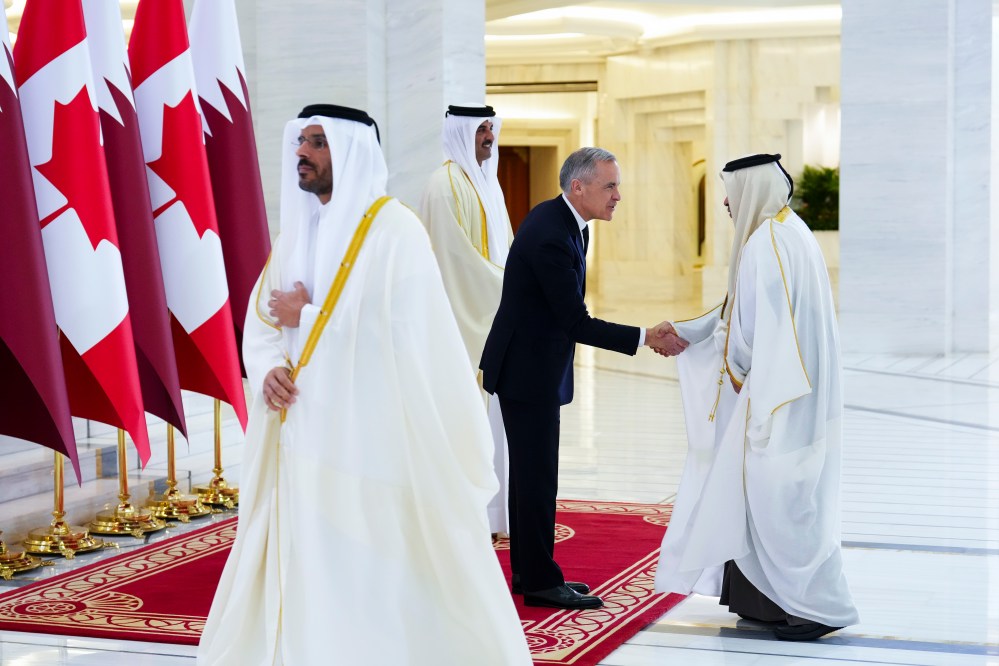
He has already signalled plans to travel to Saudi Arabia at some point on the invitation of Crown Prince Mohammed bin Salman.
“The breadth and depth of our relationship in the Gulf region is big, it’s expansive,” McGuinty told reporters in a virtual call from Doha alongside Anand on Thursday.
After decades of neglecting the region, Anand said, Canada is undertaking “a broader, long-term engagement” with the Persian Gulf.
“I want to stress that Canada’s work around the world now isn’t just economically focused,” Anand said Thursday, moments after signing a strategic partnership agreement with Qatar.
“We are here not only to grow the bilateral relationship but to show Canada’s support, not only in times of peace but also in this very difficult time of conflict.”
Their visits came as the U.S. war on Iran continued to roil the Middle East and international energy markets.
University of Ottawa professor Thomas Juneau, who specializes in the region, said Canada is still lagging but catching up to its peers on pursuing investment from wealthy oil states and co-operation in diplomacy, security and artificial intelligence.
Those efforts include tracking AI adoption in Dubai, green energy in Saudi Arabia and the diplomatic talks Qatar has overseen between warring parties such as Israel and Hamas.
“Canada has largely neglected the Persian Gulf,” Juneau said. “We still see them as oil and natural gas powers. Obviously, that’s true but it is simplistic, it is reductive.”
Anand said Thursday Canada’s partnership with Qatar will span culture, boosting visa processing and tourism. It’s among the Gulf countries where Canada is allowing more direct flights. She said she will be back in the region for a fourth time this year for a meeting of the Gulf Co-operation Council in June.
Juneau said after the U.S. decision to launch a war on Iran, Gulf countries “are looking to diversify their political, security and military partnerships beyond the United States.”
“They are not moving away completely from the U.S., either to China, to Russia or to anybody else. But they are trying to put a few eggs in other baskets,” he added.
The Gulf Research Center, a think tank based in Saudi Arabia, noted in a January report that Canada could do more with regional players on mediation.
“Canada has much to offer regarding softer security issues, such as enhancing collaboration on humanitarian aid and advancing peace negotiations in conflict zones,” the report reads.
The region has a dire human rights record and Juneau said Carney and his ministers have been conspicuously silent on those issues — largely because raising them can undermine efforts to gain influence without improving the situation.
He added that Canada has a track record of pushing to deepen ties with countries and regions before letting up as priorities shift.
“The engagement needs to be sustained. There needs to be prime ministerial visits, there needs to be ministerial visits. Our embassies need to be better staffed, they need to be engaged on the ground,” Juneau said.
He said it’s clear Ottawa has three priority countries in the region: Saudi Arabia, Qatar and the UAE.
Carney’s invitation to Saudi Arabia follows a gradual thaw in bilateral relations that began after the Trudeau government criticized the kingdom’s justice system and its treatment of women.
A Carney visit would show “the willingness of both countries to go back to more serious relation — and actually try to take it a step further from what it was before 2018,” Juneau said.
Economically, Canada could expand trade and work on building infrastructure in Saudi Arabia, which has planned various megaprojects.
During his January visit to Doha, Carney said Qatar committed to “significant strategic investments” in Canada’s major projects, including energy projects, though he did not mention any specific sums.
Qatar is an American ally that has taken on increasing diplomatic importance. It hosted negotiations between Israel and Hamas and assisted Canada’s work to bring Ukrainian children abducted by Russia back to their families.
Like the United Arab Emirates, Qatar is home to a large number of Canadian workers, particularly in white collar professions.
As of March 8 — days into the U.S. and Israeli war on Iran — 9,777 Canadians had registered their presence in Qatar with Global Affairs Canada and 30,632 had done so in the United Arab Emirates.
Carney has been courting UAE investment in critical mineral development, the energy sector, ports and AI. He has avoided criticizing the country over widespread allegations it is fuelling a genocide in Sudan.
On a visit last November to Abu Dhabi, Carney said the UAE had pledged to invest tens of billions of dollars in Canada, though no official commitment or timeline has been presented.
Juneau said the country has been “massively investing in artificial intelligence” and went on a green push ahead of hosting a United Nations climate change conference in 2023.
This report by The Canadian Press was first published May 14, 2026.