
New branch of Montreal’s REM is second-longest aerial rail network in Canada
Advertisement
Read this article for free:
or
Already have an account? Log in here »
We need your support!
Local journalism needs your support!
As we navigate through unprecedented times, our journalists are working harder than ever to bring you the latest local updates to keep you safe and informed.
Now, more than ever, we need your support.
Starting at $15.99 plus taxes every four weeks you can access your Brandon Sun online and full access to all content as it appears on our website.
Subscribe Nowor call circulation directly at (204) 727-0527.
Your pledge helps to ensure we provide the news that matters most to your community!
To continue reading, please subscribe:
Add Brandon Sun access to your Free Press subscription for only an additional
$1 for the first 4 weeks*
- Enjoy unlimited reading on brandonsun.com
- Read the Brandon Sun E-Edition, our digital replica newspaper
*Your next Free Press subscription payment will increase by $1.00 and you will be charged $20.95 plus GST for four weeks. After four weeks, your payment will increase to $24.95 plus GST every four weeks.
Read unlimited articles for free today:
or
Already have an account? Log in here »
MONTREAL –
With the new branch of Montreal’s light-rail system opening to the public on Monday, the REM —Réseau express métropolitain — is being touted as the second-longest aerial train network in Canada after Vancouver’s SkyTrain.
Four new stations over 14 kilometres of elevated track to the western region of Montreal Island will be free to ride between 9 a.m. and 6 p.m. over the weekend before their official opening.
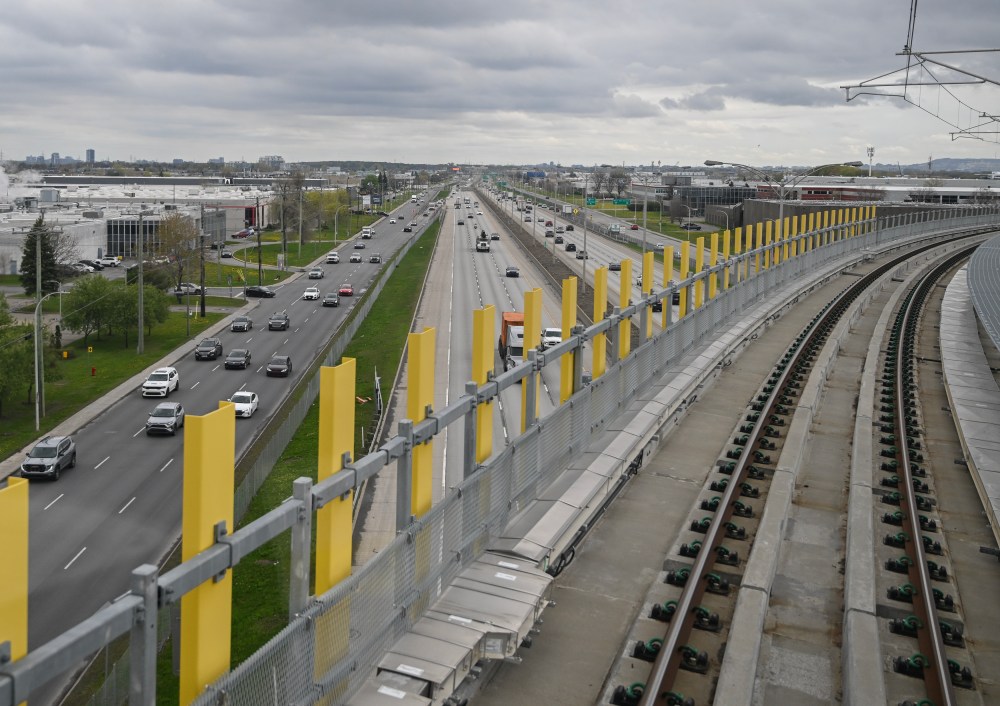
The new stations — Des Sources; Fairview—Pointe-Claire; Kirkland; and Anse-à-l’Orme — connect the towns of Pointe-Claire, Kirkland and Ste-Anne-de-Bellevue.
Carl Corbel is director of operations with the infrastructure division of Caisse de dépôt et placement du Québec, the province’s public pension fund manager and owner of the REM.
He says passengers in the West Island — a region known for inadequate public transit — will be able to travel from the Anse-à-l’Orme station to downtown Montreal in 35 minutes.
The segment was initially scheduled to go into service at the end of 2024. The deadline was pushed back twice, first to fall 2025 then spring 2026.
The final section of the REM linking to Montréal Trudeau International Airport is expected to open by the end of 2027.
In the meantime, the Aéroports de Montréal says it will fund a shuttle service linking the Des Sources station to the airport, which it expects to launch mid-June.
An agreement between the airport and the agency that plans, finances and organizes integrated transit in Greater Montreal — Autorité régionale de transport métropolitain — is being finalized.
In October 2025, CDPQ Infra promised to open the airport station in 2027. Julien Hurel, vice-president of the REM project at CDPQ Infra, says there are “no major challenges” to meet that deadline.
The REM’s timelines have been delayed several times, and it has faced criticism over outages on the Brossard branch linking to Montreal’s South Shore since it was launched.
Hurel said many of these issues have been addressed since the REM was first inaugurated in 2023.
“We have basically divided by two the number of breakdowns while we tripled the overall network,” he says.
When completed, the network will comprise 26 stations over 67 km of track across the greater Montreal area.
This report by The Canadian Press was first published May 15, 2026.