
WestJet, CUPE reach tentative deal as passengers scramble amid flight disruptions
Advertisement
Read this article for free:
or
Already have an account? Log in here »
We need your support!
Local journalism needs your support!
As we navigate through unprecedented times, our journalists are working harder than ever to bring you the latest local updates to keep you safe and informed.
Now, more than ever, we need your support.
Starting at $15.99 plus taxes every four weeks you can access your Brandon Sun online and full access to all content as it appears on our website.
Subscribe Nowor call circulation directly at (204) 727-0527.
Your pledge helps to ensure we provide the news that matters most to your community!
To continue reading, please subscribe:
Add Brandon Sun access to your Free Press subscription for only an additional
$1 for the first 4 weeks*
- Enjoy unlimited reading on brandonsun.com
- Read the Brandon Sun E-Edition, our digital replica newspaper
*Your next Free Press subscription payment will increase by $1.00 and you will be charged $20.95 plus GST for four weeks. After four weeks, your payment will increase to $24.95 plus GST every four weeks.
Read unlimited articles for free today:
or
Already have an account? Log in here »
CALGARY – WestJet and the union representing some 4,400 flight attendants reached a tentative deal Monday to resume work after a brief work stoppage, but neither side is sharing specifics yet.
The airline had said Sunday it had proposed a 13 per cent pay increase starting in October, and then a 2.5 per cent increase in each of the next three years until 2029.
The airline also said it offered a new duty pay premium, equivalent to another 12 per cent salary increase, which WestJet said is designed to solve the cabin crew’s claim of unpaid work.
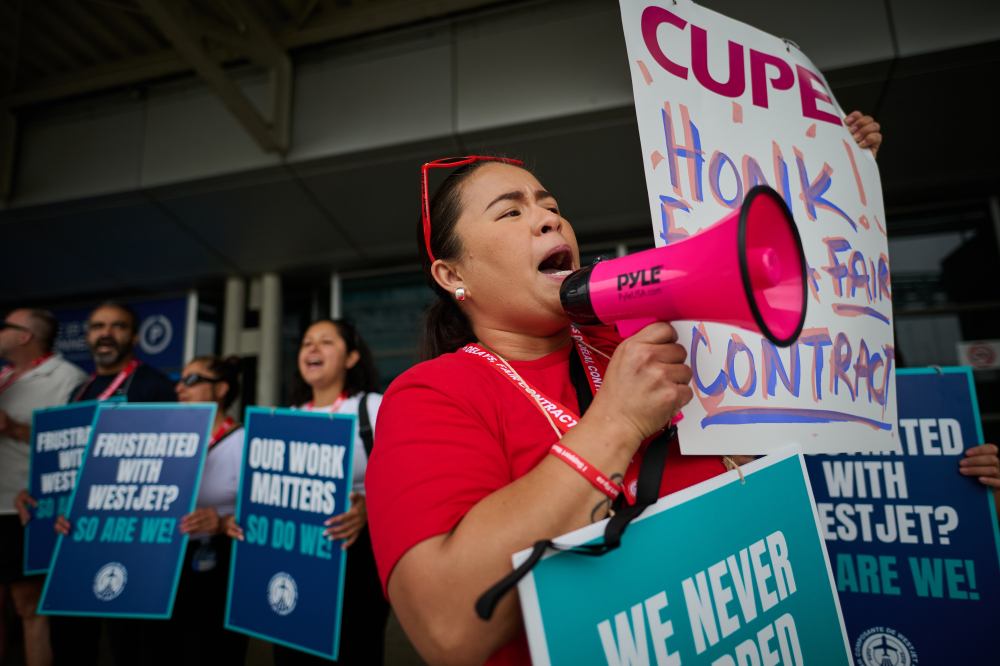
In a news conference in Calgary on Monday, CUPE local 8125 president Alia Hussain said the flight attendants have 30 days to ratify the agreement, and the union will spend the coming days preparing a slide show to present to the members.
She said the deal includes pay increases, but wouldn’t provide any further details in order to let members learn of it first.
The federal government says that airlines in Canada and internationally typically compensate flight attendants for their flight time or for a block of hours based on what the industry calls a credit-based system. It generally provides supplements to cover non-flight duties, although unions have been calling for more.
Hussain did however suggest the new deal addresses concerns around unpaid work.
“It improves on the long-standing flight credit system by recognizing more of the work that cabin crew are required to perform and increasing the compensation for that work,” Hussain told reporters outside the airport in Calgary.
“We wouldn’t bring a deal to our membership if we didn’t believe the puzzle pieces, in the way that they would come together, would be something they would ratify based on the circumstances we were facing.”
Flight attendants walked off the job early Sunday morning, after failing to reach a new contract with the airline. WestJet then grounded all flights on a long summer weekend across much of Canada.
Contract talks had been ongoing in Calgary since January, with WestJet and the CUPE WestJet Component at odds over wage increases and the cabin crew’s claim of unpaid ground work.
There was no word Monday on when the airline would be able to resume its normal operations and schedule, but flights were slowly starting to resume by Monday afternoon.
Still, passengers were decisively frustrated Monday as they scrambled to change their travel plans at the end of the long weekend.
At Toronto’s Pearson airport, some customers were sprawled out on the floor, glued to their phones on hold with customer service.
Derek McCrimmon said his flights have been rebooked four separate times, and he hasn’t slept in two days. After nearly 11 hours on hold with WestJet trying to return home from a weekend wedding, the airline claimed to have booked him a flight home to Calgary from Ottawa with a connection at Toronto Pearson.
But he said the airline failed to book the Toronto-Calgary leg of his trip and is now instructing his group of friends to rent a car and drive back to Ottawa.
“It’s been a complete nightmare,” he said at the WestJet check-in area. “The customer service is horrible.”
McCrimmon said he has been spending $300 a night on hotel rooms and is booking a $1,500 flight home with another airline.
Bouncing her sleepy four-month-old daughter in her arms, Daniela Arango anxiously glanced over her shoulder to watch her husband discuss their options with a customer service agent.
She said her direct flight home to Edmonton was cancelled. Instead, the family was offered a Toronto-Waterloo-Calgary-Edmonton trip — with an eight-hour layover between each leg and a $3,000 price tag. She said she hasn’t received consideration for travelling with a newborn baby.
“We came here to look for answers … but they’re like, ‘No, we cannot change it,’” Arango said.
In Montreal, Morgane Liquori was heading to London for a wedding Friday, but her flight Sunday was cancelled. She said she still doesn’t know when she’ll be able to re-book.
“It was my first time flying WestJet, and it’ll be my last,” she said.
Liquori tried calling the company twice. The first time, she was on hold for 45 minutes, and the second, for close to two hours. She said both calls ended when the line finally connected, then hung up the call.
“We don’t know where to go. I walked around the airport. I’m tired,” she said.
In a news release, WestJet CEO Alexis von Hoensbroech apologized for the disruptions, acknowledging the frustrations they have caused.
“Our teams are working hard to restore service and get our guests on their way to their destinations as quickly as possible and we appreciate everyone’s patience as we get back to normal,” von Hoensbroech said.
In Halifax, sisters Zahra Fazli and Hiba Fazli say WestJet has left them stranded as they have not been able to rebook flights back home to Toronto.
They were alerted to their cancelled flight in an email Monday morning that included a link to rebook, but they say the link appeared to be broken.
Hiba Fazli said she knows it’s not the staff at the WestJet counter’s fault that they’ve been unable to get information about their flight or rebook, but that it’s frustrating to be left without answers.
“We don’t know how the company is handling it because they’re not telling their customers anything,” she said. “These people at the counter, they’re just listening to customers and apologizing because they have no idea what else to do.”
Ravleen Kaur, who’s been staying in Halifax and is trying to get back home to India, said getting answers from WestJet has been impossible. She showed up to the airport Monday in hopes of rebooking her travel after spending hours on hold with WestJet’s customer service line over the weekend.
“I tried the live chat on their website, it told me to speak to an agent, and then told me there were no agents available … there’s no communication about what’s happening,” Kaur said.
This report by The Canadian Press was first published Aug. 3, 2026.
— With files from Sarah Smellie in St. John’s, Nick Murray in Ottawa, Elissa Mendes in Toronto, Marieke Glorieux-Stryckman in Montreal, and Lyndsay Armstrong in Halifax.
Note to readers:This is a corrected story. A previous version stated WestJet and the union representing its flight attendants had reached a deal that included a 13 per cent pay increase starting in October, and then a 2.5 per cent increase in each of the next three years. In fact, these provisions were details made public on Sunday by WestJet of its latest offer to the union. Neither WestJet, nor the union released details of the tentative deal on Monday.