
‘We don’t even have a phone’: Aging B.C. wildfire evacuees faced unique challenges
Advertisement
Read this article for free:
or
Already have an account? Log in here »
We need your support!
Local journalism needs your support!
As we navigate through unprecedented times, our journalists are working harder than ever to bring you the latest local updates to keep you safe and informed.
Now, more than ever, we need your support.
Starting at $15.99 plus taxes every four weeks you can access your Brandon Sun online and full access to all content as it appears on our website.
Subscribe Nowor call circulation directly at (204) 727-0527.
Your pledge helps to ensure we provide the news that matters most to your community!
To continue reading, please subscribe:
Add Brandon Sun access to your Free Press subscription for only an additional
$1 for the first 4 weeks*
- Enjoy unlimited reading on brandonsun.com
- Read the Brandon Sun E-Edition, our digital replica newspaper
*Your next Free Press subscription payment will increase by $1.00 and you will be charged $20.95 plus GST for four weeks. After four weeks, your payment will increase to $24.95 plus GST every four weeks.
Read unlimited articles for free today:
or
Already have an account? Log in here »
VANCOUVER – Helen Benallick said she was fast asleep with her husband at their home in Summerland, B.C., last week when she was woken up by neighbours ringing her doorbell.
They told the couple they needed to escape the Bald Range wildfire that was racing toward the community — Benallick, 87, and her husband had missed the evacuation orders that were issued to cellphones across the region overnight on Aug. 7.
“We don’t even have a phone,” she said in an interview, and without their neighbours they “would have slept right through it.”
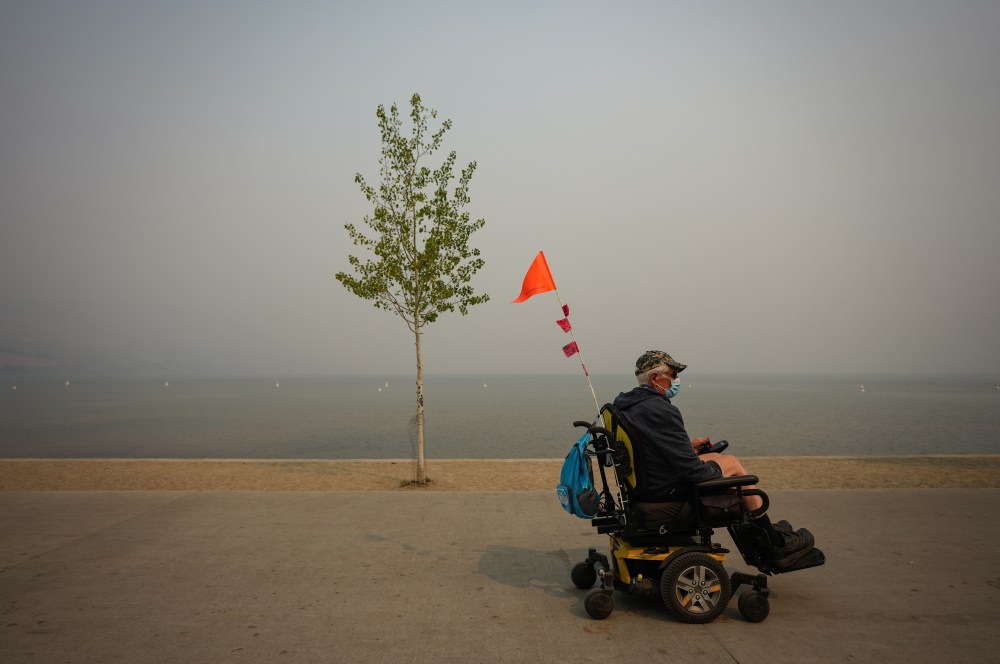
The Benallicks are among a senior population in Summerland that is 57 per cent higher than the rest of B.C., the 2021 census indicates, adding to the challenges for evacuees and those tasked with getting them to safety.
“We didn’t take what we should have, you know, but I have nine pairs of underpants,” Benallick joked from the evacuation centre in Penticton, B.C., about five days later.
Summerland, with a population of about 12,000, is home to several large seniors homes. About 32 per cent of the community is 65 and over, compared to 20 per cent across the province.
Dan Levitt, B.C.’s seniors advocate, acknowledged the work of emergency management and care home staff during the evacuation of the entire community, calling it a “job well done.”
“It could have been a lot different, but I think the first responders and emergency personnel and the care home operators worked extremely well,” he said.
“These are certainly challenging conditions and we appreciate the dedication of everyone who’s been part of this and how the government has, with the state emergency, really supported and protected (residents), especially older people who are more impacted by wildfires than other people.”
But Levitt said the quick evacuation highlighted the unique challenges seniors faced during wildfire emergencies.
He highlighted what he called “digital inequity” among the senior population, which he said could be driven by the cost of smartphones and other electronics.
That divide, he said, could prove costly if alert systems relied on people having access to digital devices.
“We have to make sure that we’re reaching out to seniors, especially in rural and remote B.C., where they may not have those connections, and make sure that we are thinking about the seniors who are our neighbours and who live in our community so that they are able to get the help they need, especially during an emergency.”
Levitt also noted seniors are more affected by the wildfire smoke.
Among those feeling the impacts was 69-year-old Faulder evacuee Cameron Forster. He said he has chronic obstructive pulmonary disease, a long-term lung condition that blocks airflow and makes breathing hard.
He said his lungs hurt as a result of the smoke that had settled over Penticton in the days after the evacuation.
“I come down, have a smoke, go back into my air-conditioned room, and I don’t like air conditioning,” he said from the lobby of his Penticton hotel room.
Levitt said other concerns during wildfires for the aging population included mobility challenges and the inability to regulate body temperatures. He said they are also more likely to have cognitive impairments and when displaced, it may be more disorienting.
“Those seniors who are isolated and not necessarily connected with other people makes it very difficult for emergency personnel to help evacuate them and find where they are and help them navigate to the emergency,” he said.
Getting seniors to safety was the main priority during times of emergency, he said.
“Once they found a place that was safe, the next thing is to communicate with families to make sure that their loved ones know of their new address and that they can visit them and stay connected with them,” he said.
B.C.’s Health Ministry said in a statement that all health authorities were required to have emergency preparedness plans for all health care and long term facilities.
The only known victim of the fire was an 80-year-old woman, although the details about her death remain unclear. RCMP said she died suddenly while trying to evacuate her home in Meadow Valley, west of Summerland.
Levitt called the news heartbreaking.
“We don’t know all the circumstances around her death, however, it reinforces the importance of checking in on seniors in your lives and having a plan before an evacuation order is issued,” he said.
“Don’t wait for that evacuation or to figure out how you’re going to get out, know where you will go, know how to get there and know who can help you,” he said.
He said older adults should have a support network of people who know their needs and can check on them.
Levitt said it was also important for people to plan to ensure they bring medication, mobility aids, glasses, hearing aids, important documents or other essentials.
Eighty-three-year-old evacuee David Hanna was in a chair at the evacuation centre on Wednesday, his cane propped beside him.
He said he was a resident of Parkdale Place Seniors Living in Summerland, and recalled hearing hammering on his door around 11:30 p.m. on Aug. 7. Hanna said it was a maintenance worker and an RCMP officer, who told him he had to get out immediately.
“We had to leave, there was no argument about it, and they were courteous, but we still had to leave,” he said.
“I had a go-to bag, grabbed it with my cane and (I was) gone. Unfortunately, I left my four-wheeler (walker) behind.”
He said the residents were set up at a motel, which he said was “not too bad at all,” but he is still eager to go back home.
While the structural losses have not yet been announced, Forster, from Faulder, said he was certain he won’t have a home to go back to. But he is trying to remain positive.
“My philosophy from now on will be, ‘phoenixes rise from the ashes,'” he said. “I’m 69 years old. I’ve been there, done it too many times, so let’s try one more kick at the cat, and I’m going to get a good kick.”
Levitt said the situation in Summerland, though it went smoothly, highlights how emergency systems need to be prepared for B.C.’s growing older population, particularly as wildfires become more frequent and severe.
He called for a “cross-ministerial seniors plan” in B.C. to consider health, housing and transportation in emergency management planning for aging populations.
“We have to take into special consideration older adults who are going to be much more reliant on those emergency preparedness supports from the province than other populations because they can’t necessarily just get in the car and go,” he said.
“Seniors should not have to manage those emergencies like wildfires on their own.”
This report by The Canadian Press was first published Aug. 15, 2026.