
B.C. forestry leader backs Canada’s trade walkout despite possible softwood progress
Advertisement
Read this article for free:
or
Already have an account? Log in here »
We need your support!
Local journalism needs your support!
As we navigate through unprecedented times, our journalists are working harder than ever to bring you the latest local updates to keep you safe and informed.
Now, more than ever, we need your support.
Starting at $15.99 plus taxes every four weeks you can access your Brandon Sun online and full access to all content as it appears on our website.
Subscribe Nowor call circulation directly at (204) 727-0527.
Your pledge helps to ensure we provide the news that matters most to your community!
To continue reading, please subscribe:
Add Brandon Sun access to your Free Press subscription for only an additional
$1 for the first 4 weeks*
- Enjoy unlimited reading on brandonsun.com
- Read the Brandon Sun E-Edition, our digital replica newspaper
*Your next Free Press subscription payment will increase by $1.00 and you will be charged $20.95 plus GST for four weeks. After four weeks, your payment will increase to $24.95 plus GST every four weeks.
Read unlimited articles for free today:
or
Already have an account? Log in here »
VANCOUVER – A leader in British Columbia’s forestry sector is voicing support for Prime Minister Mark Carney’s decision to walk away from trade talks with the United States despite reported concessions on lumber tariffs in a scuttled deal.
Kim Haakstad, president of the BC Council of Forest Industries, says the breakdown of talks will create challenges for her sector, but Ottawa had to walk away if negotiators couldn’t secure a deal that worked for Canadians broadly.
Haakstad’s comments come after U.S. Trade Representative Jamieson Greer told American media on Saturday that President Donald Trump’s administration had offered to cut tariffs on lumber during the talks that collapsed last week.
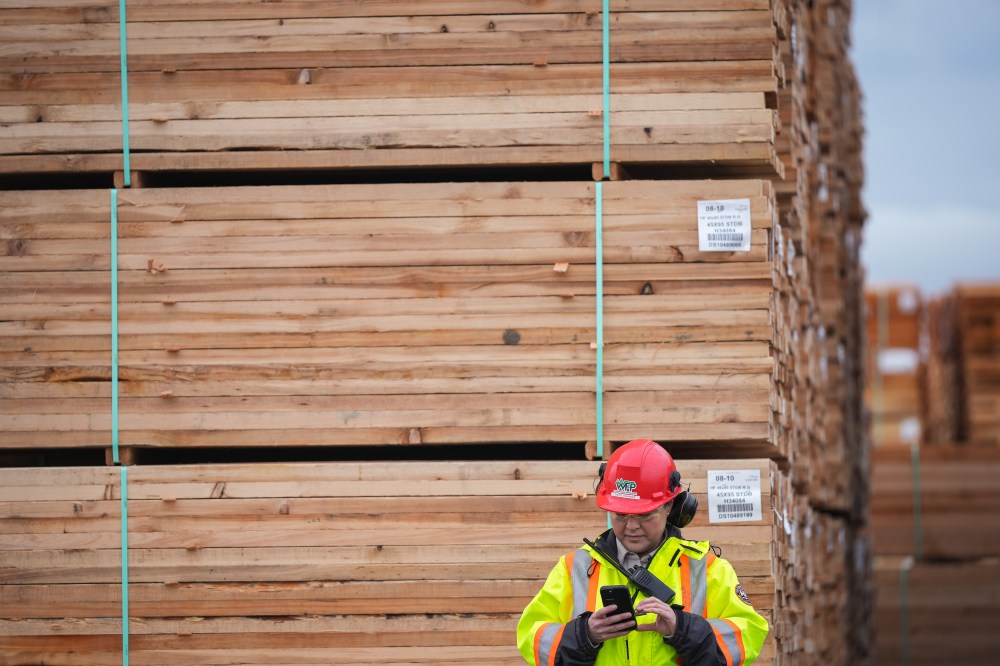
B.C. Premier David Eby said Tuesday that he understood some progress had been made in addressing the long-standing softwood lumber dispute during the most recent talks and it was “disappointing” to see that fail to materialize.
But Eby said that doesn’t mean Canada should have stayed in the talks if the deal was going to be detrimental to the country as a whole, a sentiment Haakstad echoed.
She says it is now up to the provincial and federal governments to address the impacts of the punishing U.S. tariffs triggered by the breakdown of talks.
Haakstad called for measures including reducing regulatory restrictions to allow quicker access to B.C. lumber for a more competitive product on the global market.
“We have a regulatory environment that has got, I believe, overly complex,” she said in an interview on Wednesday. “We’re asking to make sure that it is streamlined in a way that the regulations make sense and are reducing the costs.”
It can take two to three years for a company to secure a forest cutting permit in a lengthy process that “costs too much money,” Haakstad said.
She said Ottawa could also help by addressing rail transport costs, a significant barrier for Canadian lumber producers looking to sell products domestically.
“Rail costs have gone up 40 per cent since 2018 for moving forest products across Canada,” she said. “That’s an example of something that we would like to work with the federal government on, to make sure that we’re getting that into a more manageable cost.”
Eby has pressed to address the softwood lumber dispute in trade talks with the Trump administration, but said people shouldn’t be “naive” about the potential benefits had a deal been reached between the two countries in the latest round.
“Any agreement that would have been signed with this president wouldn’t have lasted as long as it took him to write his signature,” the premier said, adding Canada had to stand up to “a thug and a bully.”
This report by The Canadian Press was first published Aug. 26, 2026.