
Trump contacted Apple directly to change name of Lake Ontario to Lake America: Burgum
Advertisement
Read this article for free:
or
Already have an account? Log in here »
We need your support!
Local journalism needs your support!
As we navigate through unprecedented times, our journalists are working harder than ever to bring you the latest local updates to keep you safe and informed.
Now, more than ever, we need your support.
Starting at $15.99 plus taxes every four weeks you can access your Brandon Sun online and full access to all content as it appears on our website.
Subscribe Nowor call circulation directly at (204) 727-0527.
Your pledge helps to ensure we provide the news that matters most to your community!
To continue reading, please subscribe:
Add Brandon Sun access to your Free Press subscription for only an additional
$1 for the first 4 weeks*
- Enjoy unlimited reading on brandonsun.com
- Read the Brandon Sun E-Edition, our digital replica newspaper
*Your next Free Press subscription payment will increase by $1.00 and you will be charged $20.95 plus GST for four weeks. After four weeks, your payment will increase to $24.95 plus GST every four weeks.
Read unlimited articles for free today:
or
Already have an account? Log in here »
WASHINGTON – U.S. President Donald Trump contacted Apple directly to pressure the tech giant to change the name of Lake Ontario to “Lake America,” a top administration official said Monday.
U.S. Interior Secretary Doug Burgum told the Fox Business network the body of water’s name might soon change on Apple maps.
Trump signed an executive order last week to rename the Great Lake as tensions between the United States and Canada escalated following a breakdown in trade talks.
Google Maps updated its service to identify the body of water as “Lake America” for users in the United States over the weekend. The company said in a post on its corporate website Saturday the change was made because the U.S. government’s geographic names database had formally renamed the lake.
Users in Canada will still see it displayed as Lake Ontario on Google Maps, while people elsewhere in the world will see both names.
Apple has not yet responded to a request for comment.
In a social media post Thursday, Prime Minister Mark Carney said Canadians know Lake Ontario will be known by its original name, “then, now and always.”
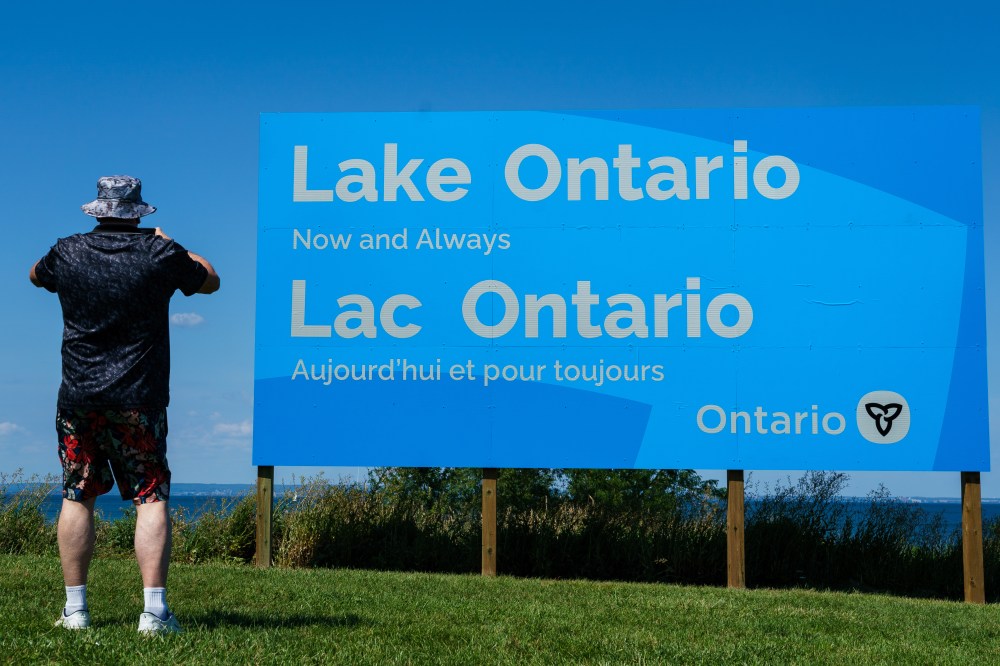
Ontario Premier Doug Ford unveiled a large sign declaring “Lake Ontario, now and always” on Saturday. Trump, meanwhile, spent much of the weekend posting on social media about the name change and making inaccurate claims about Canada.
Republicans and members of Trump’s administration fanned out across U.S. news stations Monday to make the case for the name change and Trump’s tariffs on Canada.
When asked whether the U.S. is in a “tit-for-tat” trade war with Canada on CNBC, Treasury Secretary Scott Bessent said, “I don’t think you can be in a tit-for-tat with someone who’s 13 times larger than you are.”
He accused Carney of turning the trade talks into a “political shouting match” and said the U.S. isn’t at war with Canada.
“What are they going to do, take their two submarines from the Edmonton mall and sic them on us?” Bessent said.
When Republican Rep. Andy Harris of Maryland was asked about trade tensions on the far-right Newsmax news service, he suggested the United States make Alberta the 51st state and said there’s “tremendous oil reserves there.”
“The socialism doesn’t work in Western Canada,” he said. “A lot of those provinces don’t want to be associated with Ottawa and the president is taking advantage of it.”
But the move to change the lake’s name faced widespread pushback, even from members of the Republican party. As midterm and gubernatorial elections loom, the current tensions in the bilateral relationship could be problematic for Republican candidates in states that trade heavily with Canada.
Lake Ontario, one of the five Great Lakes, is located between Ontario and New York. The name comes from the Wendat word Ontari:io, which means “the lake is beautiful, the lake is big.”
The Canadian province is named after the lake.
Indigenous leaders on both sides of the border have called Trump’s order blatantly disrespectful and a violation of treaties.
Assembly of First Nations National Chief Cindy Woodhouse said Monday that Indigenous languages, people and nations existed long before Confederation or the U.S. Constitution.
“Like the lake itself, our people will be here long after any administration has come and gone,” she said.
Over the weekend, “Lake America” popped up on maps available on the websites of Hydro One, Ontario transit service provider Metrolinx and the Liquor Control Board of Ontario, as well as websites connected to other provinces.
Hydro One blamed the name’s appearance on its power outage map on a third-party service. Hydro One did not respond to questions Monday about which service it uses for naming, but the map showed Google’s name in corner.
Google uses the U.S. Geographic Names Information System to populate its maps. The database maintained by the U.S. Geological Survey, a federal science agency, contains records for more than one million geographic features in the U.S., including lakes, streams, summits, valleys and ridges.
Bri Watson, an assistant professor in Western University’s faculty of information and media studies, said organizations in need of mapping have come to rely on the database because it’s comprehensive and cheaper than creating one from scratch.
“These companies just are using whatever free data sets are available and the freest data set is the data set the United States government developed and put out over public domain,” Watson said.
That means that when there’s a political dispute over a place’s name, it “can set off a bunch of awkwardness,” Watson said.
This report by The Canadian Press was first published Aug. 31, 2026.
— With files from Kyle Duggan and Alessia Passafiume in Ottawa and Tara Deschamps in Toronto