
Mark Carney is banking on economic reconciliation but critics say he’s not on track
Advertisement
Read this article for free:
or
Already have an account? Log in here »
We need your support!
Local journalism needs your support!
As we navigate through unprecedented times, our journalists are working harder than ever to bring you the latest local updates to keep you safe and informed.
Now, more than ever, we need your support.
Starting at $15.99 plus taxes every four weeks you can access your Brandon Sun online and full access to all content as it appears on our website.
Subscribe Nowor call circulation directly at (204) 727-0527.
Your pledge helps to ensure we provide the news that matters most to your community!
To continue reading, please subscribe:
Add Brandon Sun access to your Free Press subscription for only an additional
$1 for the first 4 weeks*
- Enjoy unlimited reading on brandonsun.com
- Read the Brandon Sun E-Edition, our digital replica newspaper
*Your next Free Press subscription payment will increase by $1.00 and you will be charged $20.95 plus GST for four weeks. After four weeks, your payment will increase to $24.95 plus GST every four weeks.
Read unlimited articles for free today:
or
Already have an account? Log in here »
OTTAWA – When Wilton Littlechild was co-chairing the landmark Truth and Reconciliation Commission more than a decade ago, he thought a lot about the idea of economic reconciliation and how it could help transform Indigenous communities.
“You may have the best ideas in the world but without a fundamental grounding and foundation to self-determination, you’re missing a very important part,” Littlechild said in an interview with The Canadian Press.
Littlechild said economic reconciliation is still the key to achieving reconciliation between Indigenous and non-Indigenous Canadians — but not in the way Prime Minister Mark Carney sees it.
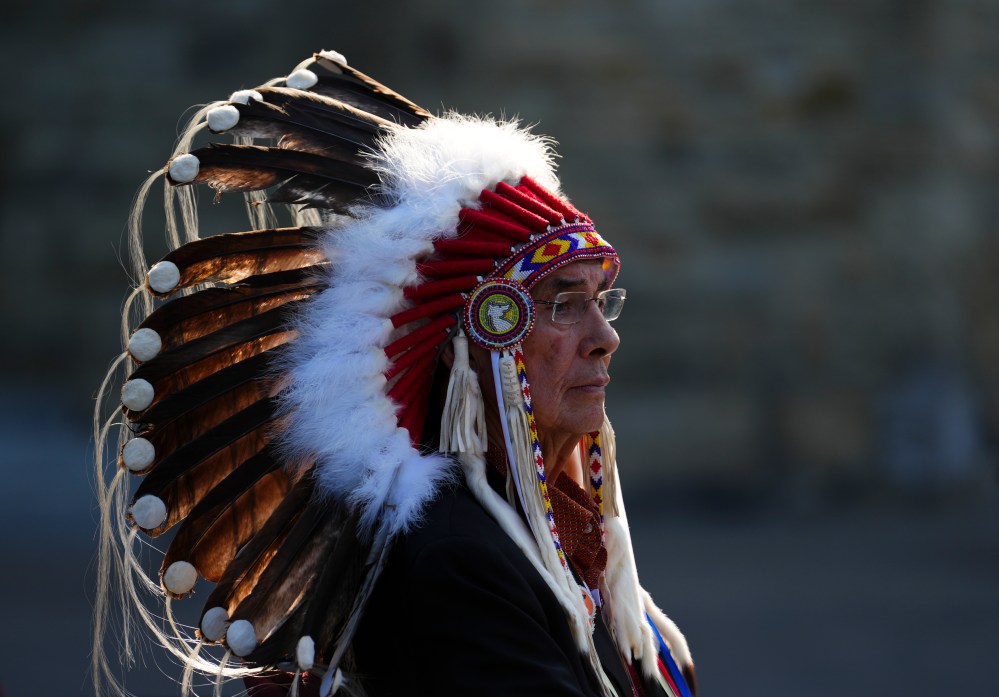
The Truth and Reconciliation Commission, launched out of a legal settlement between the federal government and survivors of residential schools, was tasked with researching the history and legacy of those institutions. It was chaired by Littlechild, Murray Sinclair and Marie Wilson.
Between 1857 and 1996, 150,000 Indigenous children were forced to attend church-run, government-funded schools. They were barred from speaking their languages in institutions often rife with abuse and located far away from their families and communities.
The Truth and Reconciliation Commission initially documented the deaths of 3,200 children attending residential schools. Experts at the National Centre for Truth and Reconciliation — who continue to comb through millions of records — say the actual number could be much higher.
The Truth and Reconciliation Commission concluded in 2015 the goal of the schools was to erase Indigenous cultures. MPs unanimously voted to recognize residential schools as a form of genocide in 2022.
Economic reconciliation is mentioned twice in the Truth and Reconciliation Commission’s 94 Calls to Action. They call on the corporate sector to engage in meaningful consultations before proceeding with economic development projects, and to ensure Indigenous people have equitable access to jobs in those projects.
The federal government under Carney has made economic reconciliation the focus of its efforts to rebuild relations with Indigenous Peoples as it pushes forward an aggressive major projects agenda in the face of U.S. President Donald Trump’s trade war.
Littlechild said that while Carney has been focused on securing overseas investments, he’s ignoring the rights of Indigenous Peoples at home and sidelining their traditional economies by fast-tracking legislation that would allow for quicker project approvals and environmental reviews.
He said Carney’s approach risks alienating Indigenous communities and the federal government’s idea of economic reconciliation falls short of the efforts industry is making to work in partnership with communities. He said he also fears traditional economies — hunting, fishing, trapping — could be damaged by an aggressive approach to resource development.
“Right now, it’s like a four-legged stool with one leg missing,” Littlechild said. That missing leg, he said, is true respect for Indigenous rights.
The federal government’s Bill C-39, known as the Building Canada Strong Act, seeks to approve projects within one year. First Nations chiefs say they worry that will severely compress the timeline for their communities to complete land-use assessments and consultations.
Similar legislation introduced by Ontario Premier Doug Ford’s government is being challenged by Indigenous and environmental groups in court.
And while Ottawa’s focus has shifted to economic reconciliation, the TRC’s Calls to Action that touch more on social issues are languishing, Littlechild said.
“(Carney is) approaching things by violating treaty rights, by violating the United Nations Declaration on the Rights of Indigenous Peoples, and just steamrolling on national interest strategies that completely exclude us by way of disrespect,” he said.
Indigenous Services Minister Mandy Gull-Masty disagreed with the suggestion that Carney does not prioritize Indigenous rights or the social issues faced by communities.
“There is a lot of institutional reconciliation that’s happening,” Gull-Masty told The Canadian Press, citing work on reforming child and family services.
“And to me, that institutional reconciliation is maybe not language people are familiar with, but it is in progress and it is occurring.”
Hayden King, executive director of the Yellowhead Institute, said he wonders what those institutional commitments are — since First Nations are still waiting for the government to pass clean drinking water legislation, improve their access to health care, address the crisis of missing and murdered Indigenous women and girls, and reduce incarceration and over-policing in their communities.
“All I’ve heard Carney talk about is resource development,” King said.
“You can look at all of the proposals to improve the relationship, institutionally or otherwise, and it’s just a record of neglect.”
Yellowhead released a report last year on major projects and the conflicts that could arise from Indigenous participation — including the prospect of one First Nation violating the rights of another in order to invest in a controversial project.
King said Carney’s approach to relations with Indigenous communities puts him more in line with former prime minister Stephen Harper than with Justin Trudeau. Harper’s government also introduced legislation to speed up project approvals, leading to the Idle No More movement that staged protests across the country in 2012.
“Where Harper was the stick, Carney is the carrot,” King said.
The “carrot” approach can be seen in how Carney’s cabinet is encouraging First Nations to back the Trans Mountain pipeline through a low-cost loan and a $2.5 million payment for willing investors that some are comparing to a bribe.
“The discourse around (economic reconciliation) is most definitely that Indigenous people are going to be formal partners and this is going to breathe life into Indigenous sovereignty,” King said.
“But it’s the reverse of the process that the TRC advocated for — it was, ‘Let’s get this relationship right, and then we can talk about partnerships.'”
King said economic reconciliation can’t be achieved until Indigenous groups no longer have to fight for their rights and their land in court.
“If we’re really interested in holding up sovereignty and jurisdiction, then we have to insist on consent, and consent means knowing all the details before we make decisions.”
Stephanie Scott heads the National Centre for Truth and Reconciliation, which works to preserve the historical record of residential schools and educate Canadians about what happened in the institutions.
She said while economic reconciliation can help create opportunities, strengthen communities and support Indigenous governance, reconciliation is about people — the survivors, their families, communities and future generations.
She pointed to the growing tide of residential school denialism — which scholars have warned risks unwinding decades of progress in the relationship between Indigenous and non-Indigenous Peoples.
“In a time when truth is being challenged and distorted, the need for trusted institutions to preserve, protect and share the historical record has never been greater,” Scott said.
NDP MP Leah Gazan has put legislation to criminalize residential school denialism before the House of Commons, but the Liberals have not indicated they will support it.
Calls for its passage grew louder this week after a group linked with white nationalism reportedly staged a demonstration in the B.C. interior.
Roseanne Casimir, chief of Tk̓emlups te Secwepemc First Nation, said on Sunday a group of masked individuals dropped a banner from an overpass in Kamloops, B.C. The banner — bearing the words “Got bones?” — appeared to be questioning reports of human burials at the former sites of residential schools.
The demonstration happened just days ahead of the National Day for Truth and Reconciliation, a day to honour the children who attended residential schools and to remember the ones who never came home.
Scott said that while Canada’s future depends on trust, justice and shared prosperity, those things can’t exist without truth.
“Residential school denialism is not harmless dialogue or a difference of opinion. It is a deliberate misinterpretation of the history and is an ongoing source of harm to Indigenous Peoples,” Scott said.
Littlechild said the way forward is to work together — both on the economy and on the social issues that have afflicted Indigenous communities for decades.
“We’re not taking advantage of opportunities because they’re still building a fence between us by not including us,” he said.
This report by The Canadian Press was first published Sept. 30, 2026.