
Liberals will table 2026 federal budget on Nov. 5, finance minister says
Advertisement
Read this article for free:
or
Already have an account? Log in here »
We need your support!
Local journalism needs your support!
As we navigate through unprecedented times, our journalists are working harder than ever to bring you the latest local updates to keep you safe and informed.
Now, more than ever, we need your support.
Starting at $15.99 plus taxes every four weeks you can access your Brandon Sun online and full access to all content as it appears on our website.
Subscribe Nowor call circulation directly at (204) 727-0527.
Your pledge helps to ensure we provide the news that matters most to your community!
To continue reading, please subscribe:
Add Brandon Sun access to your Free Press subscription for only an additional
$1 for the first 4 weeks*
- Enjoy unlimited reading on brandonsun.com
- Read the Brandon Sun E-Edition, our digital replica newspaper
*Your next Free Press subscription payment will increase by $1.00 and you will be charged $20.95 plus GST for four weeks. After four weeks, your payment will increase to $24.95 plus GST every four weeks.
Read unlimited articles for free today:
or
Already have an account? Log in here »
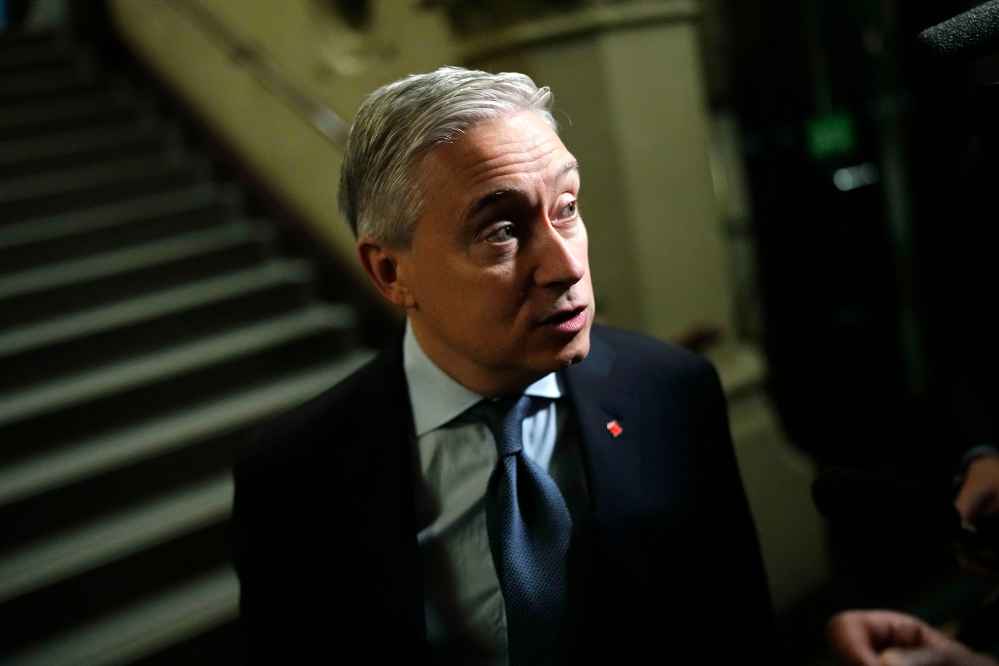
OTTAWA – The federal Liberal government will table its 2026 budget on Nov. 5, Finance Minister François-Philippe Champagne said Tuesday.
The upcoming fiscal plan will be the second delivered under Prime Minister Mark Carney and comes as Canada’s economy faces strong headwinds from U.S. tariffs and other geopolitical forces.
Champagne announced the date during question period in the House of Commons. He said the budget will “outline the next steps in our plan to build a stronger, more resilient and more affordable Canada.”
Since taking office, Carney has tried to reorient federal spending away from the day-to-day operations of government and instead focus borrowing on an aggressive infrastructure agenda.
That has meant generally higher deficits, even as the government tries to find savings from daily operations.
Canada’s economy showed some resilience in the second quarter but growth is under renewed pressure after the collapse of trade talks with the United States in August. The two countries have reignited a tariff dispute, with both sides imposing new duties at the border.
Parliamentary Budget Officer Annette Ryan published an updated economic outlook on Tuesday that casts doubt on Ottawa’s ability to meet some of its key fiscal anchors.
The PBO is now calling for real gross domestic product growth of 0.9 per cent for this year and 1.5 per cent in 2027.
The forecast is down from estimated growth of 1.1 per cent and 1.6 per cent, respectively, issued in June. The budget watchdog blamed pressure from tariffs for the downgrade.
Higher gas prices tied to the war in the Middle East have lifted federal revenues in the near term, but Ryan warns in the report that new spending announcements since the spring have outpaced that windfall.
The PBO now expects a $63.3-billion deficit in fiscal 2026-27, down from a forecast of $71.8 billion in its June outlook. The office sees annual deficit levels peaking at $70.2 billion the following year.
The PBO forecasts that federal deficits will be an average of $3 billion higher annually over the next five years than the office projected in June.
As for Ottawa’s fiscal anchors, the budget watchdog now expects the federal government will balance its operating budget by 2028-29, a year later than the Liberals promised. Carney has said the government is on track to hit that benchmark a year early.
The PBO predicts the federal government will not meet its other anchor of maintaining a declining deficit-to-GDP ratio. The office sees that measure rising in 2027-28 and 2029-30.
“Based on our projections, these two anchors have imposed limited fiscal discipline on government spending and borrowing,” the PBO report said.
The Office of the Parliamentary Budget Officer and the International Monetary Fund both view the federal government’s previous anchor — of promising to shrink the debt-to-GDP ratio — as a better metric to assess Ottawa’s overall fiscal position. The PBO report predicts this benchmark will also rise over the forecast horizon.
Champagne on Tuesday touted Canada’s relative fiscal sustainability compared to other G7 nations as a sign of Ottawa’s prudent approach to spending.
The finance minister’s spokesperson John Fragos said in a media statement Tuesday that the PBO’s assumptions differ from those of the government. He said the Liberals are sticking to their pledge to balance the operating budget a year ahead of schedule.
“The upcoming budget will detail as much, and the principled assumptions behind the accelerated timeline, including our adherence to strict anchors,” Fragos said.
“This is in keeping with our plan to spend less on operations, giving us more to invest in capital expenditure that will support the economy, draw investment, spur innovation, and advance our growth and competitiveness agenda.”
Conservatives used the PBO report to attack the Liberals’ claims of fiscal credibility on Tuesday.
The budget office projects that public debt charges — interest paid on government borrowing — will be the fastest rising cost on Ottawa’s books, increasing from $25.3 billion in 2021-22 to $83 billion nearly a decade later in 2030-31.
“That’s not money for nurses. It’s not money for housing or groceries. It is interest,” Conservative MP Melissa Lantsman said in question period on Tuesday.
This report by The Canadian Press was first published Oct. 20, 2026.