
Here’s what fiscal hawks are watching out for in Budget 2026
Advertisement
Read this article for free:
or
Already have an account? Log in here »
We need your support!
Local journalism needs your support!
As we navigate through unprecedented times, our journalists are working harder than ever to bring you the latest local updates to keep you safe and informed.
Now, more than ever, we need your support.
Starting at $15.99 plus taxes every four weeks you can access your Brandon Sun online and full access to all content as it appears on our website.
Subscribe Nowor call circulation directly at (204) 727-0527.
Your pledge helps to ensure we provide the news that matters most to your community!
To continue reading, please subscribe:
Add Brandon Sun access to your Free Press subscription for only an additional
$1 for the first 4 weeks*
- Enjoy unlimited reading on brandonsun.com
- Read the Brandon Sun E-Edition, our digital replica newspaper
*Your next Free Press subscription payment will increase by $1.00 and you will be charged $20.95 plus GST for four weeks. After four weeks, your payment will increase to $24.95 plus GST every four weeks.
Read unlimited articles for free today:
or
Already have an account? Log in here »
OTTAWA – The Liberal government is getting ready to reveal how a prolonged global energy shock and a series of spending commitments over the summer have affected the state of federal finances.
Budget 2026 — the second federal budget tabled under Prime Minister Mark Carney — is coming on Thursday.
Titled “Maître Chez Nous” — Masters of our Destiny — the budget is expected to continue pivoting the federal government away from day-to-day government program spending and toward an aggressive infrastructure agenda.
Analysts will be looking for signs the federal government is keeping federal debt on a sustainable track as it tries to stoke investment and find new markets for trade.
Parliamentary Budget Officer Annette Ryan said in a new economic and fiscal outlook last month that her office is skeptical that Ottawa will meet its fiscal anchors.
The federal government has pledged to decrease the size of the deficit as a share of the economy in future years, and to balance the operating side of the budget by 2027-28.
The PBO expects deficit-to-GDP to instead rise midway through Ottawa’s horizon. The fiscal watchdog also says the operating budget could be balanced a year late; the Liberals claim they’re a year ahead of schedule.
Randall Bartlett, deputy chief economist at Desjardins, said it’s particularly difficult to estimate Ottawa’s deficits now, in large part because this government is often less clear than its predecessors were about spending timelines and classifications.
Seemingly arbitrary definitions for operating expenses and capital spending have become sources of irritation for fiscal hawks like Bartlett and the PBO.
“I think whether governments are borrowing to spend on operating expenses or capital investments does make a big difference,” Bartlett said.
“However, the federal government’s definition of capital versus operating is unclear, erroneous and, quite frankly, self-interested.”
According to Desjardins’ account, the federal government has added roughly $50 billion in planned new spending over the coming decade since April’s spring economic update.
Ottawa’s biggest new fiscal commitments in recent months include the planned Pacific Link oil pipeline to the B.C. coast and a new expanded tax incentive called the “productivity mega-deduction.” The government also has substantial defence spending commitments on the horizon to meet rising NATO targets.
But Ottawa’s bottom line is getting a lift from stronger than expected nominal GDP — a broad measure of Canada’s tax base. Counter-tariffs on U.S. imports are also feeding into federal coffers, while higher global oil prices from the war in the Middle East have been good for the government’s revenue stream.
Bartlett said he expects to see Ottawa’s deficits come in lower over the near term, thanks largely to the energy windfall. But he also warned that those revenues are not sustainable — and the federal government will have to show it can be prudent once the well dries up.
“As oil prices start to fade going forward, when that tide goes out, we’re going to see who’s not wearing their swimsuit,” he said.
The federal government projected a deficit of $65.3 billion for fiscal 2026-27 in its spring economic statement, declining to $53.2 billion by 2030-31.
The PBO’s latest outlook has this year’s deficit $2 billion lower than that, at $63.3 billion. But the office sees the deficit fluctuating in the years ahead and ending up at $67.8 billion by 2030-31.
The PBO says that, had the government not made those spending commitments since the spring, deficits would have been $4.6 billion lower per year over the forecast horizon.
Colin Busby, director of policy engagement at the C.D. Howe Institute, said he’s looking for a commitment from Ottawa to redouble its efforts to find savings in the budget.
The Liberals announced in last year’s budget that they were planning on $60 billion in savings from government spending over five years, a target Busby dismissed as “timid.”
“As we’re looking to pay for some of the bigger-ticket items … are we going about ensuring that we’re getting the best value for money out of the programs that we have currently on offer?” he said.
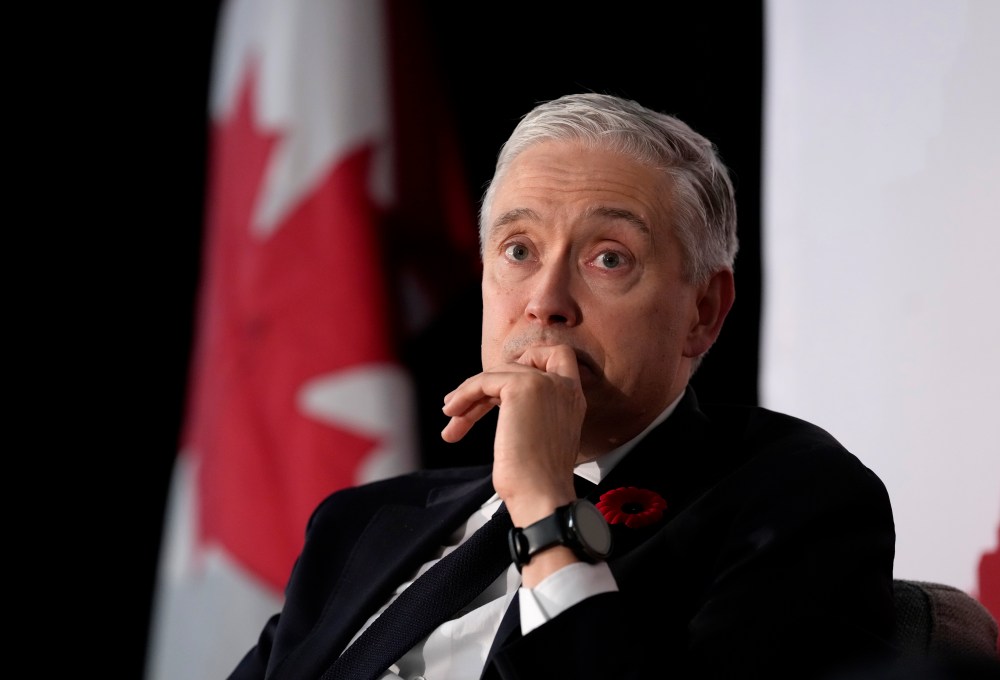
Finance Minister François-Philippe Champagne often compares Canada’s fiscal standing to that of other G7 partners to justify further borrowing and an aggressive infrastructure agenda.
Busby said while it’s true Canada is not in the same bleak fiscal situation as peer countries like the United Kingdom or France, he argued Ottawa ought not to take that for granted.
“The current trajectory that Canada is on, we have to be cautious that in five or ten years’ time, we could become like them if we don’t correct course,” he said.
The Liberals have downgraded the government’s previous fiscal anchor of a declining debt-to-GDP ratio, but many fiscal watchers — including the PBO and the International Monetary Fund — continue to see that ratio as an important marker of sustainable borrowing.
Desjardins sees this metric rising as the oil windfall fades starting in fiscal 2027-28, but predicts it will decline over the longer term.
Canada isn’t putting its sovereign credit rating at risk yet, Bartlett said, but additional spending could put Ottawa on a more precarious fiscal footing.
The federal government has used up much of its fiscal leeway with recent spending commitments, limiting its ability to respond to future shocks, he argued.
“There’s a real challenge for the federal government at this point, because it has painted itself into a bit of a fiscal corner as to what it can announce further going forward.”
This report by The Canadian Press was first published Nov. 4, 2026.