
Alberta expecting $18B budget turnaround propelled by oil royalties
Advertisement
Read this article for free:
or
Already have an account? Log in here »
We need your support!
Local journalism needs your support!
As we navigate through unprecedented times, our journalists are working harder than ever to bring you the latest local updates to keep you safe and informed.
Now, more than ever, we need your support.
Starting at $15.99 plus taxes every four weeks you can access your Brandon Sun online and full access to all content as it appears on our website.
Subscribe Nowor call circulation directly at (204) 727-0527.
Your pledge helps to ensure we provide the news that matters most to your community!
To continue reading, please subscribe:
Add Brandon Sun access to your Free Press subscription for only an additional
$1 for the first 4 weeks*
- Enjoy unlimited reading on brandonsun.com
- Read the Brandon Sun E-Edition, our digital replica newspaper
*Your next Free Press subscription payment will increase by $1.00 and you will be charged $20.95 plus GST for four weeks. After four weeks, your payment will increase to $24.95 plus GST every four weeks.
Read unlimited articles for free today:
or
Already have an account? Log in here »
EDMONTON – Alberta’s government says the oil-rich province is on track to reach record-high resource revenues this year.
Its second quarterly update of the year, released Thursday, predicts an $8.5-billion surplus — a wild swing from the $9.4-billion deficit originally expected for 2026-27.
Alberta’s finances are tethered to global energy prices, which surged earlier this year after the conflict between the United States and Iran began.
In February, the province was predicting West Texas Intermediate – the North American benchmark oil price — would average US$60.50 a barrel this year.
It’s now forecasting that price to be US$83.50 per barrel, driven by disruptions in the Strait of Hormuz, a vital shipping lane at the mouth of the Persian Gulf.
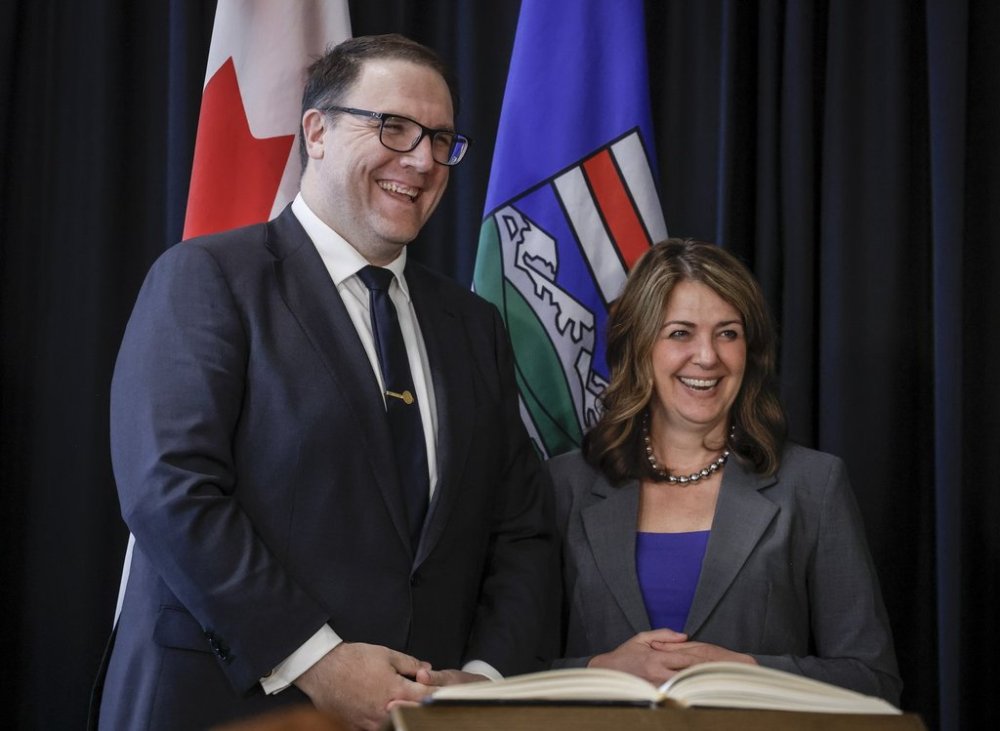
Finance Minister Jason Nixon said global energy prices can change quickly, so the United Conservative Party government still needs to exercise caution and be disciplined in its spending.
“That means resisting the temptation to treat a sudden increase in resource revenue as permanent,” he said.
In the 2022-23 fiscal year, the province took in a record $25 billion in resource revenues, but the province expects to break that with almost $29 billion this year.
Nixon noted that between July and September, the WTI price was pushed as high as US$106 per barrel and as low as US$68.50 per barrel.
With every dollar increase in the average price, Alberta’s treasury stands to gain $680 million.
The latest outlook frees up $3.9 billion in surplus cash the government plans to spend before the end of the fiscal year. By law, at least half must go to the Heritage Saving Trust Fund, which is now expected to reach $36 billion by March.
The government’s goal is to see the rainy day fund’s net assets reach $250 billion by 2050, so the province can get off what’s long been characterized as a roller-coaster of royalty revenue.
Nixon said the money will also go toward one-time infrastructure spending on things such as roadway construction, but specifics won’t be decided until the province has more actual budget numbers.
“I do hear one thing and one thing all the time, which is concerns about roads. So we’ll start with that,” he said.
Despite the expected windfall, overall spending this year is only going up by $646 million.
Nixon said headlines don’t always match kitchen-table concerns, and he acknowledged the pressure Albertans are under due to inflation and the cost of living.
However, he said the government is focused on maintaining existing affordability programs, including the province’s comparably low tax rates.
Nixon didn’t announce any new rebates or relief Thursday, but said cabinet would consider targeted ways to help.
In October, high gas prices that had battered consumers for months pushed the government to cut the gas tax for at least three months, saving most drivers 13 cents per litre.
That replaced a $100 fuel tax rebate program that began in July, but the application process was criticized as invasive and onerous.
On Thursday, the Canadian Automobile Association pegged the national average price of regular gas at $1.42 per litre. The gas price tracking website GasBuddy estimated Alberta’s average to be $1.23 per litre — the lowest in the country.
Nixon said low gas prices are lowering the inflation rate and the cost of other commodities, including groceries.
Opposition NDP finance critic Court Ellingson told reporters that the UCP government has been given the gift of higher oil prices, but Albertans aren’t feeling it.
“They’re feeling that the costs of living are exceeding wage growth,” he said.
“Albertans can’t afford to buy groceries. Albertans can’t afford to pay their rent.”
He pointed to the NDP’s affordability proposals. They include increasing the minimum wage predictably to $18 per hour from the current $15 per hour then tying it to inflation.
This report by The Canadian Press was first published Nov. 26, 2026.