
Ottawa plots ambitious plan to reshape struggling forestry industry
Advertisement
Read this article for free:
or
Already have an account? Log in here »
We need your support!
Local journalism needs your support!
As we navigate through unprecedented times, our journalists are working harder than ever to bring you the latest local updates to keep you safe and informed.
Now, more than ever, we need your support.
Starting at $15.99 plus taxes every four weeks you can access your Brandon Sun online and full access to all content as it appears on our website.
Subscribe Nowor call circulation directly at (204) 727-0527.
Your pledge helps to ensure we provide the news that matters most to your community!
To continue reading, please subscribe:
Add Brandon Sun access to your Free Press subscription for only an additional
$1 for the first 4 weeks*
- Enjoy unlimited reading on brandonsun.com
- Read the Brandon Sun E-Edition, our digital replica newspaper
*Your next Free Press subscription payment will increase by $1.00 and you will be charged $20.95 plus GST for four weeks. After four weeks, your payment will increase to $24.95 plus GST every four weeks.
Read unlimited articles for free today:
or
Already have an account? Log in here »
The federal government has unveiled what it’s calling the country’s first-ever strategy for the forestry sector, a sweeping national plan to reinvent an industry battered by decades of decline.
Natural Resources Minister Tim Hodgson said Friday the strategy, backed by a $6.5 billion funding plan, represents the largest federal investment in the industry’s history.
He said the aim is to reduce Canada’s traditional reliance on lumber, pulp and paper production by expanding into higher-value products such as biofuels, biochemicals and advanced wood-based building materials.
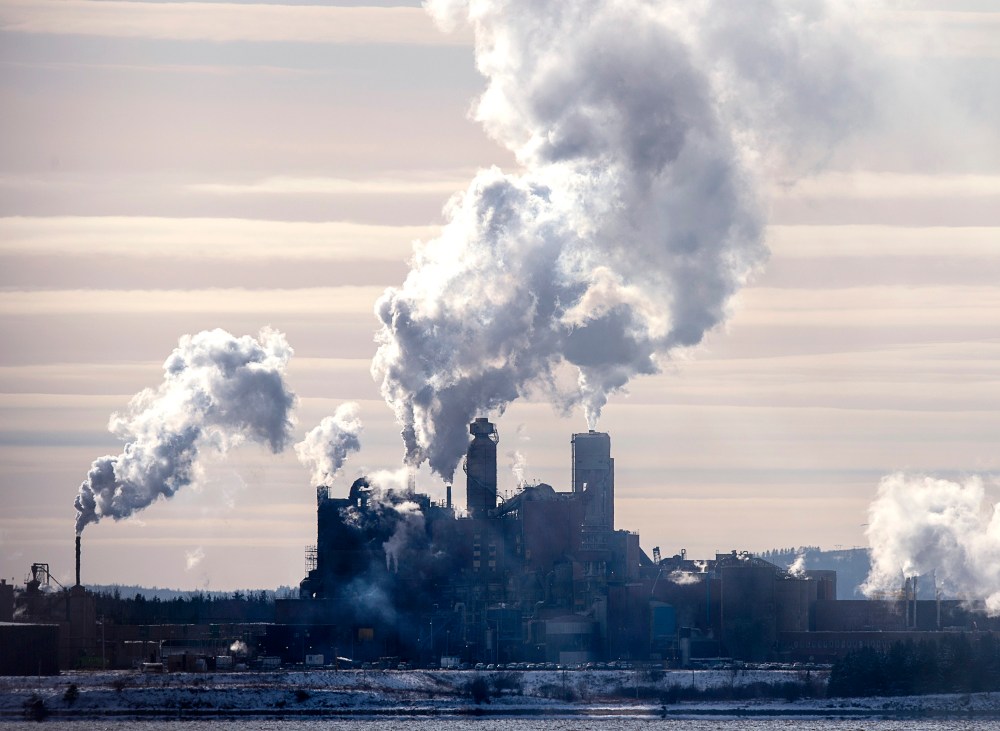
“Business as usual is no longer an option for our forest sector,” Hodgson said during Friday’s announcement at Tla’amin Nation in British Columbia.
“The status quo is not an option,” he said. “We need to invest, we need to innovate and we need to compete because a stronger forest sector means a stronger Canadian economy.”
The strategy, which charts a path for the industry through 2050, is built around four key pillars: transforming the sector through investment, partnership and innovation; securing competitive wood fibre supplies; developing new markets at home and abroad; and supporting workers and communities.
It calls for streamlining regulations, increasing the use of Canadian wood in federally funded housing and infrastructure projects, and reducing the industry’s reliance on the United States.
The record funding package includes $4 billion to build new large-scale manufacturing facilities and transform existing mills, $2 billion to modernize operations and improve productivity, and $500 million to secure reliable, affordable supplies of wood fibre.
All three funding programs are expected to launch by March 2027.
The federal government warns that without action, capital flight from Canada to the U.S. and elsewhere could accelerate, regional supply chains could collapse, industrial assets could be left stranded and job losses could further hollow out rural communities.
Canada’s forestry industry has lost roughly four in 10 jobs since 2004, while its share of the country’s gross domestic product has fallen from about three per cent to one per cent.
Between 2004 and 2024, Canadian softwood lumber production fell 42 per cent and pulp production dropped 54 per cent, even as global demand for those products grew by six and 22 per cent, respectively.
The forestry industry also faces mounting pressures from U.S. trade barriers, growing competition from lower-cost pulp producers, uncertainty over wood fibre supplies and changing consumer demand.
Most Canadian softwood lumber exports to the United States now face combined tariffs and duties of nearly 35 per cent, according to Natural Resources Canada.
John Hackett, chief of the Tla’amin Nation, said the plan strengthens the community’s belief that forestry has a strong future.
He said the strategy will “build a forest sector that lasts for generations.”
“Most of all, it will keep our greatest resource, our children and grandchildren, close to home with good jobs,” Hackett said.
The forestry sector contributed $29.7 billion to Canada’s economy in 2025, employs nearly 200,000 people and serves as the economic backbone of almost 300 communities nationwide, according to Natural Resources Canada.
This report by The Canadian Press was first published Nov. 27, 2026.