
Detroit-area utility denies flooding claims from 2021 storm
Advertisement
Read this article for free:
or
Already have an account? Log in here »
We need your support!
Local journalism needs your support!
As we navigate through unprecedented times, our journalists are working harder than ever to bring you the latest local updates to keep you safe and informed.
Now, more than ever, we need your support.
Starting at $15.99 plus taxes every four weeks you can access your Brandon Sun online and full access to all content as it appears on our website.
Subscribe Nowor call circulation directly at (204) 727-0527.
Your pledge helps to ensure we provide the news that matters most to your community!
To continue reading, please subscribe:
Add Brandon Sun access to your Free Press subscription for only an additional
$1 for the first 4 weeks*
*Your next subscription payment will increase by $1.00 and you will be charged $20.00 plus GST for four weeks. After four weeks, your payment will increase to $24.00 plus GST every four weeks.
Read unlimited articles for free today:
or
Already have an account? Log in here »
Hey there, time traveller!
This article was published 19/07/2022 (1315 days ago), so information in it may no longer be current.
DETROIT (AP) — A Detroit-area water utility said Tuesday that it will deny flooding claims stemming from a damaging storm last summer based on an independent review that found the flooding was caused by the amount of rainfall and not a defect in its wastewater collection and pumping system.
The Great Lakes Water Authority said in a statement that Michigan law also holds that a public entity can only be held liable for a sewage disposal system event if a defect in the system caused at least half of the problem and damage.
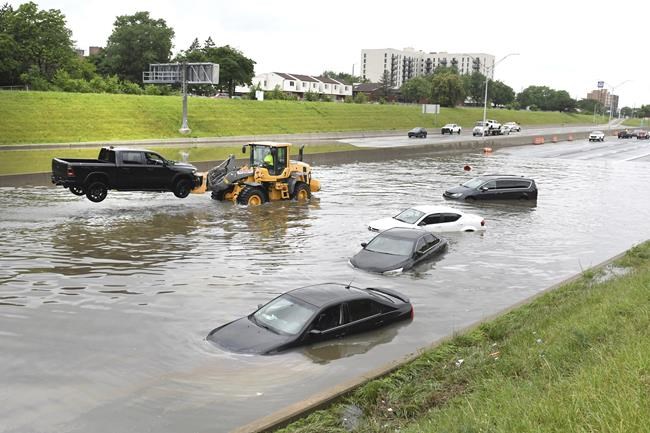
A state of emergency was declared for Detroit and surrounding Wayne County following a storm that began on June 25, 2021, and dumped more than 6 inches (15 centimeters) of rain, which overloaded the area’s wastewater systems. Some streets and hundreds of basements were flooded, causing widespread property damage.
Sue McCormick, who ran the Great Lakes Water Authority at the time, said days after the storm that two Detroit water pumping stations designed to carry wastewater and excess storm water to treatment facilities experienced power-related problems but didn’t fail during the storm.
Due to an electrical service issue, only three of six pumps at one station could be brought online, while a power outage at a second station slowed efforts to turn three of its pumps on as the rain poured, she said.
Eventually, five of the six pumps at the Connor Creek station were able to operate. Both Connor Creek and the nearby Freud stations serve Detroit’s east side and several suburban communities.
The independent investigation ordered by the water authority’s board was completed by engineering firm AECOM. It “determined that widespread basement flooding was inevitable due to the unprecedented amount and intensity of the rainfall that occurred,” the authority said.
“Even if every piece of piping and equipment in the regional system worked in an ideal manner … basement backups and surface flooding would still have occurred in GLWA’s system, or any other collection system designed to today’s standard,” it added.
The authority said it would notify people by mail that it was denying their claims.
“We understand the difficult situations homeowners and businesses face when flooding occurs,” said Suzanne R. Coffey, the authority’s current CEO. “We are experiencing increased frequency and intensity of storms hitting our region. This is why it’s critical to focus on building resiliency in the regional system.”
The Detroit-based authority is comprised of 88 member communities and provides drinking water to nearly 40% of the people living in Michigan. It also provides wastewater services to nearly 30% of state residents.
For the vast majority of affected homeowners, their insurance policies won’t cover the costs of the flood damage, according to Paul Doherty, managing attorney for Ven Johnson Law, which represents about 600 people who sustained flood damage and which filed a class-action lawsuit over the claims.
“Most people don’t have coverage and most people have to shoulder their loss,” Doherty said. “Estimates say it caused over $100 million in property damage. I think that’s (estimate) low. People have put in brand new drywall, brand new furnaces.”
Doherty called Tuesday’s announcement by the water authority “grandstanding.”
“I never held out hope they were going to voluntarily do anything,” he said. “They only will be forced by what a judge or jury tells them. Great Lakes takes the position this was a hundred-year storm, although we have them every five years.”