
Georgia spaceport land deal is off, site owner says
Advertisement
Read this article for free:
or
Already have an account? Log in here »
We need your support!
Local journalism needs your support!
As we navigate through unprecedented times, our journalists are working harder than ever to bring you the latest local updates to keep you safe and informed.
Now, more than ever, we need your support.
Starting at $15.99 plus taxes every four weeks you can access your Brandon Sun online and full access to all content as it appears on our website.
Subscribe Nowor call circulation directly at (204) 727-0527.
Your pledge helps to ensure we provide the news that matters most to your community!
To continue reading, please subscribe:
Add Brandon Sun access to your Free Press subscription for only an additional
$1 for the first 4 weeks*
*Your next subscription payment will increase by $1.00 and you will be charged $20.00 plus GST for four weeks. After four weeks, your payment will increase to $24.00 plus GST every four weeks.
Read unlimited articles for free today:
or
Already have an account? Log in here »
Hey there, time traveller!
This article was published 21/07/2022 (1314 days ago), so information in it may no longer be current.
SAVANNAH, Ga. (AP) — The owner of a large industrial site on the Georgia coast said Thursday that it has ended a longstanding agreement to sell the property to a county government whose officials worked for years on a plan to build a launch pad for commercial rockets there.
Opponents who fear the proposed Spaceport Camden would pose serious safety and environmental risks hailed the development as a potential deal breaker for the project, which Camden County officials have spent a decade and more than $10 million pursuing.
County officials, meanwhile, insisted they still have a binding contract to purchase the site.
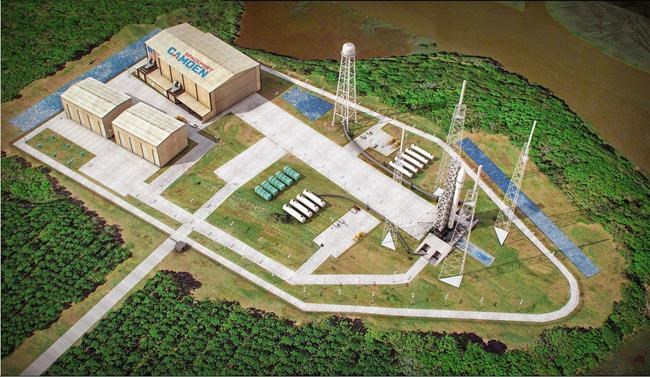
Union Carbide Corporation owns 4,000 acres (1,600 hectares) in the county where commissioners have pursued the spaceport for launching satellites into orbit. The county government in 2015 entered into an option agreement with the company to buy the land once the county obtained a spaceport operator license from the Federal Aviation Administration.
The FAA awarded the license in December. But before county commissioners could close on the land, opponents forced a referendum on the project by gathering more than 3,500 petition signatures. The project was put to a vote in March, and 72% cast ballots to block the deal.
In a statement Thursday, Union Carbide noted that Camden County voters had “repudiated” the land purchase.
“As a result, there is no longer an Option Agreement in existence between the County and UCC, and UCC does not intend to convey the property to the County pursuant to the prior Option Agreement,” said the statement, emailed to The Associated Press by Union Carbide spokesman Tomm Sprick.
Steve Howard, Camden County’s government administrator, provided a statement from the county’s lawyers insisting the deal isn’t over.
“Union Carbide most certainly has a contract with Camden,” the statement said. “The County has indicated that it is ready, willing and able to close. We expect Union Carbide to honor its contractual commitments.”
Howard has led the spaceport project, saying it would bring economic growth not just from rocket launches, but also by attracting related industries and tourists to the community of 55,000 people on the Georgia-Florida line.
Opponents say building the spaceport on an industrial plot formerly used to manufacture pesticides and munitions would pose potential hazards that outweigh any economic benefits.
Critics, including the National Park Service, have said rockets exploding soon after launch could rain fiery debris onto Little Cumberland Island, which has about 40 private homes, and neighboring Cumberland Island, a federally protected wilderness visited by about 60,000 tourists each year.
Megan Desrosiers, president of the coastal Georgia conservation group One Hundred Miles, called the end of the land purchase agreement “a huge deal.”
“If Union Carbide doesn’t sell the property to Camden County, then there’s no site for a spaceport,” said Desrosiers, whose group helped organize the petition drive that forced the referendum.
The big loss at the polls in March didn’t stop county officials from pursuing the project. Commissioners in April voted unanimously to notify Union Carbide that they planned to move forward with the land purchase. The company said at the time it was evaluating the agreement.
Meanwhile, county officials are trying to have the referendum declared invalid by the Georgia Supreme Court. Their legal appeal argues that Georgia’s constitution doesn’t allow voters to veto government projects such as the spaceport. The court is scheduled to hear the case Aug. 23.