
Saskatchewan’s chief medical health officer cries as he presents COVID-19 modelling
Advertisement
Read this article for free:
or
Already have an account? Log in here »
We need your support!
Local journalism needs your support!
As we navigate through unprecedented times, our journalists are working harder than ever to bring you the latest local updates to keep you safe and informed.
Now, more than ever, we need your support.
Starting at $15.99 plus taxes every four weeks you can access your Brandon Sun online and full access to all content as it appears on our website.
Subscribe Nowor call circulation directly at (204) 727-0527.
Your pledge helps to ensure we provide the news that matters most to your community!
To continue reading, please subscribe:
Add Brandon Sun access to your Free Press subscription for only an additional
$1 for the first 4 weeks*
*Your next subscription payment will increase by $1.00 and you will be charged $20.00 plus GST for four weeks. After four weeks, your payment will increase to $24.00 plus GST every four weeks.
Read unlimited articles for free today:
or
Already have an account? Log in here »
Hey there, time traveller!
This article was published 20/10/2021 (1615 days ago), so information in it may no longer be current.
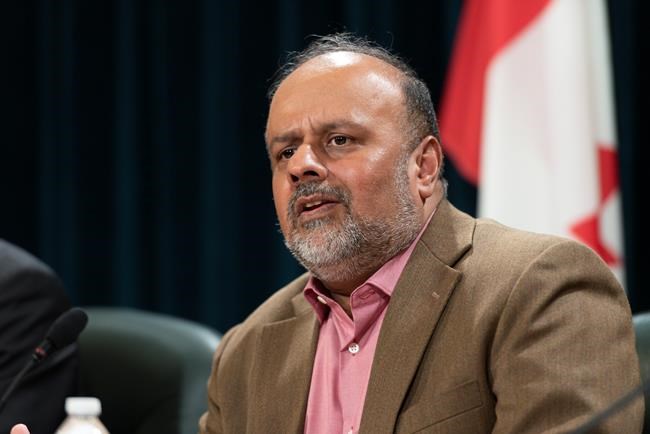
REGINA – Saskatchewan’s chief medical health officer cried Wednesday during a teleconference on COVID-19 modelling in the province.
Dr. Saqib Shahab said it’s upsetting to see what is happening in Saskatchewan’s hospitals and intensive care units.
“All the evidence is out there. And it’s very distressing to see very young, unvaccinated people ending up in ICU and dying,” Shahab said. “To see young lives lost through a vaccine-preventable disease — how can we see this in a country where we’ve had vaccines available since July?”
Saskatchewan continues to have the highest weekly death rate among the provinces and has started transferring patients to Ontario as hospitals run out of beds and staff.
Modelling based on current data shows hospitalizations continuing to increase until December unless restrictions like a limit on gathering sizes are reintroduced.
Saskatchewan could have more than 225 intensive care admissions by January and health care might not return to sustainable levels until next March, Shahab said. That would mean surgeries, the province’s organ donation program, and therapies for children wouldn’t be available until then.
In September, the Saskatchewan Health Authority reported more than 30,000 elective surgeries had been delayed so as to divert resources to the COVID-19 surge.
Tearing up, Shahab said “it’s a very challenging time.” He later apologized for not being professional.
His colleagues were quick to offer support.
“Hearing Dr. Shahab break down today … led me to break down, too, in the privacy of my office,” tweeted Dr. Alexander Wong, an infectious disease physician and clinician-researcher with the health authority.
“Saqib loves #SK & its people, as do we all. He deserves our gratitude, support, & respect. Always,” Wong wrote.
A spokesperson for the premier’s office issued a statement that said: “Premier (Scott) Moe continues to hold the highest regard for Dr. Shahab and the tireless work he continues to do for the people of Saskatchewan.”
NDP Opposition Leader Ryan Meili, a family physician who has helped throughout the pandemic, said Shahab isn’t alone in his feelings.
“To hear that level of emotion is really striking,” Meili said. “He’s really representing … what a lot of people are feeling, especially folks in health care and on the front line who feel overwhelmed and desperate.”
The NDP is urging the province to bring in limits on gathering sizes.
“How you could look at that and say, yes, we can save lives with very reasonable measures that people can handle, but no we’re not interested? It’s further proof (Scott Moe) has no business being premier of the province,” Meili said.
On Wednesday, Saskatchewan reported 246 new cases and 323 people in hospital, 82 of them in ICUs.
“Even though we’re seeing a plateau in case numbers and a decline in hospital admissions, there should be no complacency around that. It takes a long time … months, for our ICU and hospital admissions to go down,” Shahab said.
Outbreaks continue due to private gatherings in homes, other social settings and places of worship, he said.
Added Shahab: It’s “up to government to answer what my formal recommendations have been for the last few weeks.”
The Saskatchewan Party government has declined to say what those recommendations have been.
Current public health orders include a mask mandate in public indoor places and proof-of-vaccination or a negative test to enter restaurants, bars, casinos, movie theatres, gyms, concert venues and ticketed sporting events.
Saskatchewan is mainly relying on vaccinations to bring down cases and hospitalizations.
“Vaccines have proven to significantly reduce or eliminate a number of illnesses that have had similar impacts on society throughout our history,” a spokeswoman for the premier’s office said.
Shahab said vaccinations have plateaued.
“Our increase in vaccinations for first dose has slowed down, and we are increasing it by less than one per cent a week.
“That is not fast enough to have an impact on the fourth wave.”
This report by The Canadian Press was first published Oct. 20, 2021.