
Medical staff to return to pre-COVID positions
Advertisement
Read this article for free:
or
Already have an account? Log in here »
We need your support!
Local journalism needs your support!
As we navigate through unprecedented times, our journalists are working harder than ever to bring you the latest local updates to keep you safe and informed.
Now, more than ever, we need your support.
Starting at $15.99 plus taxes every four weeks you can access your Brandon Sun online and full access to all content as it appears on our website.
Subscribe Nowor call circulation directly at (204) 727-0527.
Your pledge helps to ensure we provide the news that matters most to your community!
To continue reading, please subscribe:
Add Brandon Sun access to your Free Press subscription for only an additional
$1 for the first 4 weeks*
- Enjoy unlimited reading on brandonsun.com
- Read the Brandon Sun E-Edition, our digital replica newspaper
*Your next Free Press subscription payment will increase by $1.00 and you will be charged $20.95 plus GST for four weeks. After four weeks, your payment will increase to $24.95 plus GST every four weeks.
Read unlimited articles for free today:
or
Already have an account? Log in here »
Hey there, time traveller!
This article was published 24/02/2022 (1731 days ago), so information in it may no longer be current.
As Manitoba’s COVID-19 restrictions begin to loosen, medical staff redeployed to critical care will be returned to their original stations as the province resumes other health-care services.
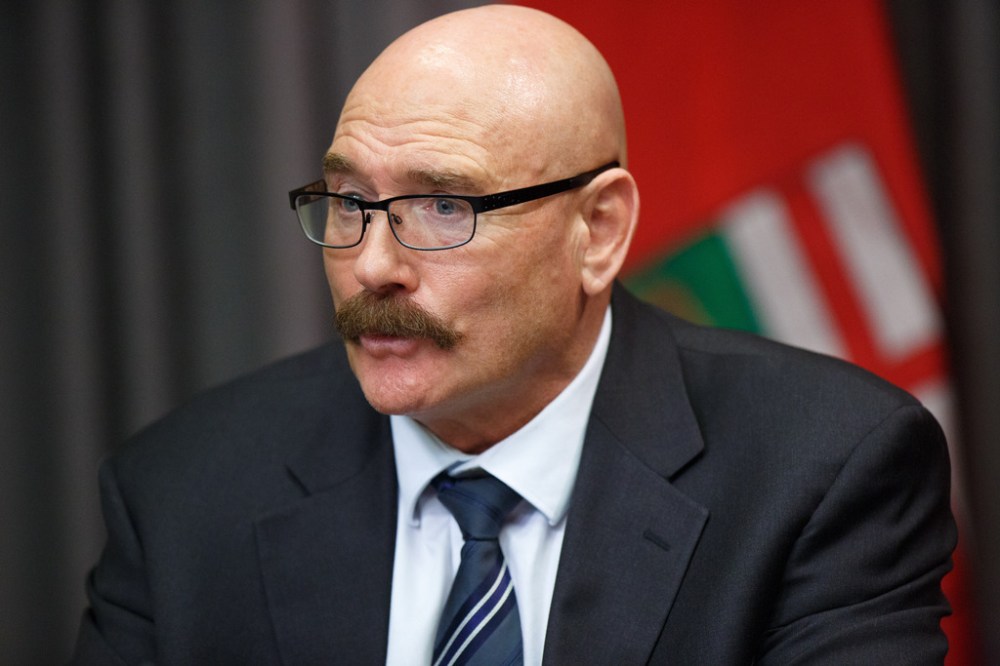
The province is taking a phased approach to resuming medical care services as modelling shows the peak has passed, said Dr. David Matear, the health system co-lead of Manitoba’s Unified Health Sector Incident Command, at a news conference Thursday.
The first phase of returning more than 500 health-care staff redeployed for COVID-related services to their regular duties began earlier this week with a focus on resuming non-COVID related urgent care services first.
There is a related focus on resuming delayed surgeries at key hospitals, including Brandon Regional Health Centre and Winnipeg’s St. Boniface Hospital and Health Sciences Centre.
“It’s a little premature for me to say what surgeries will happen first and where. We are still working on the plan, but we are going to be looking at prioritizing more complex surgeries,” Matear said.
They are also planning for a return to diagnostic and out-patient services.
Health officials are certain there will be a slight bump in COVID cases as restrictions loosen and proof of vaccination is no longer required. This is being considered in the plan, Matear said, adding the province is not back to normal. If necessary, they may scale up or scale down critical care services for COVID surges.
“While hospitals remain busy and hundreds of health-care workers continue to be deployed to support COVID-related activity, we are seeing a significant improvement in a number of key areas.”
In addition, the province is looking to reduce the number of critical care beds as part of the transition out of the fourth wave emergency measures. However, the province and stakeholders are looking at having more critical care beds on a permanent basis for the province.
“I’m sure it will be more than the 72-bed pre-pandemic baseline,” Matear said.
Earlier this week, the health system began the first phase of loosening visitor restrictions at hospitals and personal-care homes. While proof of vaccination will no longer be a requirement for visitors, health-care facilities will continue to screen staff and visitors, medical masks will still be mandated and physical distancing will need to be followed.
He pointed to Thursday’s COVID numbers to demonstrate the improving situation. While Manitoba’s COVID death toll stands at 1,668, with five more added yesterday, hospitalizations are trending down. They dipped to 524, with 222 of those patients being treated for active COVID. The province also saw COVID ICU cases climb slightly to 32, which is up from 29 on Wednesday.
Matear said COVID-positive patients in ICU declined by around 16 per cent in the last week. Since Feb. 1, the number of COVID-positive patients in ICU has improved by more than 40 per cent.
Manitoba also added 319 new cases of COVID-19, and the active case count is 8,538.
As of March 1, proof of vaccination will no longer be required in public settings and for public-sector workers. This includes education, child care, health care and other designated positions, said Dr. Brent Roussin, Manitoba’s chief provincial public health officer. However, any business or workspace that wants to check for vaccination status, or person who wants to show proof of vaccination will still have access to the system and cards.
As of March 15, masks will no longer be required in public settings.
This is a transitional time for many people, and for some it may be a difficult one, he said. He implored the public to be kind to one another and allow everyone to adjust to the new reality on their own time.
“In the coming weeks, we are transitioning from rules to guidelines. People have different perspectives, and this could be difficult for some,” he said. “Please, be respectful of one another.”
» kmckinley@brandonsun.com
» Twitter: @karenleighmck1