
Map time: A tale of two elections
Were the seeds sown for a Decter Hirst victory as far back as 2006?
Advertisement
Read this article for free:
or
Already have an account? Log in here »
We need your support!
Local journalism needs your support!
As we navigate through unprecedented times, our journalists are working harder than ever to bring you the latest local updates to keep you safe and informed.
Now, more than ever, we need your support.
Starting at $15.99 plus taxes every four weeks you can access your Brandon Sun online and full access to all content as it appears on our website.
Subscribe Nowor call circulation directly at (204) 727-0527.
Your pledge helps to ensure we provide the news that matters most to your community!
To continue reading, please subscribe:
Add Brandon Sun access to your Free Press subscription for only an additional
$1 for the first 4 weeks*
- Enjoy unlimited reading on brandonsun.com
- Read the Brandon Sun E-Edition, our digital replica newspaper
*Your next Free Press subscription payment will increase by $1.00 and you will be charged $20.95 plus GST for four weeks. After four weeks, your payment will increase to $24.95 plus GST every four weeks.
Read unlimited articles for free today:
or
Already have an account? Log in here »
Hey there, time traveller!
This article was published 30/10/2010 (5817 days ago), so information in it may no longer be current.
Shari Decter Hirst’s election as mayor on Wednesday took some by surprise. But data from the 2006 municipal election shows that the seeds of Dave Burgess’ eventual defeat were sprouting even then.
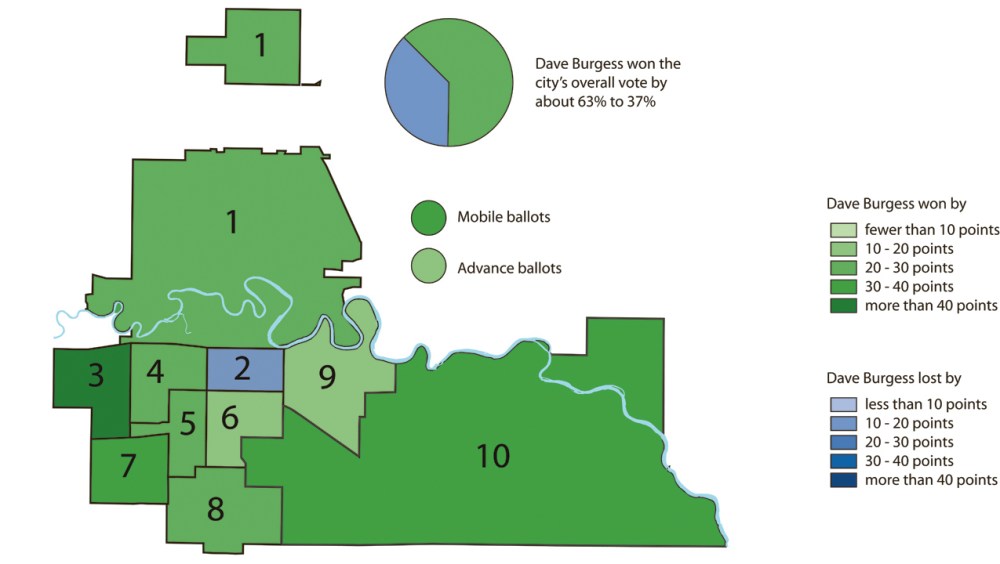
Above, on the left, is a colour-coded map of election results from the 2006 mayoral contest, when Burgess soundly defeated a slate of challengers that included Mike Abbey, Deveryn Ross and Beth Smale.
Burgess ended up with almost two-thirds of the vote, and won in every single ward. However, although Burgess took a plurality in the downtown Rosser Ward, that was the only place where his challengers combined to deny him an outright majority.
Abbey, Ross and Smale managed to eke out a combined 411 votes compared to Burgess’ 334.
Four years later, that core-area ward would also prove to be the core of Decter Hirst’s victory.
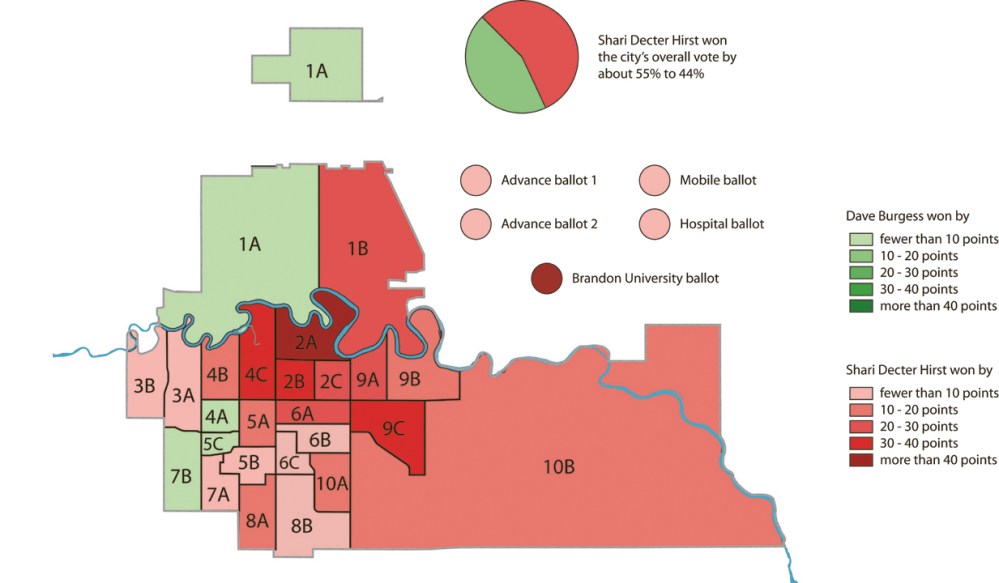
Although the ward boundaries have shifted slightly in the past four years, making exact comparisons difficult, it is clear that Decter Hirst was strongest exactly where Burgess was weakest.
This year, although Burgess wasn’t able to win any of the city’s 10 wards, he did manage to out-poll Decter Hirst in four polling substations, scattered among four different wards.
Several polling stations brought in razor-thin margins — Burgess won the 5C polling station in Meadows by just 10 votes, 129-119, for example, while Decter Hirst won the next-door 5B polling station by eight votes, 346-348.
Meadows as a whole swung to Decter Hirst by virtue of her 46-vote win (177-131) at polling station 5A.
Also swinging Decter Hirst’s way were both advance polls, the mobile polling station and the hospital ballot.
At the new polling station set up at Brandon University, where Burgess was vilified for skipping a candidates’ forum, he fell to Decter Hirst by a count of 202-60.
One big change from 2006 to 2010 was the number of rejected ballots. Four years ago, election officials rejected 42 ballots during the counting process.
New vote-counting machines used this year ensured that voters had the chance to fill in their ballots again if they were initially rejected by the machine.
Election officials reported that zero ballots were rejected in 2010.