
‘Houdini & Doyle’ series ‘like the Victorian X-Files,’ says star
Advertisement
Read this article for free:
or
Already have an account? Log in here »
We need your support!
Local journalism needs your support!
As we navigate through unprecedented times, our journalists are working harder than ever to bring you the latest local updates to keep you safe and informed.
Now, more than ever, we need your support.
Starting at $15.99 plus taxes every four weeks you can access your Brandon Sun online and full access to all content as it appears on our website.
Subscribe Nowor call circulation directly at (204) 727-0527.
Your pledge helps to ensure we provide the news that matters most to your community!
To continue reading, please subscribe:
Add Brandon Sun access to your Free Press subscription for only an additional
$1 for the first 4 weeks*
*Your next subscription payment will increase by $1.00 and you will be charged $20.00 plus GST for four weeks. After four weeks, your payment will increase to $24.00 plus GST every four weeks.
Read unlimited articles for free today:
or
Already have an account? Log in here »
Hey there, time traveller!
This article was published 01/05/2016 (3542 days ago), so information in it may no longer be current.
TORONTO – They were unlikely friends in the early 20th century: Brash American illusionist Harry Houdini, a paranormal debunker, and Sir Arthur Conan Doyle, the prim and proper British Sherlock Holmes creator who believed in spirits.
Their differences eventually made them mortal enemies, which provides rich conflict in the new 10-episode series “Houdini & Doyle,” premiering on Monday on Global/Fox.
Based on true events, the show sees the duo reluctantly working together alongside Const. Adelaide Stratton in New Scotland Yard to investigate mysterious crimes. Their journeys take them into the worlds of science fiction and the spiritual — from ghosts to vampires and aliens.
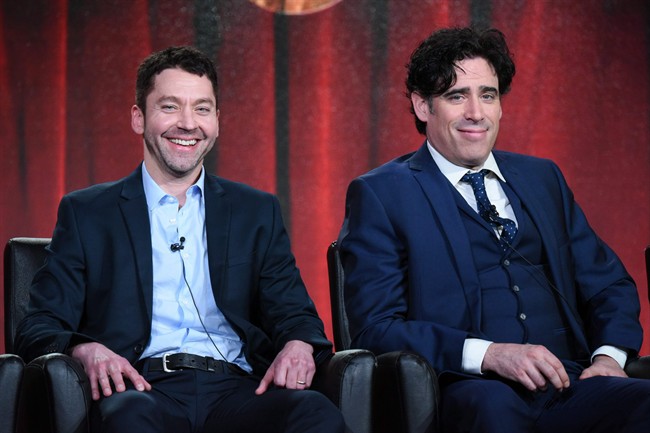
“We’re like the Victorian ‘X-Files’ in some way,” says English actor Stephen Mangan, who plays Conan Doyle.
“It combines rationalism with a bit of who-knows-what’s-out-there spooky dookiness — with gorgeous costumes.”
American actor Michael Weston plays Houdini, who tries to find a rational explanation for seemingly paranormal activities.
“He was scientific and he would always say, ‘My magic isn’t magic, it’s tricks, it’s not God, it’s not divine intervention,” says Weston.
Conan Doyle, meanwhile, was a doctor and a man of science. But when his wife was in a coma dying from tuberculosis, he desperately wanted to prove there was an afterlife.
“A belief in spiritualism was a very respectable and highly credible stance to take in those days,” says Mangan.
“A lot of intellectuals and big brains at the time believed in an afterlife, in fairies, in spirits. So it wasn’t a fringe, whacko belief at all.”
In this series, the two come together on a case involving the murder of a nun that some believe was committed by a ghost.
Stratton, played by Toronto actress Rebecca Liddiard, was the first female constable at Scotland Yard and joins forces with the two.
“She’s not your typical woman of that time period,” says Liddiard. “She’s not interested in the regular conventions that women are expected to uphold.
“But she also has a personal motive for being there. She has her own mystery that she’s trying to solve.”
Mangan had to grow a Conan Doyle-style moustache that was so thick, he “could have picked up Radio-Canada on it,” he jokes.
Meanwhile, Weston worked with an escape artist to do Houdini tricks on camera, like being lowered into a water tank while chained up.
“It was the most terrifying thing I’ve ever done in my life,” he says.
Canadian writer David Shore, who created the medical drama “House,” is an executive producer on the series.
He found himself reminded of his days on “House,” in which the main doctor character was partially inspired by Holmes and dealt with the intellect vs. emotion balance.
“I was always fascinated by that and I always admired Doyle and was surprised that he believed in the supernatural,” says Shore.
“It was one of those things as well — which I think we’re playing here — where if somebody you respect that much believes in something, maybe you’ve got to think about it a little longer.
“So that definitely was one of the things that drew me in here, and yes, there are definitely parallels here.”