
EXPLAINER: The formal rules around Charles’s accession
Advertisement
Read this article for free:
or
Already have an account? Log in here »
We need your support!
Local journalism needs your support!
As we navigate through unprecedented times, our journalists are working harder than ever to bring you the latest local updates to keep you safe and informed.
Now, more than ever, we need your support.
Starting at $15.99 plus taxes every four weeks you can access your Brandon Sun online and full access to all content as it appears on our website.
Subscribe Nowor call circulation directly at (204) 727-0527.
Your pledge helps to ensure we provide the news that matters most to your community!
To continue reading, please subscribe:
Add Brandon Sun access to your Free Press subscription for only an additional
$1 for the first 4 weeks*
*Your next subscription payment will increase by $1.00 and you will be charged $20.00 plus GST for four weeks. After four weeks, your payment will increase to $24.00 plus GST every four weeks.
Read unlimited articles for free today:
or
Already have an account? Log in here »
Hey there, time traveller!
This article was published 10/09/2022 (1259 days ago), so information in it may no longer be current.
LONDON (AP) — Charles became king immediately upon the death of his mother, Queen Elizabeth II, on Thursday. He was officially proclaimed King Charles III on Saturday during a ceremony at St. James’s Palace in London, and many more formal steps will follow until his coronation, which may not come for months.
A look at the centuries-old traditions and rules surrounding the accession of a new British monarch:
WHO FORMALLY DECLARES NEW MONARCHS?
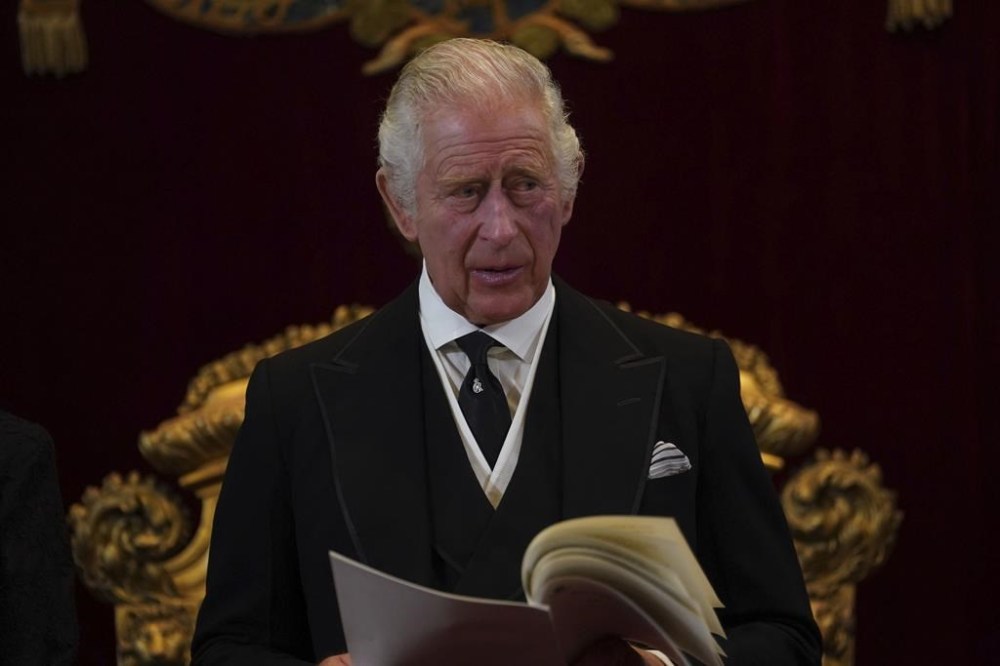
In Britain the death of a sovereign and their successor is officially proclaimed by the Accession Council, formed of a large group of senior politicians and officials.
Traditionally the council is summoned within 24 hours of a monarch’s death for a ceremonial meeting at St. James’s Palace. But the accession ceremony for King Charles III was delayed because the queen’s death wasn’t announced until early evening on Thursday, and there was not enough time to set the plans in motion for Friday.
The Accession Council is formed of members of the Privy Council — mostly past and present politicians, including all living prime ministers, as well as Church of England leaders and senior royals — and other ceremonial leaders, such as the Lord Mayor of London.
The Privy Council advises the monarch and is one of the oldest parts of government. It can be traced back to the time of the Norman kings when the monarch met with a group of advisers in private, predating the modern functions of a government cabinet.
Historically the entire Privy Council is called to the Accession Council to oversee the new monarch’s proclamation. But just 200 were summoned Saturday because the number of Privy Council members now stands at 700.
The ceremony was broadcast live on television for the first time Saturday.
WHAT HAPPENS AFTER CHARLES IS PROCLAIMED?
Shortly after a new monarch is formally confirmed, the sovereign holds his first Privy Council meeting, makes a personal declaration and then signs an oath to maintain the Church of Scotland, according to the Act of Union of 1707.
Afterward, a heraldic official known as the Garter King of Arms publicly reads out the proclamation of the new sovereign from a balcony at St. James’s Palace and gun salutes are fired around London.
The proclamation is also read aloud in locations across the U.K., including in Edinburgh, Cardiff and Belfast — the capital cities of the other three nations that make up the United Kingdom.
Union flags will be flown at full-staff for about 24 hours, before returning to half-staff in mourning for the queen.
Parliament is then recalled as soon as possible for senior lawmakers to take their oaths of allegiance to the new monarch.
The new monarch must make another oath to declare that he is a faithful Protestant and will maintain the Protestant succession later at the state opening of Parliament. The oath is mandated by the Accession Declaration Act of 1910.
WHAT ABOUT THE CORONATION?
After the initial flurry of formalities, there will be months before the next big event — the king’s coronation. This is to allow for a period of mourning and to leave time for officials to organize the ceremony.
Queen Elizabeth II was crowned on June 2, 1953 — some 16 months after her accession on Feb. 6, 1952, when her father, King George VI, died.
The date for Charles’ coronation is not yet known. It will most likely be held at London’s Westminster Abbey, where coronation ceremonies have taken place for the past 900 years.