
Iranian who inspired ‘The Terminal’ dies at Paris airport
Advertisement
Read this article for free:
or
Already have an account? Log in here »
We need your support!
Local journalism needs your support!
As we navigate through unprecedented times, our journalists are working harder than ever to bring you the latest local updates to keep you safe and informed.
Now, more than ever, we need your support.
Starting at $15.99 plus taxes every four weeks you can access your Brandon Sun online and full access to all content as it appears on our website.
Subscribe Nowor call circulation directly at (204) 727-0527.
Your pledge helps to ensure we provide the news that matters most to your community!
To continue reading, please subscribe:
Add Brandon Sun access to your Free Press subscription for only an additional
$1 for the first 4 weeks*
*Your next subscription payment will increase by $1.00 and you will be charged $20.00 plus GST for four weeks. After four weeks, your payment will increase to $24.00 plus GST every four weeks.
Read unlimited articles for free today:
or
Already have an account? Log in here »
Hey there, time traveller!
This article was published 12/11/2022 (1244 days ago), so information in it may no longer be current.
PARIS (AP) — An Iranian man who lived for 18 years in Paris’ Charles de Gaulle Airport and whose saga loosely inspired the Steven Spielberg film “The Terminal” died Saturday in the airport that he long called home, officials said.
Mehran Karimi Nasseri died after a heart attack in the airport’s Terminal 2F around midday, according an official with the Paris airport authority. Police and a medical team treated him but were not able to save him, the official said. The official was not authorized to be publicly named.
Nasseri lived in the airport’s Terminal 1 from 1988 until 2006, first in legal limbo because he lacked residency papers and later by apparent choice.
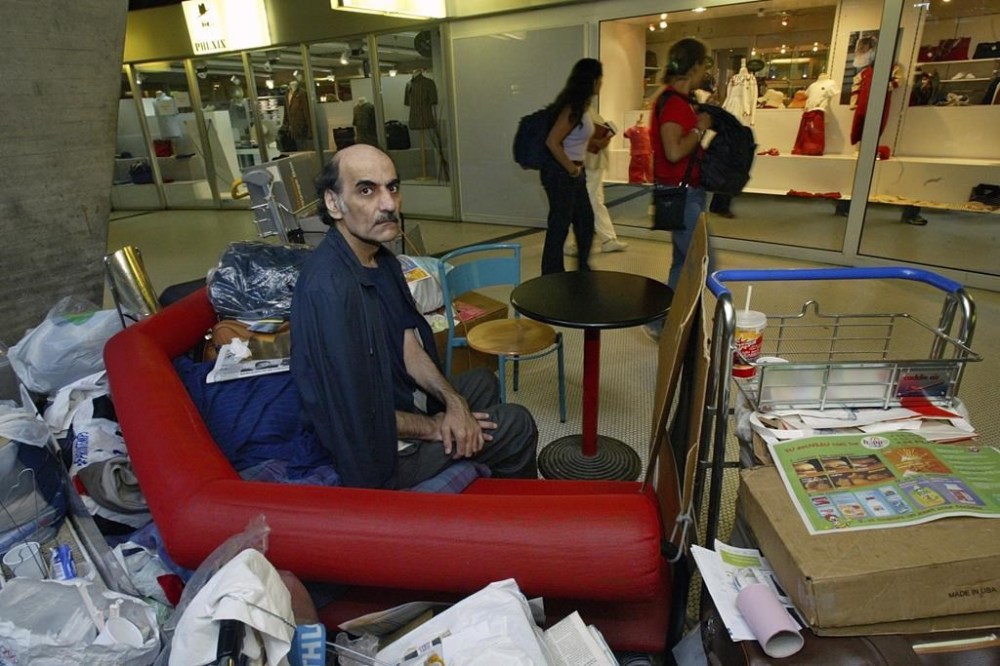
Year in and year out, he slept on a red plastic bench, making friends with airport workers, showering in staff facilities, writing in his diary, reading magazines and surveying passing travelers.
Staff nicknamed him Lord Alfred, and he became a mini-celebrity among passengers.
“Eventually, I will leave the airport,” he told The Associated Press in 1999, smoking a pipe on his bench, looking frail with long thin hair, sunken eyes and hollow cheeks. “But I am still waiting for a passport or transit visa.”
Nasseri was born in 1945 in Soleiman, a part of Iran then under British jurisdiction, to an Iranian father and a British mother. He left Iran to study in England in 1974. When he returned, he said, he was imprisoned for protesting against the shah and expelled without a passport.
He applied for political asylum in several countries in Europe. The UNHCR in Belgium gave him refugee credentials, but he said his briefcase containing the refugee certificate was stolen in a Paris train station.
French police later arrested him, but couldn’t deport him anywhere because he had no official documents. He ended up at Charles de Gaulle in August 1988 and stayed.
Further bureaucratic bungling and increasingly strict European immigration laws kept him in a legal no-man’s land for years.
When he finally received refugee papers, he described his surprise, and his insecurity, about leaving the airport. He reportedly refused to sign them, and ended up staying there several more years until he was hospitalized in 2006, and later lived in a Paris shelter.
Those who befriended him in the airport said the years of living in the windowless space took a toll on his mental state. The airport doctor in the 1990s worried about his physical and mental health, and described him as “fossilized here.” A ticket agent friend compared him to a prisoner incapable of “living on the outside.”
In the weeks before his death, Nasseri had been again living at Charles de Gaulle, the airport official said.
Nasseri’s mind-boggling tale loosely inspired 2004’s “The Terminal” starring Tom Hanks, as well as a French film, “Lost in Transit,” and an opera called “Flight.”
In “The Terminal,” Hanks plays Viktor Navorski, a man who arrives at JFK airport in New York from the fictional Eastern European country of Krakozhia and discovers that an overnight political revolution has invalidated all his traveling papers. Viktor is dumped into the airport’s international lounge and told he must stay there until his status is sorted out, which drags on as unrest in Krakozhia continues.
No information was immediately available about survivors.
___
Angela Charlton in Paris contributed.
___
This story has been updated to correct the spelling of Nasseri’s first name to Mehran, not Merhan.