
Carpaccio the artist, not the appetizer, now getting his due
Advertisement
Read this article for free:
or
Already have an account? Log in here »
We need your support!
Local journalism needs your support!
As we navigate through unprecedented times, our journalists are working harder than ever to bring you the latest local updates to keep you safe and informed.
Now, more than ever, we need your support.
Starting at $15.99 plus taxes every four weeks you can access your Brandon Sun online and full access to all content as it appears on our website.
Subscribe Nowor call circulation directly at (204) 727-0527.
Your pledge helps to ensure we provide the news that matters most to your community!
To continue reading, please subscribe:
Add Brandon Sun access to your Free Press subscription for only an additional
$1 for the first 4 weeks*
- Enjoy unlimited reading on brandonsun.com
- Read the Brandon Sun E-Edition, our digital replica newspaper
*Your next Free Press subscription payment will increase by $1.00 and you will be charged $20.95 plus GST for four weeks. After four weeks, your payment will increase to $24.95 plus GST every four weeks.
Read unlimited articles for free today:
or
Already have an account? Log in here »
Hey there, time traveller!
This article was published 15/01/2023 (1250 days ago), so information in it may no longer be current.
VENICE, Italy (AP) — When most people think of “carpaccio,” they think of the thinly sliced raw beef appetizer made famous by Venice’s iconic Harry’s Bar. Few people know that the dish is named for a lesser-known Venetian, the Renaissance painter Vittore Carpaccio, because of the intense red hues he favored.
Carpaccio the painter has recently received more attention outside his native Venice. In November, the National Gallery in Washington inaugurated the first retrospective exhibit of his work outside Italy. The show, “Vittore Carpaccio: Master Storyteller of Renaissance Venice,” is set to move to Venice’s showcase Palazzo Ducale on March 18.
The Washington exhibit includes two Carpaccio paintings that left Venice for the first time in more than 500 years.
“At first, we were a bit hesitant, because allowing these masterpieces to leave their natural habitat is always a risk,” said Piergiorgio Millich, the grand guardian of the Scuola di San Giorgio degli Schiavon fraternity.
The Venice institution, also known as the Scuola Dalmata, or Dalmatian School, has 10 Carpaccio paintings, the most still under the roof of the same place that originally commissioned the artist’s work.
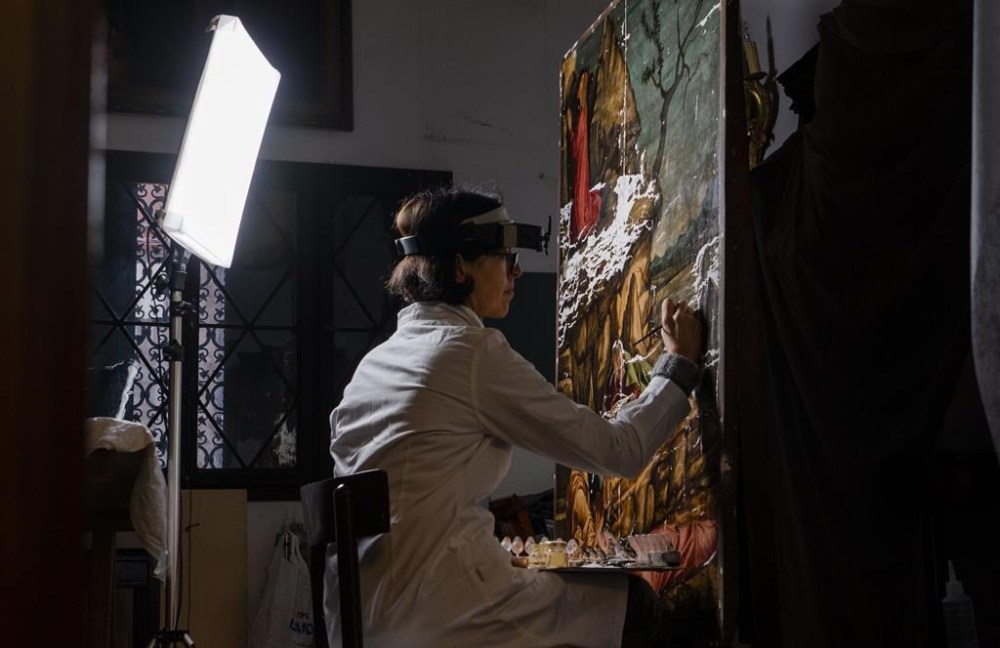
Art conservator Valentina Piovan analyzed the works and undertook a yearlong restoration before she convinced the institution that some of the canvases could safely make the journey to Washington.
Piovan is now working on restoration of several other Carpaccios in the headquarters of the fraternity, which was founded in 1451 by a group of Venetians as a social center providing medical and spiritual support for members — mostly sailors in the republic’s naval fleet. When the fleet defeated the Ottomans in the Turkish-Venetian wars, they were paid handsomely.
As a result, they were able to hire one of the most prominent Venetian painters of his time, Carpaccio, to paint a series of paintings dedicated to St. George, the legendary figure who slayed a dragon, saved a princess and convinced the Selenites to convert to Christianity.
In the first painting in the cycle “Saint George and the Dragon,” a masterpiece more than three meters (around 10 feet) long, Carpaccio paints the saint on horseback with his lance thrust into the mouth of the dragon and the ground littered with the body parts of partially devoured humans. The princess, dressed in a “carpaccio” red robe, clasps her hands together in gratitude as she watches the scene from a rocky outcropping above.
It is classic Carpaccio, a combination of narrative storytelling and attention to detail.
And it clearly was an inspiration for Giuseppe Cipriani, the Venetian restauranteur and owner of Harry’s Bar, who invented a dish named for the painter in the 1950s. According to the official Harry’s Bar history, Cipriani had a customer, Contessa Amalia Nani Mocenigo, whose doctors had prescribed a strict diet without cooked meat.
Cipriani came up with a dish of sliced raw beef with a sauce of mayonnaise and Worcestershire sauce, and named it after the painter in part because of its ressemblance to his favorite reds that were on exhibit in Venice at the time.
“I think people are starting to get an appreciation of paintings, Venetian paintings, from the very beginning of the 16th century, and also learn maybe where the word carpaccio,” came from, said Melissa Conn, director of the Venice office of Save Venice, an American nonprofit which has provided $400,000 for the restoration of several Carpaccio works.