
Met premieres Blanchard’s `Champion,’ an `opera in jazz’
Advertisement
Read this article for free:
or
Already have an account? Log in here »
We need your support!
Local journalism needs your support!
As we navigate through unprecedented times, our journalists are working harder than ever to bring you the latest local updates to keep you safe and informed.
Now, more than ever, we need your support.
Starting at $15.99 plus taxes every four weeks you can access your Brandon Sun online and full access to all content as it appears on our website.
Subscribe Nowor call circulation directly at (204) 727-0527.
Your pledge helps to ensure we provide the news that matters most to your community!
To continue reading, please subscribe:
Add Brandon Sun access to your Free Press subscription for only an additional
$1 for the first 4 weeks*
- Enjoy unlimited reading on brandonsun.com
- Read the Brandon Sun E-Edition, our digital replica newspaper
*Your next Free Press subscription payment will increase by $1.00 and you will be charged $20.95 plus GST for four weeks. After four weeks, your payment will increase to $24.95 plus GST every four weeks.
Read unlimited articles for free today:
or
Already have an account? Log in here »
Hey there, time traveller!
This article was published 06/04/2023 (1261 days ago), so information in it may no longer be current.
NEW YORK (AP) — When Terence Blanchard’s “Fire Shut Up in My Bones” proved a sell-out hit at the Metropolitan Opera in 2021, general manager Peter Gelb wasted no time lining up the composer’s other opera for the current season.
And that set the clock ticking for Blanchard and his collaborators to adapt a relatively small-scale work to the vast resources of the nation’s premiere opera house.
“We knew we had only a year and a half, so we immediately went to work,” recalled Michael Cristofer, who wrote the libretto. “We had an opportunity to enhance and expand not just story points but also certain scenes. And you want to use all of what the Met is capable of. We were a bit like kids in a candy shop.”
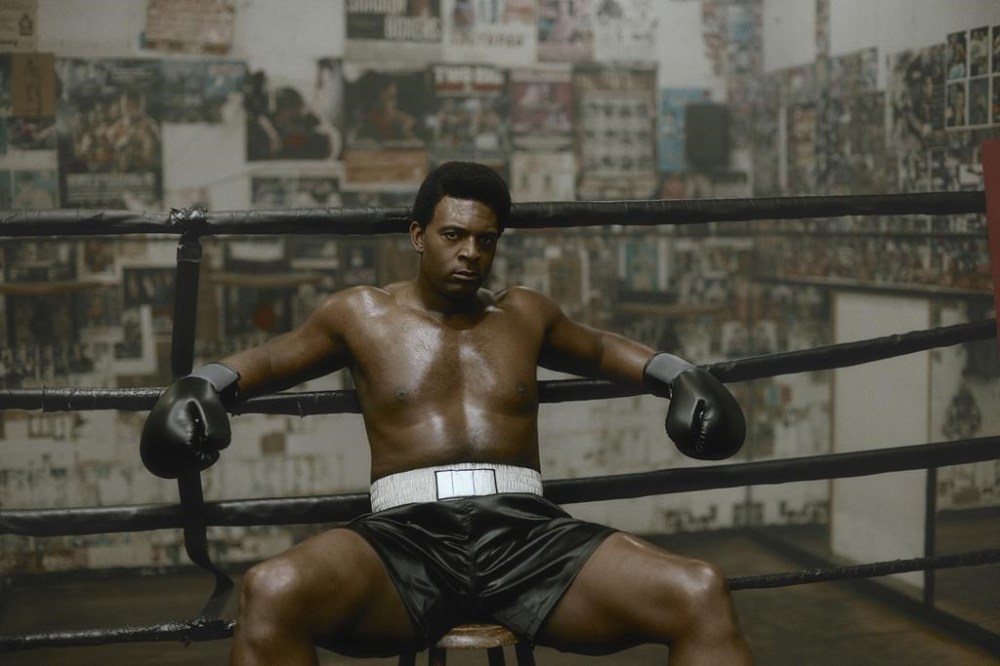
“Champion,” which Blanchard calls “an opera in jazz,” premiered at Opera Theatre of St. Louis in 2013. It’s based on the troubled life of prizefighter Emile Griffith, who knocked out Benny Paret in a welterweight title bout in 1962. Paret never regained consciousness and died 10 days later.
Griffith was haunted by guilt, his feelings complicated by the fact that Paret had humiliated him by calling him a “maricón,” (a derogatory Spanish term for homosexual) during their weigh-in. Later in Griffith’s life, he was savagely beaten after leaving a gay bar.
Blanchard, who in addition to writing operas is known as a jazz trumpeter and composer of film scores, said he was inspired by Griffith’s own words, rephrased for poetic effect in Cristofer’s libretto: “I killed a man and the world forgives me; I love a man and the world wants to kill me.’”
“To me, ‘Champion’ is about redemption and Emile forgiving himself for what happened in the ring,” Blanchard said.
The original production was directed by James Robinson, the artistic director in St. Louis, who said it was “kind of a chamber piece.” There were just 18 people in the cast plus a four-piece jazz combo that plays along with a traditional orchestra.
For the Met, Robinson devised what he calls a “supersized version” that now brings close to 80 people on stage. Besides the soloists, there are 12 dancers, 10 actors and a chorus of 46. The new production also adds choreography by Camille A. Brown, who created a sensation with her work on “Fire.”
And Blanchard made significant changes to his score, adding new material and rewriting some sections to accommodate the different voice types of his lead singers.
“I’d say maybe 15 to 20 percent has been revised, but the more I think about it, it’s probably a lot more than that,” Blanchard said. There are new chorus parts and two new arias, one for Paret and one for Griffith’s trainer, Howie Albert.
The role of Griffith’s mother, Emelda, was originally written for mezzo-soprano Denyce Graves. At the Met, it will be sung by soprano Latonia Moore, prompting substantial alterations, like moving her first aria, “Seven Babies in the Sun,” up by an interval of a fourth.
And Blanchard has kept making changes even during rehearsals, as Moore recounted at a panel discussion at the Guggenheim Museum last month:
“One day he came up to me and said, ‘I feel this scene is a bit too low for you. Mind if I take it up?’”
“I said sure, fantastic,” she added. “I thought he’d come back in a couple days. Less than 30 minutes later, he had completely rewritten the scene. Within half an hour you had new music coming from the composer! This is something I wish I could ask Verdi and Puccini to do.”
Bass-baritone Ryan Speedo Green, who stars as the young Emile, was initially skeptical when Gelb asked him to take on the role.
“I had been offered it before and when I looked at the score I thought, ‘This is a little bit too high for me,’” Green said. “I like to sing high notes occasionally, but my voice doesn’t want to sit up there.”
Gelb persuaded him, saying, “Speedo, that’s the beauty of having a living composer. Things can change.”
And change they did, often subtly, with a note here and there taken down a few tones. In one passage shortly after Emile’s first entrance, Blanchard originally called for high G’s, which now have been lowered to B’s, one step below middle C.
In one instance, however, Green went in the opposite direction. For the climax of the aria “What Makes a Man a Man,” he told Blanchard, ″Man, I really want to take it up to create more drama.” So the original D-flat has now been raised to F.
By now, Blanchard’s place as the first Black composer to have an opera performed at the Met is widely known. But with “Champion,” he’s making another kind of history: He’s the first living composer in about 75 years to have different operas performed at the Met in back-to-back seasons. (The last was Richard Strauss with “Der Rosenkavalier” in 1947-48 and “Salome” in 1948-49.)
“Get outa here!” Blanchard said with a laugh when a reporter informed him of that distinction. “That’s crazy.”
And he’s quick to note that his streak will soon be extended, since the Met is reviving “Fire” next season.
And what about a third opera?
“Oh we have some ideas floating about,” Blanchard said. “But we’re just kind of biding our time. Rehearsals have been going so well, that’s where our focus has been.”
Says Robinson, “I told him, ‘You can’t just write two operas.’ But with Terence, it has to be the right story.”
“Champion,” which opens April 10 for nine performances, also stars bass-baritone Eric Owens as the older Emile, tenor Paul Groves as his trainer, mezzo-soprano Stephanie Blythe as Kathy Hagen, owner of a gay bar, and baritone Eric Greene as Paret. Yannick Nezet-Seguin, the Met’s music director, conducts. The matinee on Sat., April 29, will be shown live in HD in movie theaters worldwide.
—-
This story was first published on April 6, 2023. It was updated on April 12, 2023 to correct the years when a living composer last had two different operas staged in consecutive seasons at the Met. That was Richard Strauss’ “Der Rosenkavalier” in 1947-48 and “Salome” in 1948-49, not the 1943-44 and 1944-45 seasons as the story stated.